Recommendation Engine -- Collaborative & Content-Based Filtering

Users who browse your catalog without personalized recommendations convert at 2-3%. Users who see relevant suggestions convert at 8-15%. That's the difference between a struggling store and a profitable one. But building a recommendation engine from scratch means months of research into collaborative filtering algorithms, cold-start problems, data sparsity, and scalability trade-offs. This solution ships a working recommendation engine with three approaches: collaborative filtering (users who liked X also liked Y), content-based filtering (items similar to what you've viewed), and a hybrid that combines both. Plug it into your e-commerce store, content platform, or any product catalog. The API returns personalized recommendations in under 100ms.

Browse All Projects

This recommendation engine uses collaborative filtering, content-based filtering, and a hybrid approach to generate personalized suggestions. Built with Python, scikit-learn, and Surprise. Includes REST API, admin dashboard, and A/B testing support. Works for e-commerce, content platforms, and media.

  • 100% Source Code
  • Free Setup Support
  • 5000+ Students Served
  • Free Updates

Three Recommendation Approaches

Collaborative Filtering

This approach finds users with similar behavior patterns and recommends items that similar users liked. The implementation uses matrix factorization (SVD) from the Surprise library, which handles sparse user-item matrices efficiently. It works well when you have sufficient user interaction data (ratings, purchases, views) but struggles with new users who have no history (the cold-start problem).

Content-Based Filtering

This approach recommends items similar to what the user has already interacted with. Item similarity is computed from item features -- product descriptions, categories, tags, and metadata. The implementation uses TF-IDF vectorization and cosine similarity. It solves the cold-start problem for new users (just need a few interactions) but can create filter bubbles where recommendations get repetitive.

Hybrid Approach

The hybrid model combines both approaches with configurable weights. New users get content-based recommendations. As interaction data accumulates, the system gradually shifts toward collaborative filtering. The weighting is automatic based on the user's interaction count -- no manual tuning needed. This is the recommended approach for most applications.

API and Integration

The REST API accepts a user ID and returns ranked recommendations with confidence scores. Average response time is under 100ms for catalogs with up to 100K items. The API supports filtering by category, price range, and availability. Batch endpoints generate recommendations for all users at once for email campaigns or pre-caching.
Available Projects

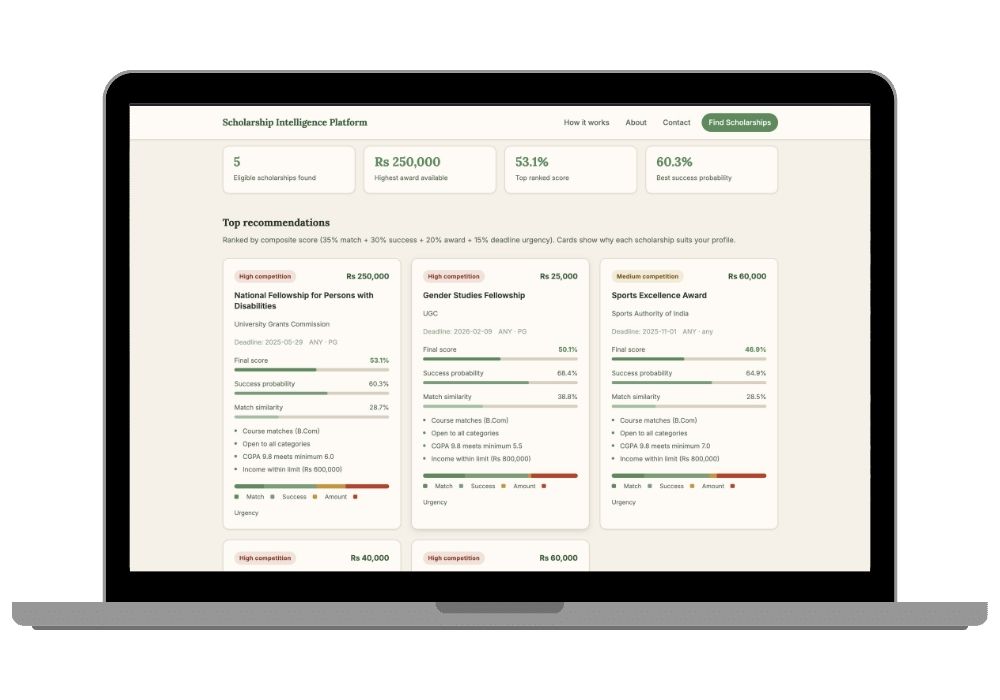
AI-Powered Scholarship Intelligence and Career Recommendation Platform
available
AI-Powered Scholarship Intelligence and Career Recommendation Platform

A complete Python and Flask final year project that predicts scholarship eligibility, recommends and ranks scholarships.

599.00

₹1999

CineMood AI — Emotion-Based Movie Recommendation System with DeepFace Facial Recognition
available
CineMood AI — Emotion-Based Movie Recommendation System with DeepFace Facial Recognition

AI-powered movie recommendation engine that detects your real-time facial emotions using DeepFace and curates perfect films based on your mood. Complete Django project with webcam integration, 84+ curated films, and privacy-first design.

399.00

₹1999

AgriAdvisor – AI-Powered Agricultural Advisory System with Marketplace
available
AgriAdvisor – AI-Powered Agricultural Advisory System with Marketplace

A full-stack final year project built with React.js and Flask, featuring AI-based plant disease detection, soil analysis, crop recommendation, yield prediction, live weather integration, and a farmer marketplace with Razorpay payment gateway.

599.00

₹1999

AI-Powered Pest Detection & Pesticide Recommendation System - Final Year Project with Source Code
available
AI-Powered Pest Detection & Pesticide Recommendation System - Final Year Project with Source Code

Complete AI-based pest detection system using deep learning for automated pest identification and pesticide recommendations. Perfect final year project with full source code, documentation, and deployment guide for CSE/IT students.

599.00

₹1999

MoodReads - AI-Powered Mood-Based Book Recommendation System with Audio Narration
available
MoodReads - AI-Powered Mood-Based Book Recommendation System with Audio Narration

An intelligent web app that detects a user’s mood using machine learning and recommends personalized books accordingly. It integrates the Google Books API, offers text-to-speech narration, and features a premium glassmorphism UI built with Flask & Python.

599.00

₹1999

AI-Powered Eye Disease Risk Prediction System with Machine Learning
available
AI-Powered Eye Disease Risk Prediction System with Machine Learning

Advanced machine learning system for early eye disease detection using 9 health parameters. Features real-time risk assessment, interactive dashboard, and personalized health recommendations with 74%+ accuracy.

399.00

₹1999

Smart Agricultural Prediction System with Machine Learning - Complete Final Year Project Solution
available
Smart Agricultural Prediction System with Machine Learning - Complete Final Year Project Solution

Advanced Flask-based agricultural advisory system using machine learning for crop yield prediction, disease assessment, and fertilizer recommendations. Perfect final year project for computer science students with complete source code and documentation.

499.00

₹1999

BookBridge – Second-Hand Book Marketplace with Razorpay Integration
available
BookBridge – Second-Hand Book Marketplace with Razorpay Integration

A full-stack Django-powered second-hand book marketplace where users can buy, sell, and discover quality pre-loved books. Features secure Razorpay payments, responsive design, admin dashboard, and future-ready AI recommendations.

699.00

₹1999

Screen Guardian: AI-Powered Child Screen Addiction Risk Detection System
available
Screen Guardian: AI-Powered Child Screen Addiction Risk Detection System

AI-powered tool to detect screen addiction in kids (8–18) using K-Means, DBSCAN & Isolation Forest for real-time risk analysis and personalized recommendations.

299.00

₹1999

Emotion-Based Movie Recommender with DeepFace & Django
available
Emotion-Based Movie Recommender with DeepFace & Django

an innovative project using Python Django, Deepface, and CV2 for real-time facial emotion analysis. It suggests personalized movie recommendations based on users' emotions..

159.00

₹1999

Why Choose CodeAj

Complete Source Code

Get 100% working source code with clean architecture and documentation.

Free Setup Support

Our team helps you install and run the project on your machine at no extra cost.

Free Updates & Customization

Get free updates and affordable customization to match your requirements.

Training and Evaluation

The training pipeline reads interaction data (CSV or database), trains the models, evaluates using precision@k, recall@k, and NDCG metrics, and saves the trained models. Retraining runs on a schedule (daily or weekly) to incorporate new interactions. The evaluation report shows which approach performs best for your data so you can tune the hybrid weights.

Handling Cold Start

New users with no interaction history get popularity-based recommendations (top items by rating or purchase count) blended with content-based suggestions from their profile attributes (age, location, stated preferences). After 5-10 interactions, the collaborative filtering component kicks in and recommendations become personalized.

Recommendation Engine FAQ

You need at least 1,000 interactions (ratings, purchases, or views) across 100+ users and 100+ items for collaborative filtering to produce meaningful results. Below that threshold, the system falls back to content-based and popularity-based recommendations automatically.

User interactions as CSV or JSON with three fields: user_id, item_id, and rating (or interaction type). Item metadata as CSV with item_id, title, description, category, and any additional features. The system also supports direct database connections to PostgreSQL and MongoDB.

The API returns recommendations in under 100ms for catalogs up to 100K items. For larger catalogs (1M+), pre-computed recommendations are cached and served in under 10ms. Batch generation for all users runs in 10-30 minutes depending on catalog size.

Yes, that is one of the primary use cases. The system integrates via REST API. Your product pages call the API with the current user ID and product ID to get "customers also bought" and "similar products" recommendations. The API supports filtering by availability and category.

Yes. New users get popularity-based recommendations blended with content similarity. New items are recommended based on content features (description, category) until they accumulate enough interactions. The hybrid model transitions smoothly as data accumulates.

Boost Your Conversion Rate

Get the recommendation engine and show every user the products they actually want to buy.

Chat on WhatsApp
Chat with us