Sentiment Analysis System -- Reviews, Social Media & Brand Monitoring

You have 10,000 product reviews and no idea what customers actually think. Manually reading reviews doesn't scale. Star ratings miss nuance -- a 3-star review might love the product but hate the shipping. Social media mentions pile up faster than your team can read them. This sentiment analysis system processes text at scale and tells you what people feel about your product, your brand, and your competitors. It goes beyond positive/negative classification. It identifies specific aspects (price, quality, support, shipping) and the sentiment toward each one. Process a batch of 10,000 reviews in minutes or analyze social media mentions in real time. You get the trained models, the processing pipeline, the API, and a dashboard with charts and export.

Browse All Projects

This sentiment analysis system uses BERT-based transformer models to classify text as positive, negative, or neutral. It supports aspect-based sentiment analysis, batch processing, and real-time API. Built with Python, HuggingFace Transformers, and Flask/FastAPI. Includes a React dashboard.

  • 100% Source Code
  • Free Setup Support
  • 5000+ Students Served
  • Free Updates

Why Basic Sentiment Analysis Falls Short

Most sentiment tools give you a single score: positive, negative, or neutral. That's almost useless for product decisions. "The laptop screen is gorgeous but the battery dies in 3 hours" is a neutral-scored review that contains critical product intelligence about two different aspects.

Aspect-based sentiment analysis solves this. It identifies the entities mentioned (screen, battery) and the sentiment toward each one separately. Now you know customers love your display but hate your battery life. That's actionable.

Model Architecture

The system uses a fine-tuned BERT model (distilbert-base-uncased for speed, bert-base for accuracy) with a classification head for sentiment labels and an extraction head for aspect terms. The model is pre-trained on a large review corpus and can be fine-tuned on your domain-specific data with as few as 500 labeled examples.

For languages beyond English, the system supports multilingual BERT (mBERT) which covers 104 languages. Accuracy is highest for English, German, French, and Spanish, but works reasonably well for most Latin-script and CJK languages.

Processing Pipeline

Text goes through preprocessing (cleaning, tokenization), model inference (sentiment + aspect extraction), and post-processing (aggregation, scoring). The pipeline handles HTML tags, emojis, slang, and abbreviations. Batch mode processes CSV/JSON files with thousands of records. The API mode accepts individual text inputs and returns results in under 200ms.

Dashboard and Reporting

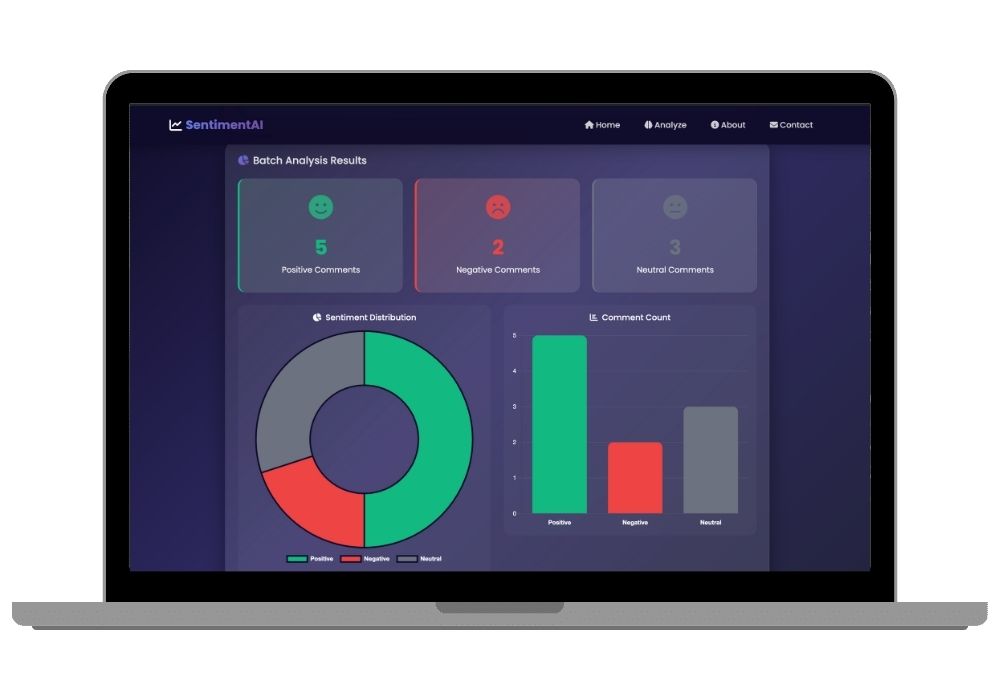
The React dashboard shows sentiment distribution over time, aspect-level breakdowns, word clouds for positive and negative mentions, and trend lines. Filter by date range, source, product, or sentiment label. Export raw results as CSV or formatted reports as PDF. The dashboard updates in real time when processing live social media feeds.

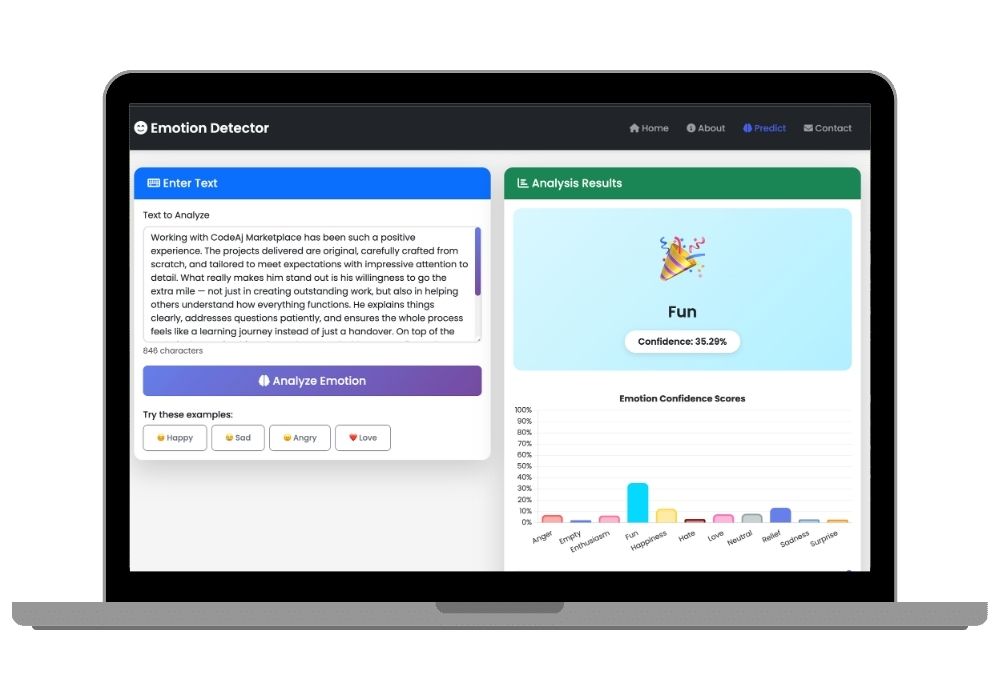
Available Projects

MindMate — AI Mental Health Companion | Django + Groq LLaMA Final Year Project with Source Code
available
MindMate — AI Mental Health Companion | Django + Groq LLaMA Final Year Project with Source Code

MindMate is an AI mental health companion built with Django and Groq's LLaMA 3.3 70B that offers empathetic chat, mood tracking, private journaling, and instant crisis helpline support.

499.00

₹1999

AI-Powered YouTube Comment Sentiment Analyzer with Real-Time NLP & Deep Learning Models
available
AI-Powered YouTube Comment Sentiment Analyzer with Real-Time NLP & Deep Learning Models

Advanced sentiment analysis web application that analyzes YouTube comments using Machine Learning (Logistic Regression) and Deep Learning (LSTM) with 76% accuracy.

499.00

₹1999

Why Choose CodeAj

Complete Source Code

Get 100% working source code with clean architecture and documentation.

Free Setup Support

Our team helps you install and run the project on your machine at no extra cost.

Free Updates & Customization

Get free updates and affordable customization to match your requirements.

Use Cases

E-commerce: Analyze product reviews to identify what customers love and hate about specific features. Feed insights to product and support teams. Brand monitoring: Track sentiment on Twitter, Reddit, and news sites. Get alerts when negative sentiment spikes. Competitor analysis: Scrape and analyze competitor reviews to identify gaps your product can fill. Customer support: Prioritize support tickets by sentiment -- angry customers get routed to senior agents.

Fine-Tuning for Your Domain

The pre-trained model works well out of the box for general text. For domain-specific accuracy (medical reviews, financial news, legal documents), fine-tune with 500-2000 labeled examples from your domain. The fine-tuning script is included -- just provide a CSV with text and labels.

Sentiment Analysis FAQ

The fine-tuned BERT model achieves 89-93% accuracy on standard benchmarks (SST-2, IMDB). On domain-specific data with fine-tuning, accuracy typically reaches 90-95%. The aspect extraction component achieves 82-87% F1 score on SemEval benchmarks.

Yes. The system supports multilingual BERT (mBERT) covering 104 languages. Best results are for English, German, French, Spanish, and Chinese. For other languages, fine-tuning with 500+ examples in the target language significantly improves accuracy.

On a GPU (RTX 3060 or better), the system processes about 1,000 reviews per minute with the full BERT model, or 3,000 per minute with DistilBERT. On CPU, expect 100-300 reviews per minute. A 10,000-review dataset completes in 3-10 minutes on GPU.

Yes. The system includes a Twitter/X API integration for streaming mentions. New tweets are processed as they arrive and sentiment is logged with timestamp. The dashboard updates in real time. You can set up alerts for sentiment drops below a configurable threshold.

Yes. Prepare a CSV with two columns: text and label (positive, negative, neutral). Run the included fine-tuning script with 500-2000 examples. Fine-tuning takes 30-60 minutes on GPU. The script handles train/validation splitting, learning rate scheduling, and early stopping.

Understand What Your Customers Think

Get the sentiment analysis system and turn thousands of reviews into actionable product insights.

Chat on WhatsApp
Chat with us