Fraud Detection System -- ML for Financial Transactions & Anomaly Detection

Credit card fraud costs businesses $32 billion annually. Manual review of flagged transactions is slow, expensive, and catches less than 50% of actual fraud. Rule-based systems generate too many false positives -- legitimate customers get blocked while sophisticated fraudsters slip through. Machine learning changes the equation. This fraud detection system analyzes transaction patterns in real time and flags anomalies with 95%+ accuracy. It learns from historical transaction data, identifies patterns that human analysts miss, and adapts as fraud techniques evolve. You get the complete ML pipeline -- feature engineering, model training, real-time scoring API, and an investigation dashboard. Train it on your transaction data and start catching fraud that your current system misses.

Browse All Projects

This fraud detection system uses gradient boosting (XGBoost/LightGBM) and isolation forest models to identify fraudulent transactions in real time. It includes feature engineering pipeline, model training, real-time scoring API, and investigation dashboard. Built with Python, scikit-learn, and Flask/FastAPI.

  • 100% Source Code
  • Free Setup Support
  • 5000+ Students Served
  • Free Updates

Why Rules-Based Fraud Detection Fails

A typical rules engine flags transactions over $500 from new locations or outside business hours. Fraudsters know these rules and stay just under the thresholds -- $490 transactions at 8:59 AM sail through. Meanwhile, a legitimate customer buying a laptop on vacation gets blocked. The false positive rate for rule-based systems typically runs 5-10%, which means your support team spends hours reviewing legitimate transactions.

ML models don't use static thresholds. They learn patterns from thousands of features simultaneously -- transaction amount, time of day, merchant category, device fingerprint, velocity patterns, geolocation, and behavioral biometrics. A $50 transaction at a gas station in a state the cardholder has never visited, followed by three more transactions in rapid succession, gets flagged even though no single feature crosses a threshold.

Feature Engineering Pipeline

Raw transaction data (amount, merchant, timestamp, location) gets transformed into 200+ features. Velocity features track how many transactions occurred in the last 1, 5, 15, and 60 minutes. Behavioral features compare the current transaction to the cardholder's historical patterns. Merchant risk scores are computed from the fraud rate at each merchant category. Time-based features capture day-of-week and hour-of-day patterns. The feature pipeline runs in under 50ms per transaction.

Model Architecture

The system uses an ensemble of three models: XGBoost for supervised classification (trained on labeled fraud/legitimate data), Isolation Forest for unsupervised anomaly detection (catches novel fraud patterns without labeled data), and a neural network autoencoder for sequence anomaly detection (flags unusual transaction sequences). The ensemble combines scores from all three models for the final fraud probability.

Real-Time Scoring

The API accepts a transaction and returns a fraud score (0-1) in under 100ms. Transactions above the threshold (configurable, typically 0.7) are blocked or held for review. The system handles 1,000+ transactions per second on a single server. For higher throughput, horizontal scaling with Redis-backed feature caching supports 10,000+ TPS.
Available Projects

Credit Card Fraud Detection System
available
Credit Card Fraud Detection System

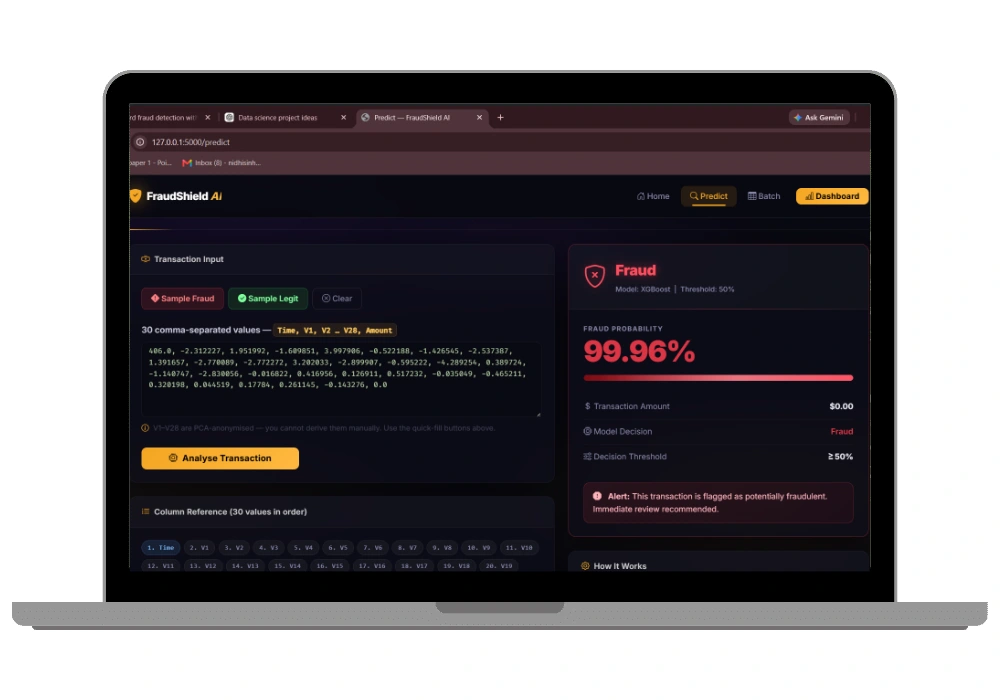
A complete machine learning web application that detects fraudulent credit card transactions in real time.

599.00

₹1999

FraudGuard - AI-Powered Google Play Store Fraud Detection System with Machine Learning
available
FraudGuard - AI-Powered Google Play Store Fraud Detection System with Machine Learning

Advanced ML system that detects fraudulent Google Play Store apps with 100% accuracy using Decision Tree models. It analyzes ratings, reviews, and behavior patterns to instantly flag suspicious apps and generate detailed fraud-probability reports.

399.00

₹1999

AI-Powered UPI Fraud Shield: Real-Time Detection System for Secure Transactions
available
AI-Powered UPI Fraud Shield: Real-Time Detection System for Secure Transactions

An innovative UPI fraud detection system using advanced machine learning to analyze transactions in real-time, preventing fraud with 99%+ accuracy. Ideal as a final year college project or best Python project for students seeking unique projects

429.00

₹1999

Why Choose CodeAj

Complete Source Code

Get 100% working source code with clean architecture and documentation.

Free Setup Support

Our team helps you install and run the project on your machine at no extra cost.

Free Updates & Customization

Get free updates and affordable customization to match your requirements.

Training on Your Data

Export your historical transactions as CSV with columns for amount, merchant, timestamp, location, and fraud label. The training pipeline handles class imbalance (fraud is typically less than 1% of transactions) using SMOTE oversampling and class-weighted loss functions. Training on 1 million transactions takes 15-30 minutes on a standard machine.

Investigation Dashboard

The dashboard shows flagged transactions with fraud scores, feature explanations (which features contributed most to the score), and investigation tools. Analysts can approve or reject flagged transactions, and their decisions feed back into the training data for model improvement. Weekly reports show fraud detection rate, false positive rate, and estimated savings.

Fraud Detection FAQ

On standard benchmarks (IEEE-CIS Fraud Detection dataset), the ensemble model achieves 95-97% AUC-ROC and 85-90% precision at 80% recall. This means catching 80% of fraud while only flagging 10-15% of legitimate transactions for review. Performance improves with more training data.

Minimum 10,000 transactions with at least 100 labeled fraud cases. For production accuracy, 100,000+ transactions with 500+ fraud cases is recommended. The system handles extreme class imbalance (0.1% fraud rate) using SMOTE oversampling and cost-sensitive learning.

Yes. The Isolation Forest and autoencoder components detect anomalies without relying on labeled fraud data. They flag transactions that deviate from normal patterns, which catches novel fraud techniques that supervised models trained on historical fraud would miss.

Under 100ms per transaction including feature computation. The system handles 1,000+ transactions per second on a single server with 4 CPU cores. Redis caching of user features reduces latency to under 50ms for returning users.

Yes. Each fraud score comes with SHAP (SHapley Additive exPlanations) values showing which features contributed most. For example: "high score because of unusual merchant category + high velocity + new device." This helps analysts validate the model's reasoning during investigation.

Stop Fraud Before It Costs You

Get the ML fraud detection system. 95%+ accuracy, real-time scoring, and investigation dashboard included.

Chat on WhatsApp
Chat with us