AI Salary Predictor & Market Trend Dashboard (Flask + XGBoost Final Year Project)
A Flask + XGBoost web app that predicts AI/ML job salaries in real time and visualizes six years of global compensation trends from 10,000+ real records.
Technology Used
Python 3 | Flask 3.0 | XGBoost 2.1 | scikit-learn 1.5 | pandas | NumPy | Chart.js 4.4 | Jinja2


Abstract
PaySignal AI is a full-stack machine learning web application that predicts salaries for AI and ML job roles and shows how compensation has shifted across experience levels, geographies, and work modes between 2020 and 2025. It's built on Flask, uses a trained XGBoost regression pipeline for predictions, and renders everything through interactive Chart.js dashboards. If you're looking for a final year project that actually involves training a model instead of just calling an API, this one checks that box.
What This Project Actually Does (Plain Explanation)
Think of it like a salary calculator, but one that's actually learned from data instead of guessing. You fill in eight details about a job — things like experience level, work mode, company size, and location — and the app runs that through a trained XGBoost model to spit out a predicted salary. It doesn't stop there, though.
There's also a whole visualization side. Four live dashboards built with Chart.js that pull straight from a cleaned dataset of over 10,000 real-world AI job salary records. You can see which roles pay the most, how remote work compares to on-site pay, and how salaries have trended year over year since 2020.
Key Features
- Salary Predictor at
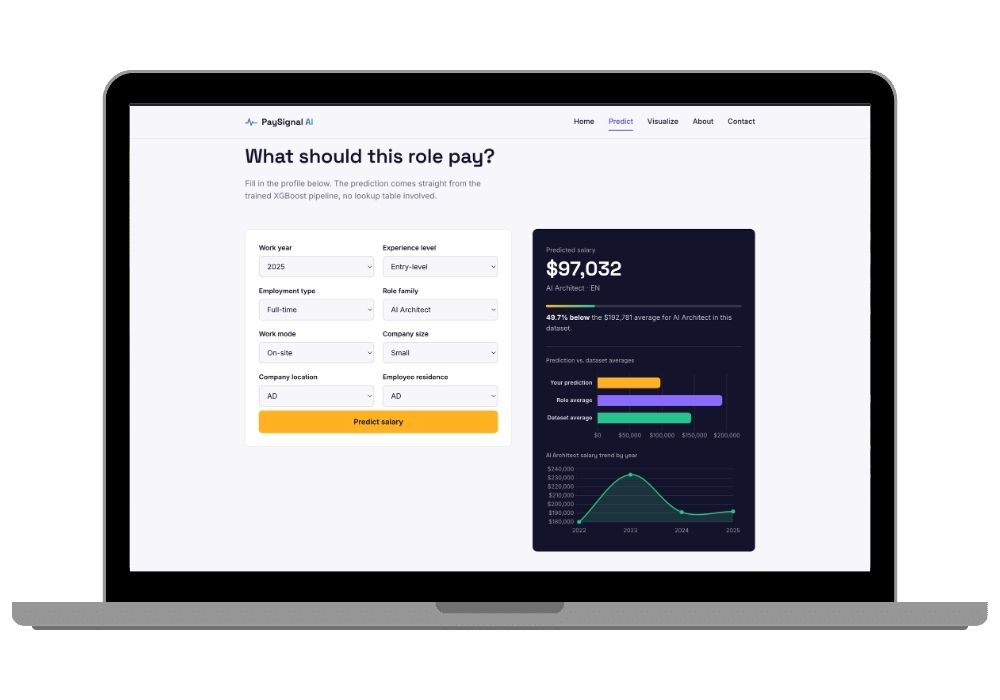
/predict— enter work year, experience level, employment type, role family, work mode, company size, company location, and employee residence, and get an instant prediction from the trained pipeline. - Prediction results come with a comparison against the dataset average for that exact role, shown as a percentage bar, plus a horizontal bar chart and a role-specific year-over-year trend line.
- Four interactive dashboards on
/visualize— average salary by year, top ten highest-paying role families, remote vs. hybrid vs. on-site pay, and salary by experience level, all rendered live from dataset aggregations, not static images. - Home page hero with real-time key stats (total records, average salary, years covered, roles tracked) computed straight from the CSV, plus a scrolling ticker of actual sampled salary records.
- An About page that lays out the model's MAE, RMSE, and R² so you can actually explain your evaluation metrics in your viva instead of dodging the question.
- Two REST endpoints —
/api/chartsfor all visualization JSON and/api/role-insights?role=<name>for role-specific averages and trends — so the frontend isn't hardcoded to the templates.
Real-World Applications
This isn't just a demo toy. The same pipeline structure shows up in HR-tech products, recruitment platforms doing salary benchmarking, and internal compensation tools that companies build to check if they're paying competitively. Job portals like the ones you'd see attached to LinkedIn or Glassdoor run something structurally similar under the hood — take in job attributes, output a compensation estimate. If your report needs a "real-world relevance" section, this is genuinely it, not a stretch.
Who Should Buy This
If you're a student who needs a working project for your college submission, final-year project, semester project, internship, or academic demonstration, this is for you. Whether you're studying BCA, B.Tech, MCA, M.Tech, Computer Science, IT, AI, Data Science, or another related field, you can choose a project that fits your requirements. If you need the source code, project report, documentation, or help setting up and running the project, CodeAj gives you the resources and support to get started faster.
Why CodeAj
You get the full source, a project report you can actually submit, and setup support if the notebook throws an error you don't recognize at 1 AM. We've seen every version of "it works on my machine" — that's kind of the point of buying instead of building from zero with three days left.
One Thing That's Genuinely Hard, One Thing That's Easier Than It Looks
The hard part is the model training step — you do need to run ai_salary_training.ipynb yourself to generate the pipeline file, and if you've never used scikit-learn or XGBoost before, that notebook will take some actual reading, not just clicking "Run All." The easier part is the web app itself. Once the model artifacts exist, Flask just loads them with joblib and serves predictions — no separate model server, no Docker, nothing exotic.
If your college wants a full AI/ML final year project with a trained model instead of a wrapper around an API, or you're browsing other machine learning projects with source code to compare, this one's built to be defensible in a viva — you can point to real metrics, not vague claims. It also pairs well if you're separately exploring Flask project source code for other coursework.
Model & Data Details
The dataset behind this — over 10,000 cleaned records spanning 2020 to 2025 — covers role families, experience bands, company sizes, and both employee residence and company location as separate fields, which matters if you want to talk about remote-work pay gaps in your report. The pipeline itself combines pandas and NumPy for preprocessing with a scikit-learn pipeline wrapping the XGBoost regressor, so feature encoding and prediction happen in one saved joblib file. That's a detail examiners tend to ask about, so know it going in.
Frequently Asked Questions
Extra Add-Ons Available – Elevate Your Project
Add any of these professional upgrades to save time and impress your evaluators.
Live 1-on-1 Mentorship
Personal session with an expert developer
Project Setup
We'll install and configure the project on your PC via remote session (Google Meet, Zoom, or AnyDesk).
Source Code Explanation
1-hour live session to explain logic, flow, database design, and key features.
Want to know exactly how the setup works? Review our detailed step-by-step process before scheduling your session.
₹999
Custom Documents (College-Tailored)
- Custom Project Report: ₹1,500
- Custom Research Paper: ₹1,000
- Custom PPT: ₹800
Fully customized to match your college format, guidelines, and submission standards.
Project Modification
Need feature changes, UI updates, or new features added?
Charges vary based on complexity.
We'll review your request and provide a clear quote before starting work.