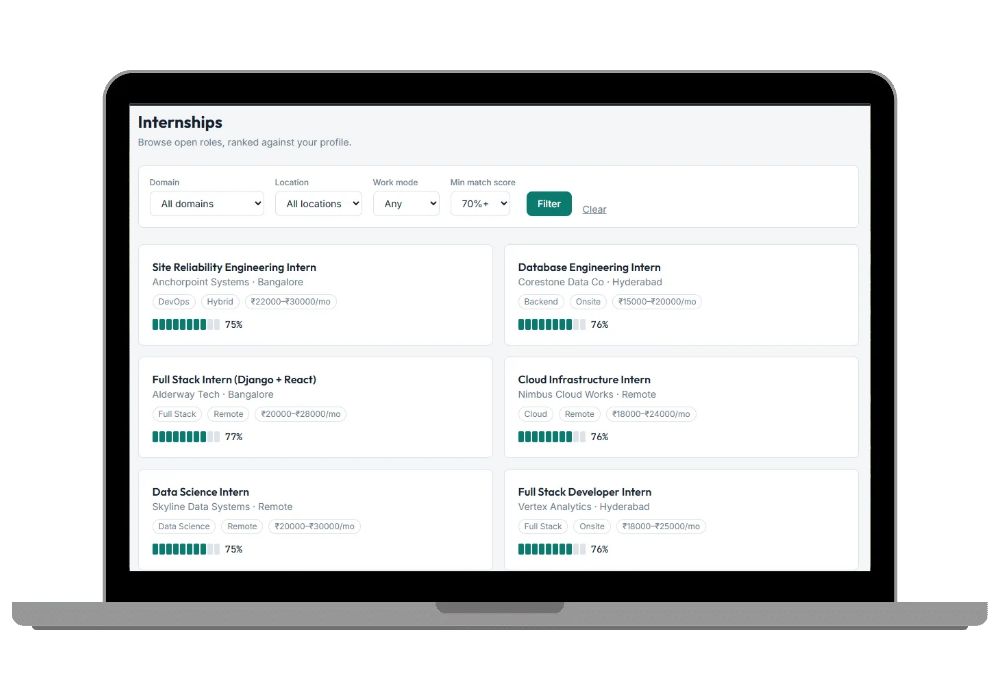
Project Title SkillBridge AI: Internship Recommendation and Skill Gap Analyzer
Upload a resume, get internships ranked by match score, and see exactly which skills you're missing. A Django AI final year project with source code and setup help.
Technology Used
Python | Django 5.2 | sentence-transformers (all-MiniLM-L6-v2) | spaCy | scikit-learn | NumPy | PyMuPDF | python-docx | Tailwind CSS | Alpine.js | SQLite | PostgreSQL | gunicorn | pytest


SkillBridge AI: Internship Matching and Skill Gap Analysis for Engineering Students
Abstract
Most engineering students apply for internships blind. The resume is generic, the eligibility rules (minimum CGPA, allowed branches) are buried in the job post, and nobody tells you which skill to learn next.
SkillBridge AI reads a student's resume, pulls out skills, projects, CGPA and branch, and then scores every open internship against that profile. Each score is split into five parts: skill overlap, semantic similarity, eligibility, project relevance and preference fit. Put the scores for all internships together and you get a skill gap report, which is a ranked list of skills the student keeps missing, with free learning links for each one.
Under the hood it mixes plain rule-based scoring with sentence embeddings from all-MiniLM-L6-v2. The rules keep results explainable. The embeddings catch cases where a resume and a job post say the same thing in different words.
What This Project Actually Does
You register, upload a PDF or DOCX resume, and the app reads it. It checks the text against a vocabulary of 29 skills (with aliases, so "JS", "Postgres" and "K8s" still get recognised), then grabs your CGPA, graduation year, email, phone and projects. You confirm or fix what it parsed. Then it ranks all active internships for you.
Open any internship and you'll see a total match percentage, five sub-scores with a one-line reason each ("2 of 3 required skills matched, 80% by weight"), and two lists: skills you have, skills you don't.
No resume? Fill in branch, degree, skills, preferred locations and minimum stipend by hand instead.
Key Features
- Resume parsing from PDF (PyMuPDF) and DOCX (python-docx), with a confirm screen before anything is saved.
- Ranked internship feed with filters for domain, location, work mode and minimum match score.
- Five-part match score on a 0 to 100 scale, so you can say exactly why internship A beat internship B.
- Matched and missing skills shown on every internship page.
- Skill gap report at
/gapsthat ranks missing skills by how often they show up across your matches. The dashboard shows the top five. - Free learning resources per skill (27 seeded), like the official Python tutorial, opened from
/gaps/<skill>. - Eligibility rules (CGPA, branch) built into the score at 15% weight, so ineligible roles score lower instead of vanishing.
- Django admin for managing skills, companies, internships and students.
- Ships with 16 internships, 29 skills and sample resumes, so the demo works on day one.
How the Scoring Works
This is the part your examiner will poke at, so read it twice. The weights live in config/settings/base.py, not buried in the engine.
| Sub-score | Weight | How it's computed |
|---|---|---|
| Skill match | 40% | Weight of matched required skills divided by total weight of required skills |
| Semantic similarity | 25% | Cosine similarity between the profile embedding and the internship embedding |
| Eligibility | 15% | 1 if CGPA and branch rules pass, otherwise 0 |
| Project relevance | 10% | Cosine similarity between project descriptions and the internship description |
| Preference fit | 10% | Weighted mix of location, work mode, stipend and domain |
Internship embeddings are precomputed with build_embeddings. Only the student's profile gets encoded when a page loads, which is why it doesn't crawl.
Real-World Applications
- A pre-final-year B.Tech student checking which of 16 openings they can realistically land, before wasting a week on applications.
- A college placement cell testing a batch's readiness against live openings and spotting the one skill half the class lacks.
- A mentor sitting with a student and saying "your gap report says Docker and SQL, so start there" instead of giving vague advice.
- A skill-tracking tool for any campus that wants to show students where they stand, not just what's available.
Who Should Buy This
If you're a student who needs a working project for your college submission, final-year project, semester project, internship, or academic demonstration, this is for you. Whether you're studying BCA, B.Tech, MCA, M.Tech, Computer Science, IT, AI, Data Science, or another related field, you can choose a project that fits your requirements. If you need the source code, project report, documentation, or help setting up and running the project, CodeAj gives you the resources and support to get started faster.
Honestly, it suits you best if you want an AI final year project that isn't another "predict house prices" notebook. This one has a real web app, a real database and a story you can tell in a viva.
The Hard Part, and the Easy Part
The hard part is explaining it. Resume parsing is rule-based, so unusual headings or fancy two-column layouts can confuse it, and you'll need to understand why the confirm screen exists. Be ready to defend the 40/25/15/10/10 weights too.
The easy part is running it. It uses SQLite in development, Tailwind through a CDN and Alpine.js, so there's no Node build step and no database server to install. About 15 minutes if your internet is decent, and most of that is the model download.
Why CodeAj
You don't just get a zip file and good luck. The project comes with source code, a project report you can adapt for your college format, and setup support if the spaCy model or the embeddings step gives you trouble. We've seen the 11 PM "it won't run" panic plenty of times, so we built the help around it.
Keep Exploring
Browsing for more? Check our AI and ML final year projects or the Django projects with source code collection. Stuck on installation basics? The project setup service will get it running with you.
What's Not Included
Company posting, application tracking, email notifications and a REST API are on the Phase 2 roadmap and aren't built yet. Good news if your guide wants "future scope" for the report. You've got some.
Frequently Asked Questions
Extra Add-Ons Available – Elevate Your Project
Add any of these professional upgrades to save time and impress your evaluators.
Live 1-on-1 Mentorship
Personal session with an expert developer
Project Setup
We'll install and configure the project on your PC via remote session (Google Meet, Zoom, or AnyDesk).
Source Code Explanation
1-hour live session to explain logic, flow, database design, and key features.
Want to know exactly how the setup works? Review our detailed step-by-step process before scheduling your session.
₹999
Custom Documents (College-Tailored)
- Custom Project Report: ₹1,500
- Custom Research Paper: ₹1,000
- Custom PPT: ₹800
Fully customized to match your college format, guidelines, and submission standards.
Project Modification
Need feature changes, UI updates, or new features added?
Charges vary based on complexity.
We'll review your request and provide a clear quote before starting work.