Fantasy XI Optimizer Machine Learning Final Year Project with Source Code (Flask + Python)
Build your own Dream11 brain. A Flask + Random Forest app that predicts fantasy points for 229 FIFA 2026 players and then solves for the mathematically best XI under your budget. Full source code included.
Technology Used
Python | Flask | scikit-learn | PuLP | Pandas | Plotly | Bootstrap 5 | Jinja2


What This Project Actually Does
You pick a budget. You pick a formation. The app hands you eleven players that squeeze the maximum predicted fantasy points out of that money. That's the whole pitch.
Under the hood two very different things are happening. First, a trained Random Forest model looks at each player's recent form — last three matches of goals, assists, minutes, shots on target, pass accuracy, tackles, distance covered, match rating — and guesses how many fantasy points they'll score in their next game. Then a solver called PuLP takes those 229 predictions and treats squad selection like a knapsack problem: maximise total predicted points, don't cross the budget, respect the formation, and land on exactly eleven names.
That second part is what makes examiners sit up. Most machine learning final year projects stop at "here's my prediction, thanks." This one takes the prediction and feeds it into an actual optimisation algorithm. Prediction plus operations research in one repo. Your classmates will have sentiment analysis on movie reviews. You'll have something people argue about at lunch.
Key Features
Per-Player Fantasy Point Predictor
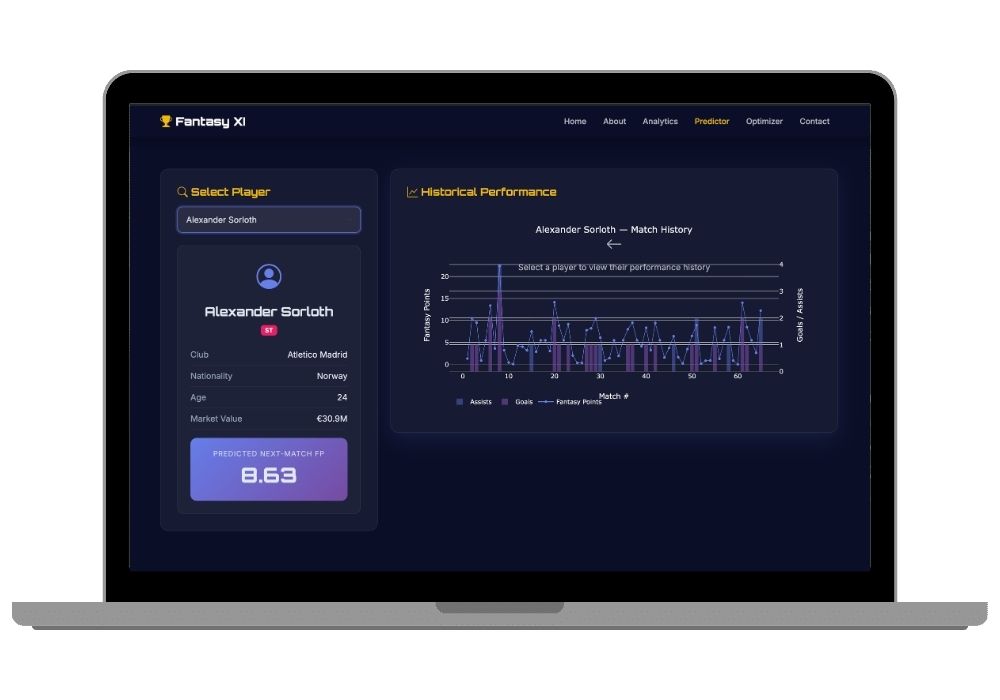
Pick any name from the dropdown — Haaland, Bellingham, whoever — and you get a predicted score for their next match plus an interactive Plotly chart tracking their fantasy points, goals and assists across the season. The chart is real Plotly, not a screenshot. You can hover, zoom, isolate a series.
Best XI Optimizer (the part that gets marks)
Drag the budget slider anywhere from €50M to €500M, choose 4-4-2, 4-3-3, 3-5-2 or 3-4-3, hit optimize. PuLP runs an Integer Linear Programming solve and returns the squad, a results table, a bar chart of contributions, and a progress bar showing how much of your budget got used. On a normal laptop it comes back in under two seconds.
Analytics Dashboard
Fantasy points distribution histogram, position-wise box plots, top 15 player ranking, a correlation heatmap, and a goals-versus-fantasy-points scatter. Five charts. All of them screenshot straight into your project report without any extra work.
A Real Dataset, Not a Toy One
13,397 match records covering 229 players from the 2025/26 Champions League season, sitting in fifa2026_player_performance_clean.csv. Already cleaned. Already feature-engineered into 16 columns including rolling three-match averages, a lag feature for the previous match, and cumulative goal and assist counts.
Four Models Trained and Compared
Random Forest, Gradient Boosting, XGBoost and LightGBM were all trained on the same split, then compared on MAE, RMSE, test R² and 5-fold cross-validated R². Random Forest won. That comparison table is already in Fantasy_XI_Optimizer_Training.ipynb and it's exactly the kind of table that fills a "Results and Discussion" chapter.
JSON APIs You Can Demo
Two endpoints — /api/predict/<player_name> for predictions and a POST to /api/optimize for squads. If your examiner asks whether the backend is separated from the frontend, open Postman and show them. Takes ten seconds and looks very good.
Honest Note: One Hard Part, One Easy Part
The hard part first, because you should know before you buy. Random Forest's test R² is 0.0384. That's low, and if your guide is sharp they will circle it in red pen. Here's the honest answer, and it's a good one: match-to-match fantasy football is genuinely close to random. A striker who scored a hat-trick on Tuesday might get subbed at halftime on Saturday. What the model actually beats is the naive baseline, and the MAE of 2.44 points means predictions land within about half a goal's worth of reality. Say that in your viva, mention that all four models clustered in the same range which confirms it's a data ceiling and not a modelling mistake, and you've turned your weakest number into evidence that you understood the problem. Trust me, that answer scores better than a fake 0.95 R².
Now the easy part. The optimizer sounds terrifying — Integer Linear Programming, constraint satisfaction, all of that. It's about thirty lines of PuLP inside app.py. Declare binary variables for each player, write the objective, add three constraints, call solve. That's it. You'll understand it in one sitting.
Real-World Applications
Fantasy sports platforms are the obvious one. Dream11, MPL, FPL — the auto-pick suggestion features on those apps run on roughly this logic, just with more data behind them.
But the pattern travels further than football. Swap players for stocks and budget for capital and you have portfolio construction. Swap them for delivery routes and you have logistics planning. Swap them for employees and shifts and you have workforce scheduling. Any problem shaped like "pick a limited set of things under constraints to maximise a predicted value" is the same maths. Scouting departments at actual clubs use versions of this for transfer shortlists under a wage cap.
Who Should Buy This
If you're a student who needs a working project for your college submission, final-year project, semester project, internship, or academic demonstration, this is for you. Whether you're studying BCA, B.Tech, MCA, M.Tech, Computer Science, IT, AI, Data Science, or another related field, you can choose a project that fits your requirements. If you need the source code, project report, documentation, or help setting up and running the project, CodeAj gives you the resources and support to get started faster.
Specifically worth it if your syllabus mentions optimisation, operations research, or decision support systems — this covers those units and the machine learning unit at once. Also good if you want a demo that a non-technical panel member instantly understands. Everyone gets fantasy cricket.
Why CodeAj
You get the complete codebase, the trained .pkl model files so you don't have to retrain anything on day one, the cleaned dataset, the full Jupyter training notebook, and a project report you can adapt to your college's format. If the app throws an error at 11 PM the night before submission, message us — setup help is part of what you paid for, not an upsell. Browse the rest of our AI and ML final year projects if you want to compare a few before deciding, or head straight to the machine learning projects with source code collection. Everything there ships the same way: code, report, support.
Building this from scratch would eat three or four weeks. Feature engineering alone — getting rolling averages and lag features right without leaking future data into your training set — is a week if you've never done it. You're skipping that and spending your time on understanding and presenting instead.
Frequently Asked Questions
Extra Add-Ons Available – Elevate Your Project
Add any of these professional upgrades to save time and impress your evaluators.
Live 1-on-1 Mentorship
Personal session with an expert developer
Project Setup
We'll install and configure the project on your PC via remote session (Google Meet, Zoom, or AnyDesk).
Source Code Explanation
1-hour live session to explain logic, flow, database design, and key features.
Want to know exactly how the setup works? Review our detailed step-by-step process before scheduling your session.
₹999
Custom Documents (College-Tailored)
- Custom Project Report: ₹1,500
- Custom Research Paper: ₹1,000
- Custom PPT: ₹800
Fully customized to match your college format, guidelines, and submission standards.
Project Modification
Need feature changes, UI updates, or new features added?
Charges vary based on complexity.
We'll review your request and provide a clear quote before starting work.
Project Files

 Reviews
What Our Students Say
He explained the project clearly and thoroughly. He was very supportive throughout the process and was always available to help when needed. His guidance and assistance made it easier to understand the project and complete tasks effectively.
I had a very good experience with CodeAj Marketplace. The team is professional and supportive, especially Ajay Pandit sir who guides clearly throughout the project. The work was completed neatly and according to requirements. A great place for learning and project development. Highly recommended for students and developers.
Excellent explanation! Concepts are explained in a very simple and understandable way. It really helped me a lot in improving my knowledge. Great work!
Codeaj was really helpful with my project, especially during the customization part. He didn't just do the work but also took the time to explain everything, from the project structure and database to the code itself. It was a huge help, especially for students trying to understand how everything fits together. I really appreciated his support and the way he made things easier to follow.
Working with CodeAj Marketplace has been such a positive experience. The projects delivered are original, carefully crafted from scratch, and tailored to meet expectations with impressive attention to detail. What really makes him stand out is his willingness to go the extra mile — not just in creating outstanding work, but also in helping others understand how everything functions. He explains things clearly, addresses questions patiently, and ensures the whole process feels like a learning journey instead of just a handover. On top of the technical expertise, his calm and approachable personality makes communication effortless. No unnecessary stress, just smooth collaboration and genuine support. I truly value the dedication he brings to his work and would highly recommend him to anyone in search of high-quality, authentic projects.
I purchased a project from him recently and I have to say it's one of the best decisions I've made. The project was absolutely beautiful, built completely from scratch with no shortcuts, and perfectly matched what I wanted. What makes him stand out is not just his ability to create anything we ask for, no matter how complex, but also the way he helps us understand every part of it. He patiently explains the process, clears doubts, and makes sure we actually learn from the project instead of just using it. On top of his skills, his personality is amazing — he's calm, chill, and very friendly to talk to. There's no stress when working with him, only smooth communication and genuine support. I truly appreciate the effort he puts in and would highly recommend him to anyone looking for original, high-quality projects.
I received my project from CodeAJ Marketplace on time, and the work was very neat and well-presented. The team maintained good communication and delivered everything as promised. I appreciate their timely completion and professional approach.
I sincerely thank Mr. Ajay Pandit for his constant support and valuable guidance throughout the project. His timely advice, encouragement, and expertise greatly contributed to the successful completion of the work. I'm truly grateful for his mentorship.
I had an outstanding experience with CodeAj while developing my mobile app. Their team was incredibly cooperative, ensuring every customization I requested was implemented flawlessly. The service was top-notch, and the final product exceeded my expectations. Highly recommend CodeAj for anyone seeking professional and reliable app development services! 11/10
I would like to sincerely thank Ajay Pandit for providing me with the project. His guidance and explanation of the system's architecture, modules, and AI integration were extremely helpful in understanding the project thoroughly. Ajay's support played a key role in helping me implement the hotel booking and payment module effectively. His willingness to clarify concepts and walk me through complex logic made the learning process smooth and insightful. I truly appreciate his mentorship and the time he dedicated to ensuring I was well-prepared for both the development and presentation of this project.
I had a great experience with the project I purchased. It was well-structured and met all my expectations. The team was responsive and supportive throughout, addressing all my queries promptly. Highly recommended for anyone looking for quality projects and good service.
I'm really thankful to Codeaj for helping me with my project explanation and guiding me throughout. Your support made everything much easier and clearer.
The project he made was wonderful, and the way he patiently listened, understood all my ideas and presented them so well in the project, was amazing. I would highly recommend him to everyone.
I would like to sincerely thank Ajay Pandit for providing me with the project. His guidance and explanation of the system's architecture, modules, and AI integration were extremely helpful in understanding the project thoroughly.
Too good experience, I love their projects and they are available for you to help, they are incredible good. Must avail their services. I am happy customer.
The team was very supportive and their explanation was very good, they are clarifying each and every doubts with lots of patience. Highly recommended for quality projects.
I really like their work and they made good project in less amount.
Thank you, CodeAj Bro, for supporting the Doctor Appointment System project. Your guidance during the project setup, installation, and report creation was very helpful and greatly appreciated.
One of the best Software Developer provide the best setup environment for project, good explain skills, and good technical skills, step by step explain project through google meet and budgetly price project Available.
Thank you so much for your excellent work on our project! Your kindness and clear explanations made the entire process smooth and enjoyable. Highly recommend!
Really very supportive, helpful and kind, loving nature. Available for any time for any query, highly recommend to get projects from him.
Awesome projects. They support on setting up the project after purchasing. Completely legal one. Affordable projects too.
Code AJ guide team are very formal, friendly to setup project step by step and explain each question 🙂
Thank you codeAj, Best site to get your project done quickly, with fast responses and instant clarification of any project-related doubts.
I really liked the work, and they solved my issues very well too.
They provide very good service and code also running condition and they fulfill all the queries it's very helpful.
Really helpful, makes things easy to understand and very kind nature, you can look forward to get help from here.
Thank you so much for building the Project for my requirement.
Looking forward to many many collaborations and always tend to buy the projects.
I am so satisfied with codeAJ because of his help.
Thank you so much sir for your support and help.
Ajay bro has excellent knowledge and his response is nice.
This is a great app I love it with good functionality.
Thank you so much for your help and support.
Highly recommended for the projects.
Loved the project work.
It is super for students.
I recently purchased this project online and I am very satisfied with it. The project was well-designed, properly organized, and included all the necessary files and documentation. The source code was clean, easy to understand, and worked as expected. A special appreciation for the project explanation and setup session. The session was detailed and easy to understand, covering both the project implementation and the complete setup process. All my questions were answered clearly, which helped me understand the project much better. Thanks for giving your time.