CellPulse EV Battery Health Prediction Final Year Project (Flask + ML)
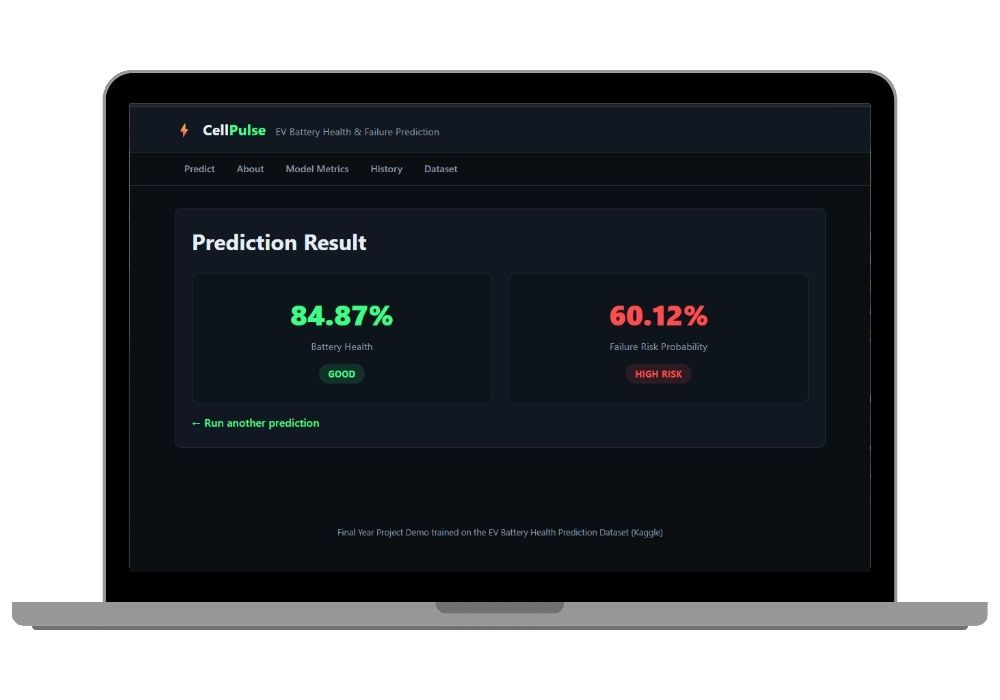
Predict EV battery health % and failure risk with a Random Forest model (R² 0.9944) wrapped in a full Flask dashboard API, metrics, history, all included.
Technology Used
Python | Flask | scikit-learn | pandas | joblib | Jinja2 | Vanilla JS | HTML/CSS


Abstract
Every EV owner eventually asks the same question: how much life is actually left in this battery? CellPulse answers that with numbers instead of guesswork. It's a machine learning pipeline trained on a 20,000-row EV telemetry dataset - vehicle specs, BMS/cell readings, charging habits, driving behaviour, environmental conditions - that predicts two things: battery health percentage and the probability of outright failure. Three regression models get compared (Random Forest, Gradient Boosting, Linear Regression), and Random Forest wins with an R² of 0.9944. A second, class-balanced Random Forest classifier handles the failure prediction at 93.75% accuracy. Both get served through a Flask web app, not left sitting in a notebook.
What This Project Actually Does
You feed it details about a car's battery - capacity, cycle count, charging patterns, temperature exposure, driving style - and it spits back a health percentage and a failure risk label. That's it in plain English. Under the hood there's a full ML pipeline (EDA, preprocessing, train/test split, model comparison, evaluation) but you don't need to touch any of that to demo it. The Load Sample Data button fills all 64 form fields with a real row from the dataset, so you can run a prediction in ten seconds flat without typing anything.
Key Features
- One form, two predictions - battery health % and failure risk run together on every submission, no separate pages.
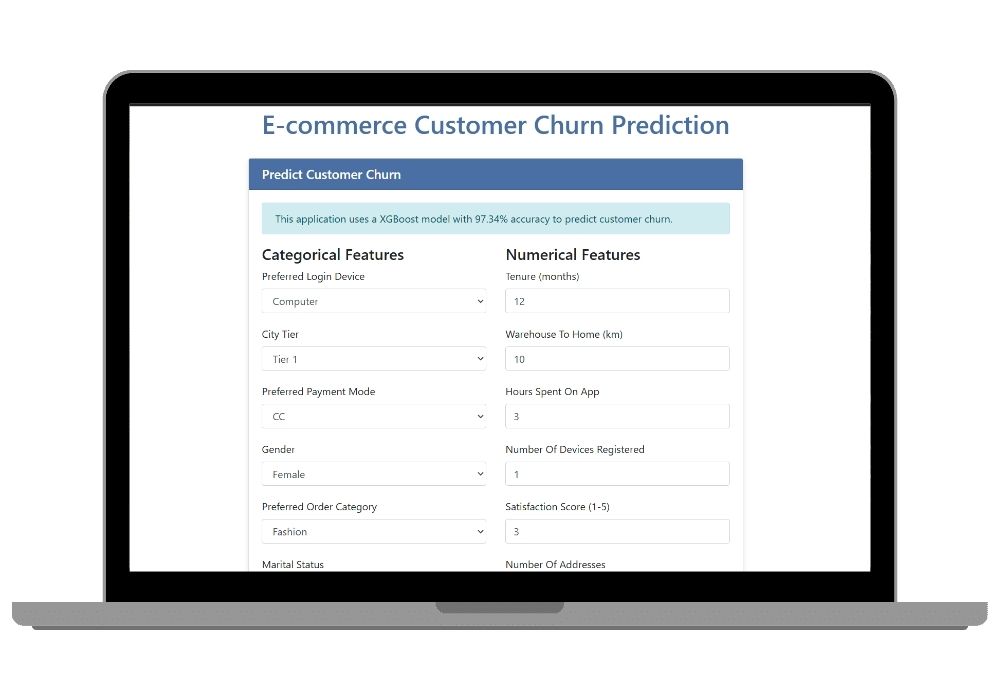
- 64 input fields auto-grouped into Vehicle Info, Battery & BMS, Charging Behaviour, Driving Behaviour, and Environment — built dynamically from the saved feature config, not hardcoded.
POST /api/predict- a working REST endpoint you can hit from Postman or curl, JSON in, JSON out.- Live Model Metrics dashboard - R² / MAE / RMSE comparison table plus precision/recall/F1 for the classifier, computed fresh from whatever
.pklfiles are actually loaded. - Every prediction (web or API) gets logged to
predictions_log.jsonland shows up in a sortable History table. - Dataset Explorer with per-column stats - min, mean, max, missing %, brand filtering, pagination.
- Dark, responsive UI with zero JS frameworks - vanilla JS and server-rendered Jinja templates, so there's nothing extra to install or break.
Real-World Applications
- Fleet managers flagging EVs that need battery service before they actually fail on the road.
- Used-EV resale platforms estimating remaining battery health as a pricing input.
- Insurance and warranty teams doing risk-based pricing using predicted failure probability.
- Charging network operators studying how charging and driving habits correlate with battery stress.
Who Should Buy This
If you're a student who needs a working project for your college submission, final-year project, semester project, internship, or academic demonstration, this is for you. Whether you're studying BCA, B.Tech, MCA, M.Tech, Computer Science, IT, AI, Data Science, or another related field, you can choose a project that fits your requirements. If you need the source code, project report, documentation, or help setting up and running the project, CodeAj gives you the resources and support to get started faster.
Why CodeAj
You're not just getting a zip file and a "good luck." Every CellPulse purchase comes with a project report you can actually submit, clear documentation of the preprocessing and leakage-column handling (useful when your guide starts asking "why did you drop this column"), and setup support if something breaks on your machine. We built this so a BCA student in their final semester — stressed, short on time, needs something that runs — can get it working without fighting dependency errors for three days straight.
This fits well alongside our other AI/ML final year projects, and if Flask specifically is your stack, browse more Flask project source code in the catalog. Machine learning final year projects are honestly one of the most in-demand categories right now, and this one has a real dataset and real evaluation metrics behind it - not a toy demo.
One Thing That's Genuinely Hard, One Thing That's Easier Than It Looks
The hard part: explaining the failure classifier's precision/recall trade-off to your examiner. It's 97% precise on "no failure" but only 54% on "failure" — that's a real class-imbalance story, and you need to actually understand why (rare failure events, small positive class) instead of just reading numbers off a slide. The easier part: the Flask app itself. You're not building the UI from scratch. Forms, dashboards, API — all done. You just need to run the notebook once, drop the eight .pkl files into models/, and you're demoing in fifteen minutes.
Frequently Asked Questions
Extra Add-Ons Available – Elevate Your Project
Add any of these professional upgrades to save time and impress your evaluators.
Live 1-on-1 Mentorship
Personal session with an expert developer
Project Setup
We'll install and configure the project on your PC via remote session (Google Meet, Zoom, or AnyDesk).
Source Code Explanation
1-hour live session to explain logic, flow, database design, and key features.
Want to know exactly how the setup works? Review our detailed step-by-step process before scheduling your session.
₹999
Custom Documents (College-Tailored)
- Custom Project Report: ₹1,500
- Custom Research Paper: ₹1,000
- Custom PPT: ₹800
Fully customized to match your college format, guidelines, and submission standards.
Project Modification
Need feature changes, UI updates, or new features added?
Charges vary based on complexity.
We'll review your request and provide a clear quote before starting work.