PromptSense - AI Prompt Recommendation & Semantic Search System | Python Final Year Project with Source Code
A Sentence-BERT search engine that understands what you mean, not what you typed. Search 2,152 LLM prompts by meaning, with a Flask UI, charts, and a REST API. Full source code included.
Technology Used
Python | Flask | Sentence-BERT | scikit-learn | Jupyter Notebook | JavaScript


Abstract
Prompt libraries like awesome-chatgpt-prompts have quietly turned into giant spreadsheets. Thousands of rows, no structure, and a search box that only matches exact words. Type "detect fake news" into a normal keyword search and a prompt literally titled "Factcheck" will never show up, even though it's exactly what you wanted.
PromptSense fixes that with semantic search. Every one of the 2,152 prompts in llm_prompts.csv gets converted into a 384-dimensional vector using Sentence-BERT (all-MiniLM-L6-v2). When you type a query, your sentence gets converted into a vector too, and cosine similarity ranks the entire corpus by how close the meanings are. Not the spellings. The meanings.
The whole thing ships as two halves that talk to each other: a Jupyter notebook that does the data analysis, trains the recommender, plots the embedding space, and saves the model artifacts to disk, plus a Flask app that loads those artifacts once at startup and serves a dark-themed search interface, a chart gallery, and a JSON API.
What This Project Actually Does
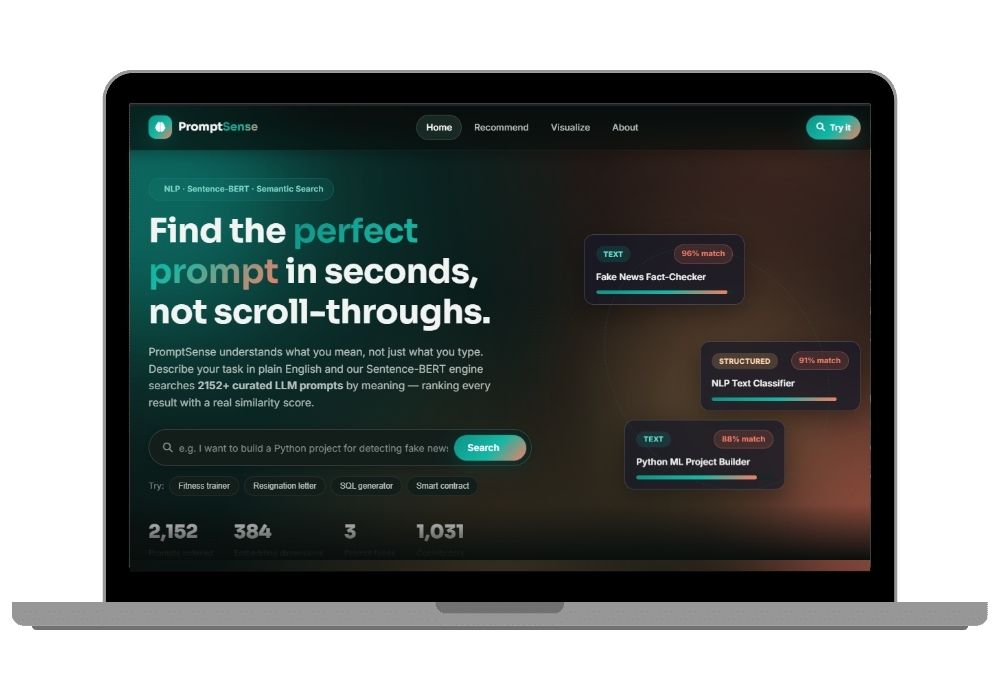
You type a sentence. It gives you back the prompts that mean the same thing, ranked with a percentage score next to each one.
That's the whole idea. The interesting part is how. Behind the search box, app.py loads a pre-computed NumPy array of embeddings (model/prompt_embeddings.npy) into memory. Your query hits POST /api/recommend, gets encoded by the same Sentence-BERT model that encoded the dataset, and scikit-learn computes cosine similarity against all 2,152 vectors at once. Sorted, sliced to your top-N, sent back as JSON. Takes under 100ms once the model is warm.
The frontend then animates similarity bars, lets you filter by prompt type, and copies any prompt to your clipboard in one click. It looks like a real product because it kind of is one.
How the Search Actually Works (the part your guide will ask about)
Three stages, and you should be able to explain all three in your viva:
- Encoding — every prompt's text is passed through Sentence-BERT once, offline, in the notebook. Output: a 384-number vector per prompt, stored as a
.npyfile so you never recompute it. - Query embedding — at runtime, only your one query gets encoded. That's why it's fast. You're not running the model over 2,152 rows every time somebody hits enter.
- Cosine similarity — the angle between your query vector and each prompt vector. Closer angle equals closer meaning. Multiply by 100 and you've got the percentage the UI displays.
Key Features
- Search "I want to build something that checks if news is real" and get back the Factcheck prompt at the top, even though not a single word overlaps.
- Every result shows a live similarity score from 0 to 100 percent with an animated bar, so your demo actually looks like something is being computed.
- Filter results by prompt type (TEXT, STRUCTURED, IMAGE) and by whether the prompt is developer-focused or general.
- Top-N slider from 1 to 25 results, so you can show the examiner how ranking depth changes the output.
- Sub-100ms responses on the full corpus after the model warms up — the API response itself returns an
elapsed_msfield you can point at. - Debounced live search on the Recommend page, meaning results update as you type without hammering the server on every keystroke.
- One-click copy-to-clipboard on every prompt card.
- A Visualize page with PCA and t-SNE projections of the embedding space, colored by prompt type, plus distribution plots and a word cloud of roles. Opens in a lightbox viewer.
- A working REST endpoint at
POST /api/recommendthat takes{"query": "...", "top_n": 5}and returns ranked JSON. Test it with curl in front of your panel. - Dark glassmorphism UI built on CSS custom properties, fully responsive down to phone width, with a scroll-aware sticky header.
- A reload sanity-check inside the notebook that confirms your saved artifacts deserialize correctly before you deploy anything.
Real-World Applications
- Internal documentation search — swap the prompt CSV for a company's help articles and the same embed-and-rank code becomes a support search engine. The logic doesn't change at all.
- IDE and CLI tooling — the
/api/recommendendpoint is designed to be called by something else. A VS Code extension that suggests prompt templates based on the file you have open is a genuinely reasonable extension of this. - Teaching embeddings — the t-SNE plot where image-generation prompts cluster in one corner and coding prompts in another is the single clearest way to explain vector space to somebody who has never seen it.
- Curriculum and content curation — an instructor searching "data analysis" and pulling every semantically related prompt without having tagged a single row manually.
- FAQ and ticket routing — same pattern, different corpus. Incoming ticket goes in, closest matching known issue comes out.
Frequently Asked Questions
Extra Add-Ons Available – Elevate Your Project
Add any of these professional upgrades to save time and impress your evaluators.
Live 1-on-1 Mentorship
Personal session with an expert developer
Project Setup
We'll install and configure the project on your PC via remote session (Google Meet, Zoom, or AnyDesk).
Source Code Explanation
1-hour live session to explain logic, flow, database design, and key features.
Want to know exactly how the setup works? Review our detailed step-by-step process before scheduling your session.
₹999
Custom Documents (College-Tailored)
- Custom Project Report: ₹1,500
- Custom Research Paper: ₹1,000
- Custom PPT: ₹800
Fully customized to match your college format, guidelines, and submission standards.
Project Modification
Need feature changes, UI updates, or new features added?
Charges vary based on complexity.
We'll review your request and provide a clear quote before starting work.