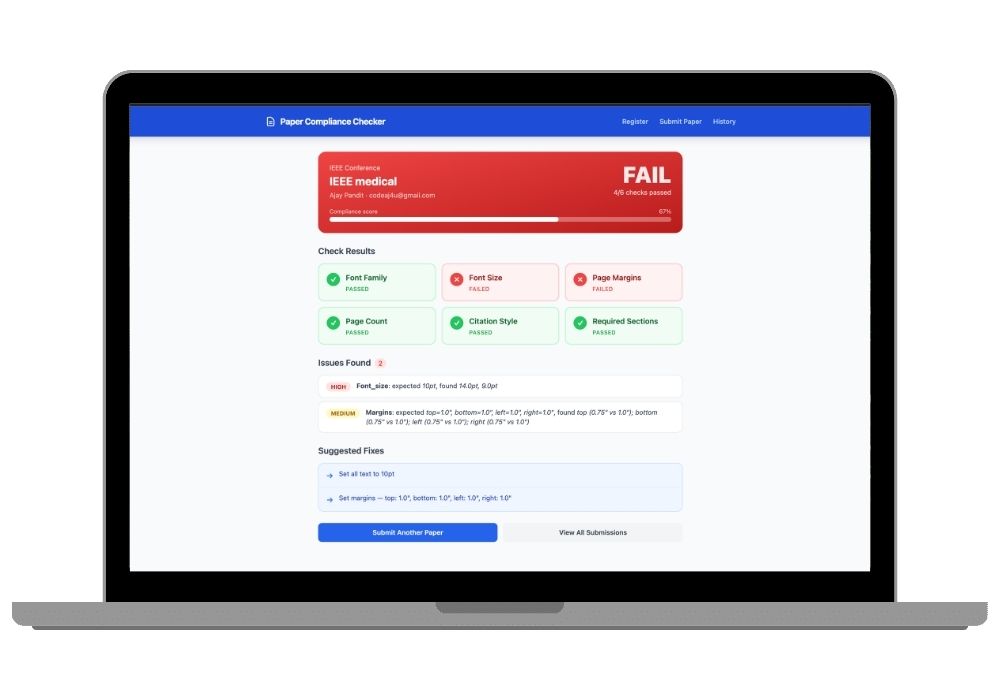
PaperCheck AI — Automated Research Paper Submission Compliance Checker
A full-stack web application that automatically checks your research paper against conference formatting guidelines — font, margins, page count, citation style, required sections — and emails a detailed compliance report within seconds.
Technology Used
Python | Flask | Flask-CORS | SQLite3 | PyMuPDF | python-docx | smtplib | React 18 | Vite | Tailwind CSS | Axios | threading

Every research paper submission carries the same quiet anxiety — did I get the font right, are the margins correct, did I miss a required section? Most students find out only after rejection. PaperCheck AI solves this before it becomes a problem.
This is a complete final year project built with Python Flask and React 18 that accepts your paper as a PDF or DOCX file, runs it through a structured compliance engine, and delivers a detailed report — all within seconds. If you are looking for a practical AI-powered final year project that solves a real academic problem, this is it.
What This Project Does
The system checks your uploaded paper against any conference template you configure — IEEE, NeurIPS, CVPR, or your own institution's format. It reads font families, font sizes, page margins, total page count, citation style patterns, and the presence of required sections like Abstract, Introduction, Methodology, and Conclusion. After the check completes, it sends a full HTML compliance report to the author's registered email.
The compliance engine runs in a background thread so your HTTP response comes back immediately while processing happens behind the scenes. Results are stored in SQLite so authors can review their entire submission history from a dedicated History page.
Key Features
- Upload PDF or DOCX research papers and check them against stored conference templates
- Font family and font size validation across every paragraph run in DOCX files
- Page margin checks with 0.1-inch tolerance for real-world formatting variations
- PDF page count verification against the conference maximum via PyMuPDF
- Citation style detection for IEEE, APA, MLA, and ACM patterns
- Required section detection — Abstract, Introduction, Conclusion, References, and more
- Automated HTML compliance report delivered to the author via Gmail SMTP
- Full submission history with compliance status per submission
- REST API backend with clearly documented endpoints for easy extension
- Add unlimited conference templates via API, SQLite, or seed data
How the Compliance Engine Works
When a paper is submitted, the engine identifies the file type and routes it through the appropriate parser. DOCX files are parsed with python-docx to extract raw formatting data — every run is inspected for font name and size, and section margins are read from the document's page setup. PDF files are handled by PyMuPDF (fitz), which counts pages reliably even for complex multi-column academic layouts.
Compliance issues are classified by severity. Font violations and page count overflows are marked High — they trigger an immediate FAIL. Missing sections or incorrect citation styles are Medium severity and fail the report only when combined with a high issue. This tiered system reflects how real conference review committees evaluate formatting problems.
If you are exploring web development final year projects with practical backend logic, this project demonstrates threading, file parsing, database design, and API design in a single codebase.
Project Architecture
The backend is a Flask REST API with five core modules: the main app entry point, a SQLite database layer, the compliance checker engine, an SMTP mailer, and a config file for credentials and paths. Uploaded files are stored in a UUID-named uploads directory so filenames never collide.
The frontend is built with React 18 and Vite, styled with Tailwind CSS.
It has four pages — Register, Submit, Report, and History — and uses Axios to communicate with the Flask API.
The Vite dev server proxies all /api/* requests to localhost:5000 so there are no CORS issues during development.
The database has five tables: users, conferences, submissions, compliance_reports, and email_logs. Everything runs on SQLite with no external database server required, which makes local setup genuinely simple.
Real-World Applications
- University research submission portals to auto-validate papers before faculty review
- Conference organizers who want to filter non-compliant submissions before peer review
- Student research cells that want to help juniors format papers correctly
- Academic publishing platforms requiring consistent document structure
- Internal IEEE student branch tools for chapter paper formatting checks
Who Should Build This Project
This project is well suited for MCA, BCA, BTech CSE, and BSc IT students who want something that goes beyond CRUD. It touches file parsing, background processing, email integration, REST API design, and a React frontend — all areas that actually come up in placement interviews and viva evaluations.
If your college requires a research paper along with your project, this project itself becomes the subject — you can write about document compliance automation, NLP-based section detection, or formatting rule enforcement systems. Check the research paper writing support available on CodeAj if you need help with that.
You can also explore more final year projects with source code across categories like AI, blockchain, computer vision, and cybersecurity — all available with full setup support.
What You Get with This Project
- Complete source code — backend and frontend — ready to run locally
- SQLite database with pre-seeded conference templates (IEEE, NeurIPS, CVPR)
- College-format project report prepared to your institution's guidelines
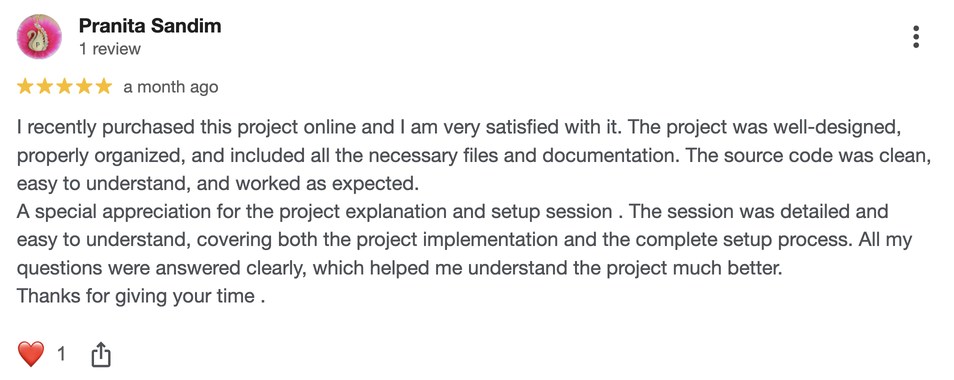
- Project setup session with source code explanation
- Debugging support throughout your submission period
- Optional research paper writing and publishing guidance
Need a version with custom features — multi-language support, a different UI, or additional check types? The custom project development service handles that from scratch based on your exact requirements.
Frequently Asked Questions
Extra Add-Ons Available – Elevate Your Project
Add any of these professional upgrades to save time and impress your evaluators.
Live 1-on-1 Mentorship
Personal session with an expert developer
Project Setup
We'll install and configure the project on your PC via remote session (Google Meet, Zoom, or AnyDesk).
Source Code Explanation
1-hour live session to explain logic, flow, database design, and key features.
Want to know exactly how the setup works? Review our detailed step-by-step process before scheduling your session.
₹999
Custom Documents (College-Tailored)
- Custom Project Report: ₹1,500
- Custom Research Paper: ₹1,000
- Custom PPT: ₹800
Fully customized to match your college format, guidelines, and submission standards.
Project Modification
Need feature changes, UI updates, or new features added?
Charges vary based on complexity.
We'll review your request and provide a clear quote before starting work.