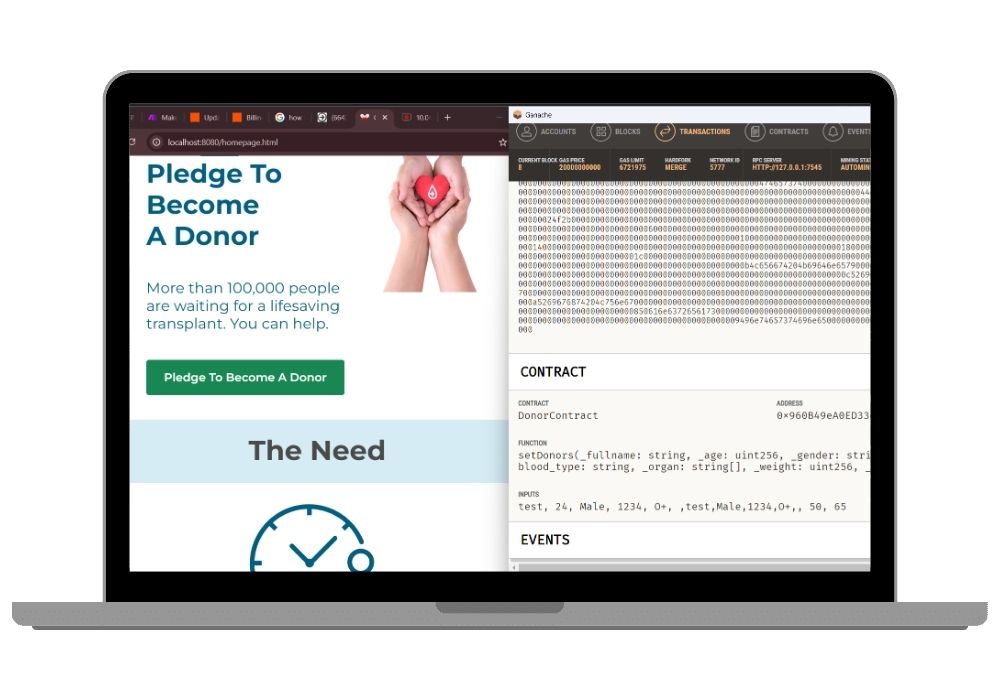


Project Files
Blockchain-Based Organ Donation Platform - Revolutionary Healthcare Solution
This innovative final year project leverages the power of blockchain technology to build a secure, transparent, and decentralized organ donation system. It addresses critical challenges like organ allocation fraud, lack of transparency, and trust issues in the healthcare system by implementing smart contracts and distributed ledger technology to create an immutable record of all organ donation activities.
🚀 Advanced Project Features
- Smart Contract Registration System: Automated donor registration and receiver matching using Ethereum-based smart contracts that ensure fair and transparent organ allocation based on medical compatibility and waiting list priority
- Immutable Blockchain Ledger: Secure distributed ledger tracking every organ donation, transplant request, and allocation decision with cryptographic verification to prevent tampering or unauthorized modifications
- Decentralized Data Management: Tamper-proof records of all activities including donor registrations, recipient applications, medical compatibility tests, and transplant outcomes stored across multiple nodes
- Real-Time Stakeholder Access: Live updates and secure access portals for hospitals, government healthcare authorities, transplant coordinators, and authorized medical professionals with role-based permissions
- Modern Web Interface: User-friendly responsive interface built with Node.js, Express.js, and React providing intuitive dashboards for donors, recipients, hospitals, and administrators
- Multi-Signature Authorization: Critical operations require approval from multiple stakeholders ensuring no single entity can manipulate the organ allocation process
- Automated Matching Algorithm: Intelligent matching system considering blood type compatibility, tissue matching, geographic proximity, waiting time, and medical urgency
- Audit Trail System: Complete transparent history of all transactions viewable by authorized parties ensuring accountability and compliance with healthcare regulations
- Privacy Protection: Advanced encryption techniques protecting sensitive medical information while maintaining transparency in allocation processes
- Emergency Priority Handling: Special protocols for urgent transplant cases with expedited matching and notification systems
🔧 Real-World Applications
- National Healthcare Systems: Government-level implementation for transparent, fair organ allocation across entire countries eliminating regional disparities and corruption in the donation process
- Hospital Network Integration: Seamless integration with existing hospital management systems allowing real-time organ availability updates and transplant coordination across multiple medical facilities
- Donor Registry Management: Comprehensive digital registry maintaining verified donor information, consent status, medical history, and organ compatibility data accessible to authorized medical professionals
- Medical Research Platforms: Verifiable transplant data for clinical research studying organ transplant success rates, post-transplant outcomes, and improving matching algorithms without compromising patient privacy
- International Organ Sharing: Cross-border organ sharing programs connecting donors and recipients globally while maintaining regulatory compliance and tracking international transplants
- Living Donor Programs: Management of living donor kidney and liver transplant programs with smart contracts handling consent verification and follow-up care coordination
- Tissue Banking Systems: Extension to tissue and cornea banks tracking donations, processing, storage, and distribution with full traceability
- Emergency Response Coordination: Rapid response systems for time-critical organ retrievals coordinating transportation logistics and surgical teams across regions
💡 Why Use Blockchain for Organ Donation?
Blockchain technology ensures data immutability, security, and complete traceability—making it the perfect solution to streamline organ transplants and eliminate corruption or mismatches in donor allocation. Traditional centralized systems are vulnerable to manipulation, data tampering, and lack transparency in decision-making processes. Blockchain addresses these critical issues through:
- Immutability: Once recorded, organ donation data cannot be altered or deleted, preventing fraudulent modifications to waiting lists or allocation decisions
- Transparency: All stakeholders can verify allocation fairness while maintaining patient confidentiality through cryptographic techniques
- Decentralization: No single authority controls the system, reducing corruption risk and ensuring democratic governance of organ allocation
- Smart Contract Automation: Automated execution of allocation rules eliminates human bias and ensures consistent application of medical criteria
- Enhanced Security: Cryptographic protection prevents unauthorized access to sensitive medical records and donor information
- Real-Time Synchronization: Instant updates across all network participants ensuring coordinated response for time-sensitive transplants
- Reduced Administrative Costs: Automation reduces paperwork and manual verification processes saving healthcare system resources
🛠️ Technical Architecture & Implementation
Blockchain Layer
- Ethereum Platform: Built on Ethereum blockchain using Solidity smart contracts for executing organ allocation logic with gas-optimized code for cost efficiency
- Web3.js Integration: JavaScript library connecting frontend applications to Ethereum nodes enabling seamless blockchain interactions
- Truffle Framework: Development environment for compiling, testing, and deploying smart contracts with automated migration scripts
- Ganache Local Blockchain: Personal Ethereum blockchain for development and testing allowing rapid iteration without mainnet costs
- IPFS Storage: InterPlanetary File System for storing large medical documents and images with blockchain-stored content hashes
Backend Technologies
- Node.js Runtime: High-performance JavaScript runtime handling API requests and blockchain transaction management
- Express.js Framework: Lightweight web framework providing RESTful API endpoints for frontend communication
- MongoDB Database: NoSQL database storing off-chain data like user profiles, medical records, and transaction metadata
- JWT Authentication: JSON Web Tokens ensuring secure user authentication and authorization with role-based access control
- Socket.io: Real-time bidirectional communication for instant notifications about organ availability and match alerts
Frontend Technologies
- React.js Framework: Component-based UI framework creating responsive, dynamic user interfaces for all stakeholder types
- Redux State Management: Centralized application state management ensuring consistent data flow across components
- Material-UI Components: Professional design system providing polished, accessible user interface components
- MetaMask Integration: Browser extension wallet enabling users to interact with Ethereum blockchain directly
- Chart.js Visualizations: Data visualization library displaying statistics, trends, and analytics dashboards
📊 Key Modules & Functionality
Donor Management Module
Comprehensive donor registration system capturing demographic information, medical history, organ donation preferences, and consent documentation. Donors can update preferences, view their registration status, and receive educational resources about organ donation. The module includes verification workflows ensuring authenticity of donor registrations.
Recipient Management Module
Patient-facing portal for transplant candidates to register medical needs, upload compatibility test results, track waiting list position, and receive match notifications. Includes severity scoring based on MELD (Model for End-Stage Liver Disease) or similar medical urgency metrics integrated into smart contract allocation logic.
Hospital Administration Module
Healthcare facility interface for managing local donor-recipient databases, reporting organ availability, coordinating transplant surgeries, and accessing patient medical records. Includes tools for transplant coordinators to facilitate communications between surgical teams and update transplant outcomes.
Government Oversight Module
Regulatory authority dashboard providing system-wide analytics, compliance monitoring, policy enforcement, and audit capabilities. Government officials can generate reports on transplant statistics, investigate irregularities, and ensure equitable organ distribution across demographics and regions.
Smart Matching Engine
Sophisticated algorithm implemented in smart contracts evaluating multiple criteria including HLA tissue typing, ABO blood compatibility, organ size matching, geographic distance, waiting time, and medical urgency. The engine automatically identifies optimal matches and triggers notification workflows.
🔐 Security & Privacy Features
- End-to-End Encryption: All sensitive medical data encrypted during transmission and storage using industry-standard AES-256 encryption
- Role-Based Access Control: Granular permissions ensuring users only access data relevant to their role preventing unauthorized information disclosure
- Two-Factor Authentication: Additional security layer requiring secondary verification for account access and critical operations
- HIPAA Compliance: Architecture designed to meet Health Insurance Portability and Accountability Act requirements for protecting patient health information
- Zero-Knowledge Proofs: Advanced cryptographic techniques allowing verification of medical compatibility without revealing underlying sensitive data
- Audit Logging: Comprehensive logs of all system access and modifications creating accountability trail for security investigations
📈 Performance & Scalability
The platform architecture supports horizontal scaling to accommodate growing numbers of donors, recipients, and hospitals. Layer-2 scaling solutions like Polygon or Optimistic Rollups can be integrated to reduce transaction costs and increase throughput for high-volume operations. Caching strategies using Redis ensure responsive user experience even during peak usage periods.
🎓 Ideal For
- Computer Science Final Year Students: Comprehensive project demonstrating blockchain development, full-stack web programming, and database management skills suitable for academic evaluation
- Blockchain Specialization Projects: Advanced implementation of smart contracts, decentralized applications, and distributed systems perfect for blockchain-focused coursework
- Healthcare Technology Research: Intersection of healthcare and technology providing rich opportunities for research papers on blockchain adoption in medical systems
- Social Impact Hackathons: Meaningful project addressing real-world healthcare challenges with potential for social entrepreneurship and startup development
- Master's Thesis Projects: Complex system suitable for graduate-level research exploring blockchain scalability, privacy-preserving techniques, or healthcare interoperability
- Portfolio Development: Impressive showcase project demonstrating advanced technical skills across multiple domains attractive to employers in blockchain and healthcare sectors
📚 Learning Outcomes
Working with this project provides hands-on experience with:
- Blockchain fundamentals including distributed consensus, cryptographic hashing, and peer-to-peer networks
- Smart contract development using Solidity with security best practices and gas optimization techniques
- Full-stack JavaScript development covering Node.js backend and React frontend architectures
- Database design for hybrid blockchain-database applications balancing on-chain and off-chain data storage
- Healthcare IT systems understanding HIPAA compliance, medical data standards, and interoperability requirements
- User experience design creating intuitive interfaces for diverse stakeholder groups with varying technical literacy
- Security engineering implementing authentication, authorization, encryption, and audit mechanisms
- Software testing strategies including unit tests for smart contracts and integration testing for distributed systems
🎯 Project Deliverables
Get this comprehensive project package including:
- Complete Source Code: Fully functional codebase with Solidity smart contracts, Node.js backend, React frontend, and deployment scripts
- Setup Documentation: Detailed installation guide covering environment setup, dependency installation, blockchain configuration, and deployment procedures
- Source Code Explanation: Line-by-line code walkthroughs explaining smart contract logic, API endpoints, frontend components, and system architecture
- Professional Project Report: Academic-quality documentation including introduction, literature review, system design, implementation details, testing results, and conclusions suitable for university submission
- Database Schema: MongoDB collections structure and Ethereum smart contract state variable documentation
- API Documentation: Complete REST API reference with endpoint descriptions, request/response formats, and authentication requirements
- User Manuals: Guides for different user roles explaining how to navigate interfaces and perform common tasks
- Presentation Materials: PowerPoint slides for project defense with technical diagrams, architecture illustrations, and demonstration screenshots
- Testing Suite: Automated tests for smart contracts using Truffle's testing framework and backend API tests using Mocha/Chai
- Deployment Guide: Instructions for deploying to Ethereum testnets (Goerli, Sepolia) or mainnet with cost estimates and best practices
🔄 Future Enhancement Opportunities
This project serves as an excellent foundation for advanced features and research directions:
- AI-Powered Matching: Integrate machine learning algorithms to predict transplant success probability based on historical data improving allocation decisions
- IoT Integration: Connect with medical IoT devices for real-time organ viability monitoring during transportation between facilities
- Mobile Applications: Develop native mobile apps for iOS and Android allowing donors and recipients to manage registrations on-the-go
- Cross-Chain Interoperability: Implement bridges to other blockchain networks enabling international organ sharing across different blockchain platforms
- Decentralized Identity: Integrate self-sovereign identity solutions allowing users to control their medical data while proving credentials
- Token Economics: Design incentive mechanisms using blockchain tokens to encourage organ donation registration and maintain network participation
- Advanced Analytics: Build predictive models analyzing transplant outcomes, identifying improvement areas in allocation algorithms, and forecasting organ demand
🌟 Why Choose This Project from CodeAj?
- Production-Ready Code: Clean, well-documented code following industry best practices ready for deployment and further development
- Academic Excellence: Comprehensive documentation and reports designed to meet university project requirements and impress evaluation committees
- Real-World Impact: Addresses genuine healthcare challenges creating meaningful social impact beyond academic requirements
- Technical Depth: Covers advanced blockchain concepts, smart contract security, and distributed systems architecture demonstrating sophisticated technical understanding
- Career Advancement: Impressive portfolio project showcasing skills in emerging technologies highly valued by employers in blockchain and healthcare technology sectors
- Extensibility: Modular architecture designed for easy customization and addition of new features supporting creative exploration and research
- Expert Support: Optional setup assistance and technical guidance available through our project setup services
🚀 Get Started Today
Transform your final year project into an impressive demonstration of blockchain expertise and social innovation. This organ donation platform combines cutting-edge technology with meaningful healthcare applications, providing an ideal foundation for academic success and career development in the rapidly growing blockchain industry.
Explore more innovative blockchain solutions in our complete projects catalog or discover related projects like our AI Blockchain Document Verification System. Need personalized assistance? Our expert team offers mentorship services to guide you through implementation and customization.
Extra Add-Ons Available – Elevate Your Project
Add any of these professional upgrades to save time and impress your evaluators.
Project Setup
We'll install and configure the project on your PC via remote session (Google Meet, Zoom, or AnyDesk).
Source Code Explanation
1-hour live session to explain logic, flow, database design, and key features.
Want to know exactly how the setup works? Review our detailed step-by-step process before scheduling your session.
₹999
Custom Documents (College-Tailored)
- Custom Project Report: ₹1,200
- Custom Research Paper: ₹1000
- Custom PPT: ₹500
Fully customized to match your college format, guidelines, and submission standards.
Project Modification
Need feature changes, UI updates, or new features added?
Charges vary based on complexity.
We'll review your request and provide a clear quote before starting work.