ExamPilot AI RAG Exam Prep Assistant That Cites Your Own Notes | Django Final Year Project with Source Code
Upload your notes and PYQ papers, get page-cited answers, spot which topics repeat every year, and auto-generate a predicted model paper. A Django RAG final year project with full source code.
Technology Used
Python | Django | Django REST Framework | ChromaDB | Sentence-Transformers | Groq API | PyMuPDF | scikit-learn | ReportLab | Chart.js | Tailwind CSS | SQLite


What This Project Actually Does
ExamPilot AI is a study assistant that only knows what you feed it. You upload your unit-wise notes and your college's previous-year question papers as PDFs, and the app does four things with them: answers your questions while citing the exact page it pulled the answer from, groups reworded duplicate questions across years to show which topics your university keeps repeating, builds a predicted model paper out of those repeat topics, and writes answers sized to the marks allotted.
Here's the part that matters for your viva. This isn't a ChatGPT wrapper with a nice UI on top. If the answer isn't in your uploaded notes, the Chat module replies "Not found in your notes" instead of confidently making something up. That behaviour is enforced twice — once by a cosine-distance threshold in core/rag.py that rejects weak retrieval matches, and again by a system prompt that forbids the model from answering out of its own general knowledge. When your examiner asks "how do you stop hallucination," you have a real, specific, two-layer answer.
Your PDFs never leave your laptop either. PyMuPDF extracts the text, all-MiniLM-L6-v2 from sentence-transformers embeds it locally, and ChromaDB stores the vectors in a folder called chroma_store/ right there on disk. The only outbound network call is the final answer generation, which hits the Groq API.
Key Features
Chat with page-level citations
Ask "what is thrashing" and you get an answer plus the page numbers it came from — not a vague "according to your notes." Chunking happens per page, not across page boundaries, precisely so a citation can never point to an ambiguous location.
PYQ Pattern Analyzer
Hit "Process PYQs" and the app extracts every individual question from your uploaded papers as structured JSON (question text, marks, unit), embeds each one, and clusters them with scikit-learn's AgglomerativeClustering at a cosine distance threshold of 0.35. Questions worded three different ways across three different years land in the same cluster. Each cluster gets scored by frequency plus a recency weight with a 3-year half-life, so a topic asked twice in 2024 and 2025 outranks one asked three times back in 2015. Output is a bar chart of top topics and a stacked chart of questions per unit split by marks band, both rendered with Chart.js.
Model Paper Generator
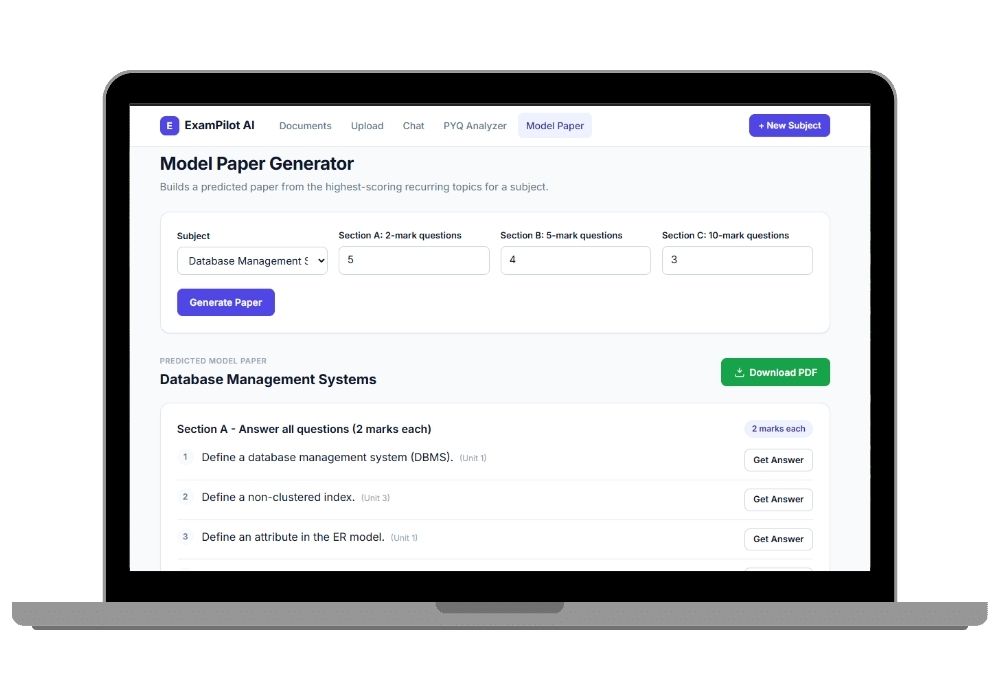
Pick a subject, pick how many questions you want per section, and it lays out Section A (2 marks), Section B (5 marks), and Section C (10 marks) from the highest-scoring clusters. Downloadable as a PDF via ReportLab.
Marks-aware answers
Click "Get Answer" next to any generated question. A 2-mark answer comes back as a 40–50 word definition with a short example. A 10-mark answer comes back with an intro, five or six headed points, a diagram description, a conclusion, and key terms bolded. Different marks, genuinely different answer shapes — not the same paragraph padded out.
Sample dataset that works with zero API key
Run python manage.py load_sample_data and you instantly get two subjects — Operating Systems and Database Management Systems — with notes for 3 units each and five years of PYQ papers from 2021 to 2025. Real PDFs, pushed through the real ingest pipeline, embedded by the real model, clustered by the real clustering code. The analyzer dashboard and paper generator work immediately, no Groq key needed.
AJAX everywhere, no build step
Upload, chat, PYQ processing, and answer generation all run through vanilla fetch() helpers in static/js/app.js with spinners and toasts. Django views branch on the X-Requested-With header to serve either a normal page or JSON from the same URL. And there's no Node, no npm install, no webpack — Tailwind comes off the Play CDN and the design tokens live in a hand-written static/css/app.css.
Real-World Applications
The obvious one is a student prepping for university semester exams with five years of departmental papers sitting in a WhatsApp group. But the pattern goes further than that.
Coaching institutes preparing students for GATE, UGC NET, or state PSC exams can feed in their own question banks and show learners exactly where the repeat weightage sits. College departments can run it over their own paper archive to check whether their question setting has gotten predictable. Corporate L&D teams use the same retrieval-with-citations pattern for internal policy documents where a wrong answer is a compliance problem, not just a lost mark. And any team building a document Q&A tool over private data — legal, medical, HR handbooks — is building this exact architecture, just with different PDFs going in.
What's Hard About It, and What's Easier Than It Looks
The hard part is the clustering threshold. There's no formula that hands you 0.35. Set it too low and "Explain paging" and "What is paging in OS" end up in separate clusters, which wrecks your frequency counts. Set it too high and paging gets merged with segmentation and your model paper starts recommending nonsense. The reasoning behind the chosen value and the average-linkage choice is written out in full inside core/clustering.py — read that docstring before your viva, it's written to be quoted from out loud.
Now the easy part. You'd assume a RAG project means Docker, a vector DB server, a Celery worker, and a Redis instance. This one has none of that. SQLite is the database, Chroma runs in persistent local mode with no server process, ingestion runs synchronously inside the request, and the whole thing starts with python manage.py runserver. If you've built literally any Django CRUD app before, you already know 70% of the structure here. The unfamiliar bits are five or six files inside core/, and each one does exactly one thing.
Who Should Buy This
If you're a student who needs a working project for your college submission, final-year project, semester project, internship, or academic demonstration, this is for you. Whether you're studying BCA, B.Tech, MCA, M.Tech, Computer Science, IT, AI, Data Science, or another related field, you can choose a project that fits your requirements. If you need the source code, project report, documentation, or help setting up and running the project, CodeAj gives you the resources and support to get started faster.
One honest filter though. If your syllabus is strictly a web-development-only paper and your guide wants zero machine learning involved, this might be more than you were asked for. Everyone else — especially if you want something in the AI and ML final year projects space that isn't another Iris flower classifier — should be fine.
Why CodeAj
You get the complete source code, every Python module and template and migration, plus a project report written to match what Indian university departments actually ask for — abstract, literature survey, system design, ER and data flow diagrams, testing, and results. Setup support is included, so if your virtualenv refuses to activate on your college lab machine at 11 PM the night before submission, that's a fixable problem and not a disaster. You'll find more Django-based builds in our Django projects with source code collection, and if you're still comparing options, the wider Python final year projects catalog is a good place to browse before deciding.
Frequently Asked Questions
Extra Add-Ons Available – Elevate Your Project
Add any of these professional upgrades to save time and impress your evaluators.
Live 1-on-1 Mentorship
Personal session with an expert developer
Project Setup
We'll install and configure the project on your PC via remote session (Google Meet, Zoom, or AnyDesk).
Source Code Explanation
1-hour live session to explain logic, flow, database design, and key features.
Want to know exactly how the setup works? Review our detailed step-by-step process before scheduling your session.
₹999
Custom Documents (College-Tailored)
- Custom Project Report: ₹1,500
- Custom Research Paper: ₹1,000
- Custom PPT: ₹800
Fully customized to match your college format, guidelines, and submission standards.
Project Modification
Need feature changes, UI updates, or new features added?
Charges vary based on complexity.
We'll review your request and provide a clear quote before starting work.
Project Files

 Reviews
What Our Students Say
He explained the project clearly and thoroughly. He was very supportive throughout the process and was always available to help when needed. His guidance and assistance made it easier to understand the project and complete tasks effectively.
I had a very good experience with CodeAj Marketplace. The team is professional and supportive, especially Ajay Pandit sir who guides clearly throughout the project. The work was completed neatly and according to requirements. A great place for learning and project development. Highly recommended for students and developers.
Excellent explanation! Concepts are explained in a very simple and understandable way. It really helped me a lot in improving my knowledge. Great work!
Codeaj was really helpful with my project, especially during the customization part. He didn't just do the work but also took the time to explain everything, from the project structure and database to the code itself. It was a huge help, especially for students trying to understand how everything fits together. I really appreciated his support and the way he made things easier to follow.
Working with CodeAj Marketplace has been such a positive experience. The projects delivered are original, carefully crafted from scratch, and tailored to meet expectations with impressive attention to detail. What really makes him stand out is his willingness to go the extra mile — not just in creating outstanding work, but also in helping others understand how everything functions. He explains things clearly, addresses questions patiently, and ensures the whole process feels like a learning journey instead of just a handover. On top of the technical expertise, his calm and approachable personality makes communication effortless. No unnecessary stress, just smooth collaboration and genuine support. I truly value the dedication he brings to his work and would highly recommend him to anyone in search of high-quality, authentic projects.
I purchased a project from him recently and I have to say it's one of the best decisions I've made. The project was absolutely beautiful, built completely from scratch with no shortcuts, and perfectly matched what I wanted. What makes him stand out is not just his ability to create anything we ask for, no matter how complex, but also the way he helps us understand every part of it. He patiently explains the process, clears doubts, and makes sure we actually learn from the project instead of just using it. On top of his skills, his personality is amazing — he's calm, chill, and very friendly to talk to. There's no stress when working with him, only smooth communication and genuine support. I truly appreciate the effort he puts in and would highly recommend him to anyone looking for original, high-quality projects.
I received my project from CodeAJ Marketplace on time, and the work was very neat and well-presented. The team maintained good communication and delivered everything as promised. I appreciate their timely completion and professional approach.
I sincerely thank Mr. Ajay Pandit for his constant support and valuable guidance throughout the project. His timely advice, encouragement, and expertise greatly contributed to the successful completion of the work. I'm truly grateful for his mentorship.
I had an outstanding experience with CodeAj while developing my mobile app. Their team was incredibly cooperative, ensuring every customization I requested was implemented flawlessly. The service was top-notch, and the final product exceeded my expectations. Highly recommend CodeAj for anyone seeking professional and reliable app development services! 11/10
I would like to sincerely thank Ajay Pandit for providing me with the project. His guidance and explanation of the system's architecture, modules, and AI integration were extremely helpful in understanding the project thoroughly. Ajay's support played a key role in helping me implement the hotel booking and payment module effectively. His willingness to clarify concepts and walk me through complex logic made the learning process smooth and insightful. I truly appreciate his mentorship and the time he dedicated to ensuring I was well-prepared for both the development and presentation of this project.
I had a great experience with the project I purchased. It was well-structured and met all my expectations. The team was responsive and supportive throughout, addressing all my queries promptly. Highly recommended for anyone looking for quality projects and good service.
I'm really thankful to Codeaj for helping me with my project explanation and guiding me throughout. Your support made everything much easier and clearer.
The project he made was wonderful, and the way he patiently listened, understood all my ideas and presented them so well in the project, was amazing. I would highly recommend him to everyone.
I would like to sincerely thank Ajay Pandit for providing me with the project. His guidance and explanation of the system's architecture, modules, and AI integration were extremely helpful in understanding the project thoroughly.
Too good experience, I love their projects and they are available for you to help, they are incredible good. Must avail their services. I am happy customer.
The team was very supportive and their explanation was very good, they are clarifying each and every doubts with lots of patience. Highly recommended for quality projects.
I really like their work and they made good project in less amount.
Thank you, CodeAj Bro, for supporting the Doctor Appointment System project. Your guidance during the project setup, installation, and report creation was very helpful and greatly appreciated.
One of the best Software Developer provide the best setup environment for project, good explain skills, and good technical skills, step by step explain project through google meet and budgetly price project Available.
Thank you so much for your excellent work on our project! Your kindness and clear explanations made the entire process smooth and enjoyable. Highly recommend!
Really very supportive, helpful and kind, loving nature. Available for any time for any query, highly recommend to get projects from him.
Awesome projects. They support on setting up the project after purchasing. Completely legal one. Affordable projects too.
Code AJ guide team are very formal, friendly to setup project step by step and explain each question 🙂
Thank you codeAj, Best site to get your project done quickly, with fast responses and instant clarification of any project-related doubts.
I really liked the work, and they solved my issues very well too.
They provide very good service and code also running condition and they fulfill all the queries it's very helpful.
Really helpful, makes things easy to understand and very kind nature, you can look forward to get help from here.
Thank you so much for building the Project for my requirement.
Looking forward to many many collaborations and always tend to buy the projects.
I am so satisfied with codeAJ because of his help.
Thank you so much sir for your support and help.
Ajay bro has excellent knowledge and his response is nice.
This is a great app I love it with good functionality.
Thank you so much for your help and support.
Highly recommended for the projects.
Loved the project work.
It is super for students.
I recently purchased this project online and I am very satisfied with it. The project was well-designed, properly organized, and included all the necessary files and documentation. The source code was clean, easy to understand, and worked as expected. A special appreciation for the project explanation and setup session. The session was detailed and easy to understand, covering both the project implementation and the complete setup process. All my questions were answered clearly, which helped me understand the project much better. Thanks for giving your time.