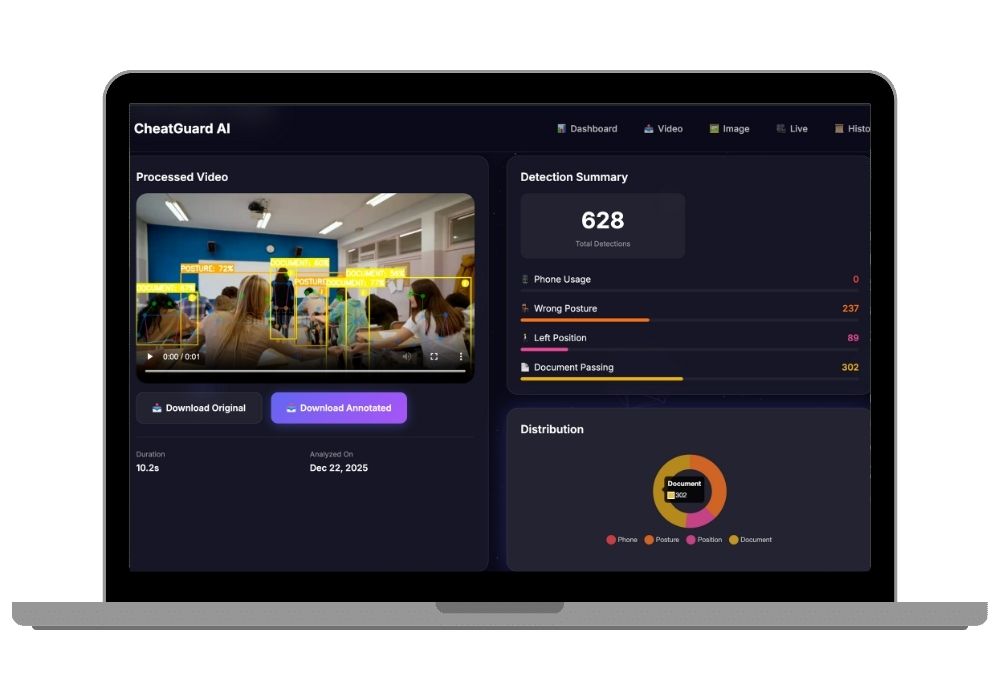
CheatGuard AI - Real-Time Classroom Cheating Detection System with YOLOv8 & Pose Estimation
Advanced AI-powered classroom monitoring system that detects cheating behaviors in real-time using YOLOv8 object detection and pose estimation to identify phone usage, suspicious postures, unauthorized movements, and document passing during examinations.
Technology Used
Django 5.0 | Python | YOLOv8 | YOLOv8-Pose | Ultralytics | OpenCV | NumPy | Pillow | HTML5 | CSS3 | JavaScript | Chart.js | Three.js | SQLite


Project Files
CheatGuard AI - Intelligent Classroom Cheating Detection System
CheatGuard AI is a cutting-edge artificial intelligence-powered examination monitoring solution designed to maintain academic integrity in educational institutions. Built using advanced YOLOv8 deep learning models and pose estimation algorithms, this system provides real-time detection of multiple cheating behaviors including mobile phone usage, suspicious body postures, unauthorized movement, and document exchange between students.
Project Overview
This Django-based web application leverages state-of-the-art computer vision technology to automate the tedious process of exam invigilation. The system processes both pre-recorded video footage and live webcam feeds to identify potential cheating incidents with high accuracy, generating comprehensive analytical reports with visual statistics and detailed timestamps of suspicious activities.
Key Features and Capabilities
1. Mobile Phone Detection System
The system employs YOLOv8 object detection algorithm trained on extensive datasets to identify mobile phones in the examination environment. It can detect phones in various orientations and lighting conditions, instantly flagging any student attempting to use unauthorized electronic devices during tests. The detection engine runs at real-time speeds, ensuring no suspicious activity goes unnoticed.
2. Intelligent Posture Analysis
Using YOLOv8-Pose estimation technology, CheatGuard AI monitors each student's body posture throughout the examination. The system identifies abnormal head angles, body positions, and suspicious movements that may indicate looking at hidden materials or attempting to copy from neighboring students. Advanced keypoint detection tracks 17 body landmarks to calculate posture angles and detect deviations from normal exam-taking behavior.
3. Position Tracking and Movement Detection
The application continuously monitors student positions within the examination hall. It tracks whether students remain seated in their designated areas and alerts supervisors if anyone leaves their seat without authorization. The position tracking system uses bounding box coordinates and centroid tracking algorithms to maintain persistent identity tracking across video frames.
4. Document Passing Detection
One of the most sophisticated features is the hand-to-hand document exchange detection system. By analyzing hand proximity between students and tracking object transfer patterns, the system can identify when students are passing notes, cheat sheets, or answer papers to each other. This feature uses advanced spatial relationship analysis and temporal tracking to minimize false positives.
5. Real-Time Live Monitoring Dashboard
The web-based dashboard features a modern glassmorphism design with Three.js animated backgrounds, providing an intuitive interface for examination supervisors. Real-time statistics are displayed using Chart.js visualizations, showing detection counts, confidence scores, and temporal distribution of cheating incidents. The dashboard updates dynamically as the AI engine processes video feeds.
6. Video Upload and Batch Processing
Users can upload pre-recorded examination videos for retrospective analysis. The drag-and-drop interface supports multiple video formats and displays upload progress with estimated processing time. Once uploaded, videos are automatically queued for AI analysis, with processed results saved for future reference and report generation.
7. Comprehensive Analytics and Reporting
After processing, the system generates detailed analytical reports containing timestamps of all detected incidents, confidence scores, incident categories, and visual evidence with bounding boxes drawn on detected objects. These reports can be exported for administrative review and record-keeping purposes.
Technical Architecture
Backend Framework
Built on Django 5.0, the backend provides robust model-view-template architecture, efficient database operations, and secure user authentication. Django's ORM handles storage of detection results, user data, and video metadata in a SQLite database that can be easily migrated to PostgreSQL or MySQL for production deployments. Similar to our Student Management System and E-Learning Platform with AI Monitoring, the system follows best practices for scalable Django applications.
Artificial Intelligence Engine
The AI core utilizes Ultralytics YOLOv8, the latest version of the You Only Look Once object detection family. YOLOv8 offers superior speed and accuracy compared to previous versions, making it ideal for real-time video analysis. The system uses two specialized models: YOLOv8 for object detection (phones, documents) and YOLOv8-Pose for human keypoint detection and posture analysis. This technology is similar to what we use in our Real-Time Object Detection WebApp.
Video Processing Pipeline
OpenCV handles all video capture, frame extraction, and image preprocessing operations. The pipeline reads video streams frame-by-frame, applies the YOLO models for inference, draws detection overlays, and writes processed frames to output video files. Multi-threading capabilities ensure smooth processing even with high-resolution video inputs. For students interested in similar computer vision applications, check out our Face Recognition Attendance System and Emotion Detection projects.
Frontend Design
The user interface features modern HTML5, CSS3, and JavaScript with glassmorphism aesthetic principles. Three.js creates immersive 3D animated backgrounds that enhance visual appeal without compromising functionality. Chart.js generates interactive graphs showing detection statistics over time, incident type distributions, and confidence score histograms.
Real-World Applications
Educational Institutions
Universities, colleges, and schools can deploy CheatGuard AI in examination halls to reduce the burden on human invigilators while increasing detection accuracy. The system can monitor multiple camera feeds simultaneously, covering large examination halls with hundreds of students. This complements other educational technology solutions like Learning Management Systems and College AI Assistant Chatbots.
Online Examination Platforms
E-learning platforms conducting remote proctored exams can integrate CheatGuard AI to monitor students through their webcams, ensuring academic integrity in distance learning scenarios. The system can flag suspicious behavior for manual review by human proctors. Similar to our EduNexa E-Learning LMS, this ensures quality education delivery.
Competitive Examinations
Organizations conducting high-stakes competitive exams can use this technology to maintain fairness and credibility. The automated detection system provides evidence-based incident reports that can be used in disciplinary proceedings if needed.
Research and Development
The project serves as an excellent foundation for computer vision research in behavior analysis, anomaly detection, and human activity recognition. Researchers can extend the detection capabilities to identify additional behaviors or adapt the system for other surveillance applications.
Project Benefits
- Automated Monitoring: Reduces dependence on human invigilators, allowing them to focus on critical supervision tasks rather than continuous observation
- Objective Detection: Eliminates human bias and fatigue factors, providing consistent and fair monitoring throughout examination duration
- Evidence-Based Records: Creates timestamped video evidence of all detected incidents, supporting transparent disciplinary processes
- Scalable Solution: Can monitor multiple camera feeds and large examination halls simultaneously without performance degradation
- Deterrent Effect: The presence of AI monitoring systems discourages students from attempting to cheat, promoting honest exam-taking behavior
- Cost-Effective: After initial setup, the system operates with minimal ongoing costs compared to hiring additional human invigilators
- Real-Time Alerts: Provides instant notifications to supervisors, enabling immediate intervention when suspicious behavior is detected
Future Enhancement Possibilities
The system architecture supports future expansions including: eye gaze tracking using specialized models, audio analysis to detect whispered conversations, multi-camera fusion for 360-degree coverage, integration with student information systems for automated report generation, mobile app for supervisors to receive push notifications, and cloud deployment for centralized monitoring across multiple examination centers.
Learning Outcomes for Students
Implementing this project provides hands-on experience with deep learning frameworks, computer vision algorithms, video processing techniques, web application development with Django, frontend design with modern JavaScript libraries, real-time data visualization, database design and management, RESTful API development, and deployment of AI-powered web applications. Students gain practical knowledge of integrating multiple technologies to solve complex real-world problems.
Why Choose This Project?
CheatGuard AI represents an excellent final year project because it addresses a genuine problem faced by educational institutions worldwide. The project demonstrates proficiency in artificial intelligence, computer vision, web development, and system design. It showcases the ability to integrate cutting-edge technologies like YOLOv8 with traditional web frameworks to create a practical, deployable solution. The comprehensive feature set, modern UI design, and real-world applicability make this project an impressive addition to any student portfolio, demonstrating both technical competence and problem-solving abilities to potential employers. Check out our success stories to see how students have benefited from similar projects.
Project Support and Services
At CodeAj, we provide comprehensive support services for this project including complete project setup assistance, source code walkthrough, and mentorship guidance. Our team helps with custom modifications, report generation, and research paper writing to ensure your project stands out. For any questions, feel free to contact us.
Related AI and Computer Vision Projects
Explore our other innovative AI/ML and computer vision projects:
- AI-Powered Classroom Cheating Detection System - Alternative implementation approach
- Face & Uniform Attendance System - Smart attendance with dress code verification
- Classroom Attendance System - Automated attendance tracking
- Face Recognition Attendance Project - Biometric attendance solution
- Student Performance Prediction - ML-based academic analytics
- AI Disease Prediction Web Application - Healthcare AI system
- Real-Time Fire Detection YOLOv8 - Safety monitoring system
Browse more projects or use our project finder tool to discover the perfect match for your requirements.
Extra Add-Ons Available – Elevate Your Project
Add any of these professional upgrades to save time and impress your evaluators.
Project Setup
We'll install and configure the project on your PC via remote session (Google Meet, Zoom, or AnyDesk).
Source Code Explanation
1-hour live session to explain logic, flow, database design, and key features.
Want to know exactly how the setup works? Review our detailed step-by-step process before scheduling your session.
₹1999
Custom Documents (College-Tailored)
- Custom Project Report: ₹1,200
- Custom Research Paper: ₹1000
- Custom PPT: ₹500
Fully customized to match your college format, guidelines, and submission standards.
Project Modification
Need feature changes, UI updates, or new features added?
Charges vary based on complexity.
We'll review your request and provide a clear quote before starting work.