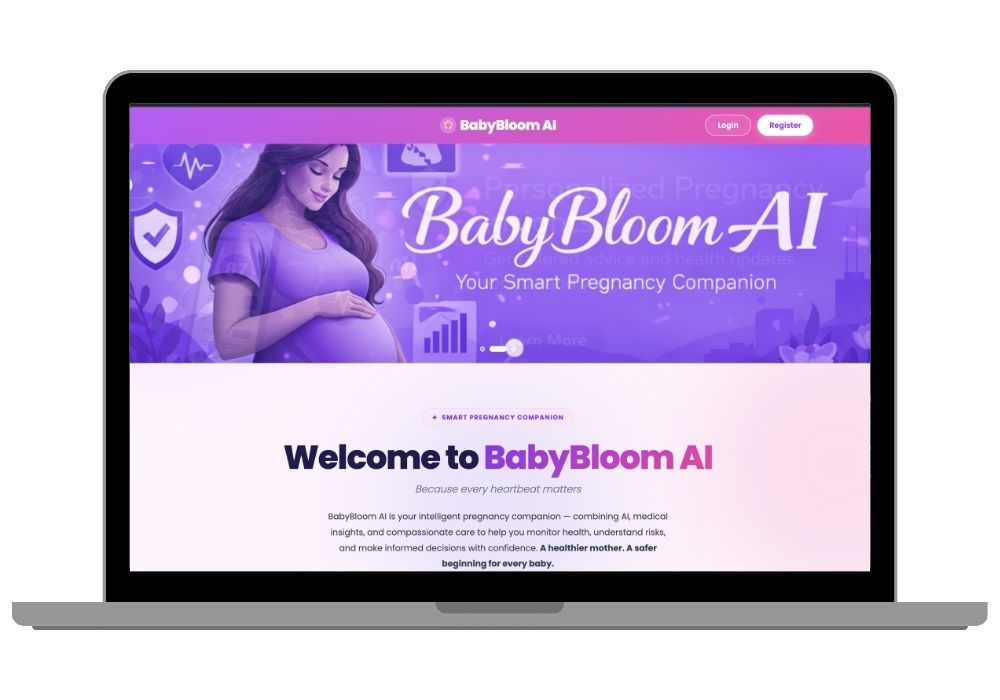
BabyBloom AI - Pregnancy Health Monitoring and Risk Prediction System with ML-Powered Analysis and AI Chatbot
A full-stack Django web app for maternal health monitoring with ML-based risk prediction, an AI chatbot (Groq LLaMA 3.3), health tracking, medicine reminders, and a wellness dashboard.
Technology Used
Django | Python | TensorFlow | Keras | scikit-learn | Groq API | Llama 3.3 70B | SQLite | HTML5 | CSS3 | JavaScript | Explainable AI | Pillow


Project Files
BabyBloom AI is a full-stack pregnancy health monitoring platform built with Django and TensorFlow. It lets expectant mothers log their daily vitals, get instant risk predictions from a trained neural network, talk to an AI chatbot about pregnancy concerns, manage medication schedules, and track personal health goals, all from a single dashboard.
The system processes five key vital signs: systolic blood pressure, diastolic blood pressure, blood sugar level, body temperature, and heart rate. A Multi-Layer Perceptron model trained on the UCI Maternal Health Risk Dataset (1,015 clinical samples) classifies each reading into one of three risk categories: low, medium, or high. Every prediction comes with a per-feature explanation that shows exactly which vital sign pushed the risk score up or down, so users and evaluators can understand the reasoning behind each result.
What the platform actually does
When a user logs in, they land on a dashboard that greets them by name, shows a countdown to their due date, and displays a daily pregnancy health tip. From there, they can navigate to the risk analysis page, where metric cards display their latest vitals alongside historical trend charts. The prediction engine runs through a subprocess-isolated ML pipeline, so even if the model crashes, the application itself stays up. There is also a rule-based fallback engine grounded in clinical thresholds (WHO and ACOG guidelines) that kicks in automatically if the Keras model fails to load.
The AI chatbot runs on Groq's Llama 3.3 70B model. It is not a generic question-answering bot. It receives the user's profile data (age, trimester, due date) and their latest health metrics as context with every message, so when a user asks "Is my blood pressure okay?", the chatbot can look at their actual numbers and respond accordingly. This kind of context-aware medical conversation is a strong differentiator for academic presentations and viva sessions.
Health tracking and medicine management
The health tracker stores daily entries with a unique constraint per user per date, preventing duplicate records. All data is visualized through trend charts on the risk analysis page, making it easy to spot patterns over days or weeks. The medicine tracker allows users to add medications with name, dosage, and scheduled time. An overdue alert system flags missed doses, and users can trigger an email reminder directly from the interface. By default, emails print to the Django console for testing, but the system is fully configured for SMTP (Gmail) in production.
If you are looking for more Django-based final year projects with similar depth, browse the AI and ML project collection at CodeAj Marketplace, which has over 500 ready-to-use academic projects starting at just 99 rupees.
Explainable AI (XAI) built into every prediction
Most student projects stop at showing a prediction label. BabyBloom AI goes further. It runs a perturbation-based explanation after every prediction. The system takes each input feature, resets it to its population mean, and measures how much the high-risk probability changes. The feature that causes the biggest swing gets flagged as the primary contributor. This technique is simple enough to explain in a report but sophisticated enough to impress evaluators who care about model interpretability.
Technical architecture
The backend runs on Django 6.0 with SQLite for development. Five database models handle everything: Profile (user demographics and due date), HealthMetric (daily vitals, unique per user per date), JournalEntry (mood journal), Goal (personal health targets), and Medicine (medication records with scheduling). The ML pipeline lives in a separate directory (ml_contents) with its own model loader, preprocessing scripts, cross-validation code, and ROC curve generation. The prediction service itself runs as a standalone Python subprocess, which means the model loads in its own process and communicates results back to Django through standard I/O.
The frontend is built with vanilla HTML, CSS, and JavaScript. There are no heavy frameworks involved, which makes the project easier to understand, explain, and modify. Each page (landing, dashboard, risk analysis, chat, medicine, goals) has its own dedicated CSS and JS files in the static directory.
For students working on mobile app projects and looking for a companion web-based healthcare system, BabyBloom AI pairs well with Flutter-based health tracking apps.
Who this project is for
BabyBloom AI is designed for final year BCA, MCA, BTech CSE, and BSc IT students who want a project that covers multiple domains in one application: machine learning, natural language processing, web development, database design, and healthcare informatics. The project touches enough technical ground to fill a complete academic report and offers plenty of talking points for a viva or presentation. It also works well for students pursuing research papers on maternal health prediction or explainable AI in healthcare.
If you need help getting the project running on your machine, CodeAj offers a dedicated project setup service with live screen-sharing sessions.
Key features at a glance
ML-based risk prediction using a Keras MLP trained on 1,015 clinical samples. Explainable AI with perturbation-based feature importance. Context-aware AI chatbot powered by Groq Llama 3.3 70B. Daily health metric logging with trend visualization. Medicine tracking with email reminder support. Personal goal setting and completion tracking. Mood journal with daily pregnancy tips. Due date countdown on the dashboard. User authentication with profile management and picture upload. Rule-based clinical fallback engine for model failures. Subprocess-isolated ML serving for stability. Seven REST API endpoints for frontend-backend communication.
What you get with this purchase
Complete source code for the Django application. Trained Keras MLP model and StandardScaler pickle file. ML training, cross-validation, and evaluation scripts. All static assets (CSS, JS) and HTML templates. SQLite database with the schema ready to go. The original Maternal Health Risk Dataset (CSV). Full project structure as documented in the README. Installation instructions to get everything running in under 10 minutes.
Need a custom report, research paper, or presentation for this project? Check out the custom documentation services at CodeAj Marketplace, where professional writers prepare college-format deliverables tailored to your submission requirements.
Extra Add-Ons Available – Elevate Your Project
Add any of these professional upgrades to save time and impress your evaluators.
Project Setup
We'll install and configure the project on your PC via remote session (Google Meet, Zoom, or AnyDesk).
Source Code Explanation
1-hour live session to explain logic, flow, database design, and key features.
Want to know exactly how the setup works? Review our detailed step-by-step process before scheduling your session.
₹999
Custom Documents (College-Tailored)
- Custom Project Report: ₹1,200
- Custom Research Paper: ₹1000
- Custom PPT: ₹500
Fully customized to match your college format, guidelines, and submission standards.
Project Modification
Need feature changes, UI updates, or new features added?
Charges vary based on complexity.
We'll review your request and provide a clear quote before starting work.