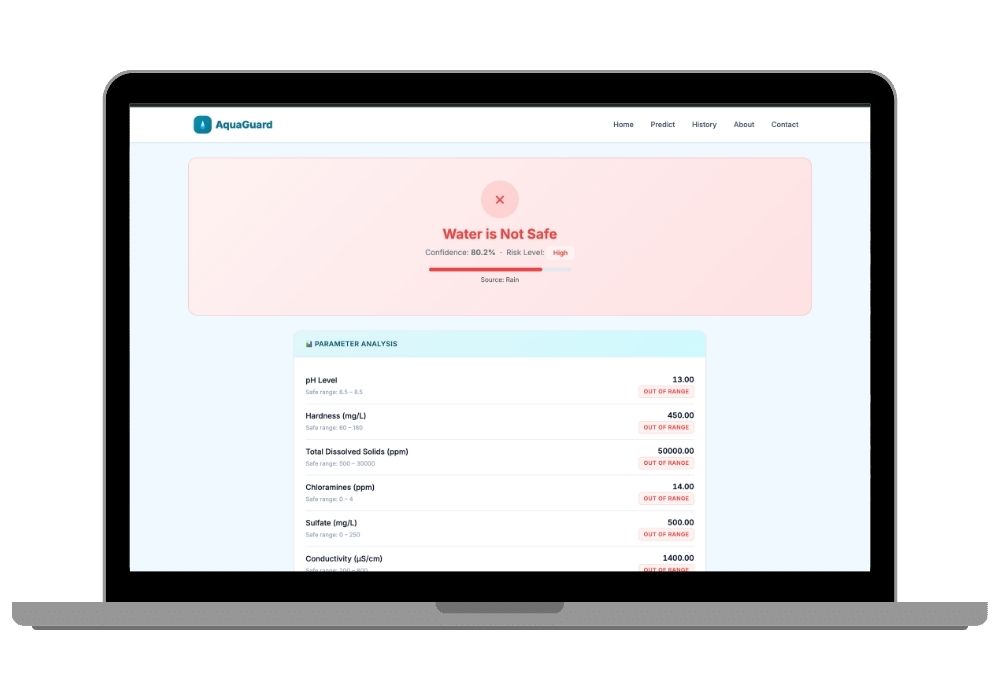
AquaGuard — AI Water Quality Prediction Final Year Project (Flask + ML)
A Flask and scikit-learn final year project that predicts drinking water potability from 9 physicochemical parameters with WHO safety flags and risk scoring.
Technology Used
Python | Flask | scikit-learn | Bootstrap 5 | SQLAlchemy | pandas | NumPy | joblib

AquaGuard is a full-stack water quality prediction system built for students who want a final year project that actually solves a real public health problem instead of another to-do list clone. It takes nine physicochemical readings from a water sample and runs them through a trained Random Forest classifier to tell you, in seconds, whether that water is safe to drink or not. Every prediction comes back with a confidence percentage, a risk level, and color-coded flags showing which parameters fall outside WHO-recommended safe ranges.
Project Features
The core of AquaGuard is its Random Forest model, trained on over 3,000 water samples and served through a clean Flask backend. Parameters like pH, hardness, chloramines, sulfate, conductivity, organic carbon, trihalomethanes, and turbidity are validated on both the client and server side before being passed to the model, so the prediction pipeline never breaks on bad input. Students get a REST API endpoint for external integrations, a searchable and filterable prediction history page, tooltips explaining each parameter in plain language, and a responsive aqua-themed UI that looks presentable in a viva without extra styling work.
Applications
Beyond the academic submission, this kind of system maps directly onto real use cases — municipal water testing dashboards, rural water source monitoring for NGOs, IoT sensor integration for continuous river or borewell monitoring, and lab pre-screening tools that flag samples needing deeper chemical analysis. That real-world relevance is exactly what examiners look for when scoring a project's practical value.
Who It's For
AquaGuard suits BTech CSE, BCA, and MCA students building a final year project around machine learning and Flask who want something with a genuine environmental or public health angle rather than a generic prediction app. It also works well for students who prefer a lighter, faster-to-explain stack compared to a full Django setup — if you'd rather work in Django instead, the Django project collection has similar prediction-style builds. Anyone targeting an AI/ML category final year project with a working, demoable model will find this a strong pick.
Why Choose This Project
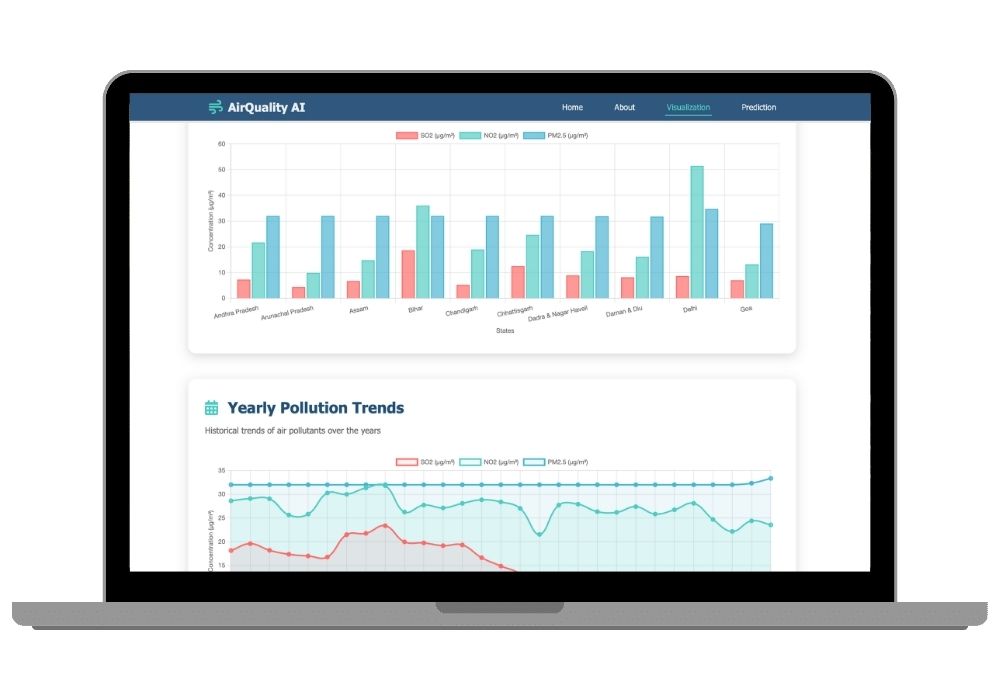
Water potability prediction is a well-documented dataset problem, which means you get a project that's technically solid and easy to defend in a viva, while still being uncommon enough that it doesn't feel copy-pasted from every other student's laptop. The codebase is organized cleanly into an app factory pattern, dedicated ML prediction module, and SQLAlchemy models, so extending it — say, adding PostgreSQL support or a mobile companion app — is straightforward. If you want a similar environment-focused build with a different dataset, the air quality prediction project uses a comparable Flask and scikit-learn architecture and pairs well as a reference for report writing.
Frequently Asked Questions
Extra Add-Ons Available – Elevate Your Project
Add any of these professional upgrades to save time and impress your evaluators.
Live 1-on-1 Mentorship
Personal session with an expert developer
Project Setup
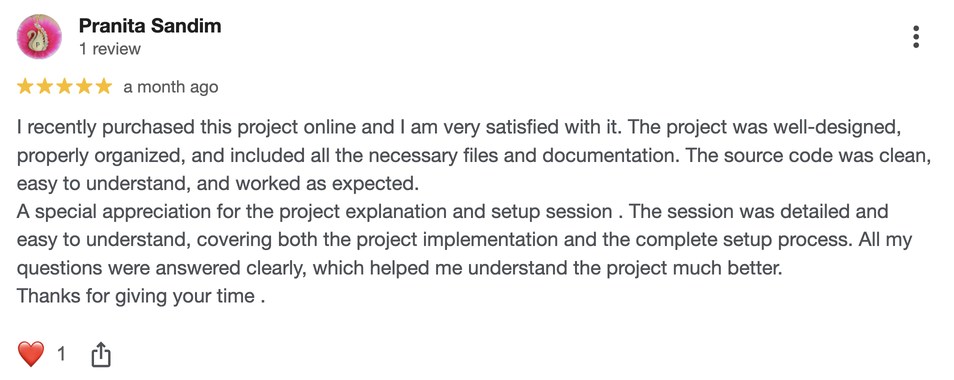
We'll install and configure the project on your PC via remote session (Google Meet, Zoom, or AnyDesk).
Source Code Explanation
1-hour live session to explain logic, flow, database design, and key features.
Want to know exactly how the setup works? Review our detailed step-by-step process before scheduling your session.
₹999
Custom Documents (College-Tailored)
- Custom Project Report: ₹1,500
- Custom Research Paper: ₹1,000
- Custom PPT: ₹800
Fully customized to match your college format, guidelines, and submission standards.
Project Modification
Need feature changes, UI updates, or new features added?
Charges vary based on complexity.
We'll review your request and provide a clear quote before starting work.