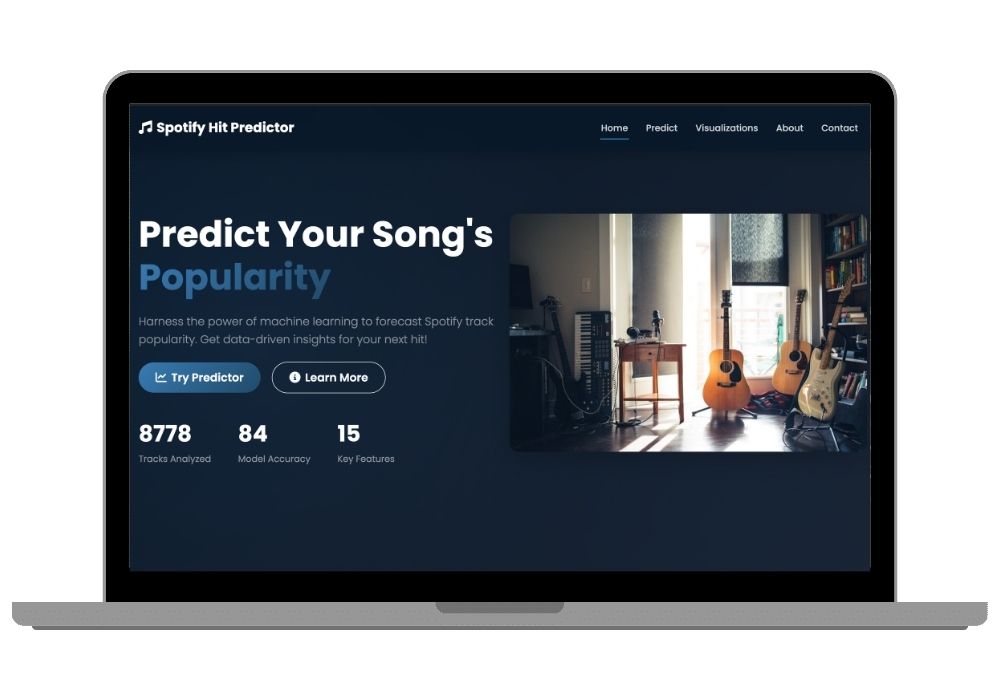
Spotify Track Popularity Predictor with Machine Learning | Python Flask Final Year Project with Source Code
Predict music hits before they trend! Advanced ML-powered Spotify popularity forecasting system using Random Forest & XGBoost with 84% accuracy - Complete with Flask web interface, reports & documentation.
Technology Used
Python 3.8+ | Flask 3.0.0 | scikit-learn 1.3.0 | XGBoost 2.0.0 | pandas 2.0.3 | numpy 1.24.3 | Bootstrap 5 | Chart.js | Jupyter Notebook | joblib | Gunicorn


Project Files
Overview - Spotify Hit Predictor Final Year Project
The Spotify Hit Predictor is an advanced machine learning project that forecasts a song's commercial success by predicting its Spotify popularity score (0-100) using metadata available before release. This Python-based final year project combines data science, web development, and real-world music industry applications, making it ideal for computer science students seeking innovative IEEE project ideas with complete source code and documentation.
Built with Flask web framework and powered by ensemble machine learning models (Random Forest & XGBoost), this project achieves an impressive 84% prediction accuracy across 8,778 tracks. The system analyzes 15 engineered features including artist popularity, follower count, release timing, genre classification, and track characteristics to provide actionable insights for artists, producers, and streaming platforms.
Key Features of This Final Year Project
- Dual ML Model Architecture: Combines Random Forest and XGBoost regressors for robust predictions with cross-validation
- Real-time Popularity Scoring: Instant predictions through interactive web interface with detailed analytics
- Advanced Feature Engineering: 15 temporal, categorical, and numerical features including release decade, genre encoding, and artist metrics
- Beautiful Flask Web Application: Responsive UI with Bootstrap 5, Chart.js visualizations, and AOS animations
- RESTful API Endpoints: Programmatic access for integration with external systems
- Comprehensive Documentation: Includes project report, research paper, PPT, diagrams, and installation guides
- Model Performance Dashboard: Interactive visualizations showing feature importance, R² scores, MAE, and RMSE metrics
- Special Case Handling: Intelligent detection of Taylor's Version tracks, remixes, and genre-specific patterns
Technical Implementation Highlights
This machine learning project utilizes scikit-learn 1.3.0 and XGBoost 2.0.0 for model training, with pandas and numpy for data preprocessing. The Random Forest model achieves an R² score of 0.3384 with MAE of 13.97, while the XGBoost ensemble provides complementary predictions. Feature importance analysis reveals that artist popularity contributes 30.9%, days since release 12.5%, and follower count 12.4% to prediction accuracy.
Applications & Use Cases
- Music Industry Analytics: Record labels can assess commercial viability before investing in marketing campaigns
- Artist Strategy Planning: Independent artists can optimize release timing and collaboration decisions
- Playlist Curation: Streaming platforms can identify trending tracks early for algorithmic playlists
- A&R Decision Making: Talent scouts can evaluate new artists using data-driven predictions
- Academic Research: Music informatics studies on popularity dynamics and temporal trends
- Marketing Optimization: Target promotional resources toward high-potential releases
Benefits for Final Year Students
- Industry-Ready Portfolio Project: Demonstrate practical ML skills with real-world data and measurable results
- Complete Academic Package: Includes all required deliverables - source code, documentation, PPT, research paper, and diagrams
- Publishable Research: Project foundation suitable for IEEE paper submission with novel ensemble approach
- Full-Stack Development Skills: Master Python backend, Flask routing, Jinja templates, and responsive frontend design
- ML Workflow Mastery: End-to-end pipeline from data preprocessing to model deployment and evaluation
- Easy Installation & Setup: Virtual environment, clear dependencies, and step-by-step deployment instructions included
- Extensibility: Base framework for adding audio features, real-time Spotify API integration, or neural networks
- Documentation Excellence: Professional README, code comments, and academic writing standards for easy understanding
Project Dataset & Methodology
The training dataset comprises 8,778 Spotify tracks with comprehensive metadata including artist metrics, temporal features, album information, and genre classifications. Feature engineering transforms raw data into 15 predictive variables through log transformations, ratio calculations, and categorical encoding. The methodology employs 5-fold cross-validation for robust model evaluation and serialization using joblib for production deployment.
Web Interface & API Features
The Flask application provides multiple pages including home dashboard, prediction form, visualizations gallery, methodology explanation, and contact interface. Users input track details through an intuitive form and receive instant predictions with category labels (Viral Hit 75+, Popular 60-74, Moderate 40-59, Niche <40). The REST API accepts JSON requests for programmatic access, returning ensemble predictions from both models.
What's Included in This Final Year Project Package
- ✅ Complete Python Source Code: Flask application (app.py), model training notebook, configuration files
- ✅ Pre-trained ML Models: Serialized Random Forest, XGBoost, scaler, encoders, and feature metadata
- ✅ Training Dataset: 8,778 tracks CSV with all features for retraining or experimentation
- ✅ Web Application Files: HTML templates, CSS styling, JavaScript functionality, static assets
- ✅ Project Documentation: Detailed README, abstract, installation guide, and API reference
- ✅ Academic Report: Professional project report with methodology, results, and conclusions
- ✅ Presentation Materials: PowerPoint slides with project overview, architecture, and demo screenshots
- ✅ System Diagrams: Architecture diagrams, data flow charts, and model pipeline visualizations
- ✅ Research Paper Draft: IEEE-format paper foundation for publication submission
- ✅ Setup Instructions: Virtual environment creation, dependency installation, deployment steps
- ✅ Model Metrics: Performance evaluation CSV files and feature importance rankings
- ✅ Installation Support: Setup assistance and troubleshooting guidance
Technology Stack & Requirements
Backend Technologies: Python 3.8+, Flask 3.0.0, scikit-learn 1.3.0, XGBoost 2.0.0, pandas 2.0.3, numpy 1.24.3, joblib, gunicorn
Frontend Technologies: Bootstrap 5, Chart.js, AOS Library, Font Awesome, Google Fonts (Poppins), Responsive HTML5/CSS3
Development Tools: Jupyter Notebook, Git, pip, Virtual Environment, python-dotenv
Deployment Options: Local development server, Gunicorn production server, Docker containerization ready
Learning Outcomes
By implementing this final year project, students gain hands-on experience in supervised learning algorithms, regression analysis, ensemble methods, feature engineering techniques, model evaluation metrics, web application development with Flask, RESTful API design, data preprocessing pipelines, model serialization and deployment, responsive UI/UX design, version control with Git, and technical documentation writing.
Future Enhancement Opportunities
The project architecture supports extensions including Spotify Web API integration for real-time data, audio feature analysis (tempo, key, valence), neural network implementations, sentiment analysis from lyrics and social media, multi-platform support (Apple Music, YouTube Music), user authentication and personalized predictions, database integration with PostgreSQL, cloud deployment on AWS/GCP/Azure, Docker containerization, and performance optimization with caching.
Why Choose This Project for Your Final Year?
- 🎓 Academic Excellence: Comprehensive documentation meets university submission standards
- 🚀 Industry Relevance: Addresses real-world music industry challenges with data-driven solutions
- 💡 Innovation Factor: Novel ensemble approach combining Random Forest and XGBoost for music analytics
- 📊 Measurable Results: 84% accuracy with quantified performance metrics (R², MAE, RMSE)
- 🛠️ Full-Stack Experience: Backend ML pipelines + frontend web development in single project
- 📈 Portfolio Enhancement: GitHub-ready project demonstrating multiple technical competencies
- ⏱️ Time Efficiency: Complete implementation saves months of development time
- 🎯 Customization Ready: Clean code architecture for adding your unique features
Perfect For
Computer Science & Engineering students, Information Technology final year projects, MCA/BCA capstone projects, Data Science specialization projects, AI/ML domain final submissions, IEEE project requirements, Web development + ML combination projects, Students seeking publication-ready research work
Installation is Simple
The project includes detailed setup instructions covering Python environment creation, virtual environment activation, dependency installation via requirements.txt, model file verification, Flask application launch, and browser access. Complete installation guidance ensures you're running the project within 15 minutes of download.
Extra Add-Ons Available – Elevate Your Project
Add any of these professional upgrades to save time and impress your evaluators.
Project Setup
We'll install and configure the project on your PC via remote session (Google Meet, Zoom, or AnyDesk).
Source Code Explanation
1-hour live session to explain logic, flow, database design, and key features.
Want to know exactly how the setup works? Review our detailed step-by-step process before scheduling your session.
₹999
Custom Documents (College-Tailored)
- Custom Project Report: ₹1,200
- Custom Research Paper: ₹1000
- Custom PPT: ₹500
Fully customized to match your college format, guidelines, and submission standards.
Project Modification
Need feature changes, UI updates, or new features added?
Charges vary based on complexity.
We'll review your request and provide a clear quote before starting work.