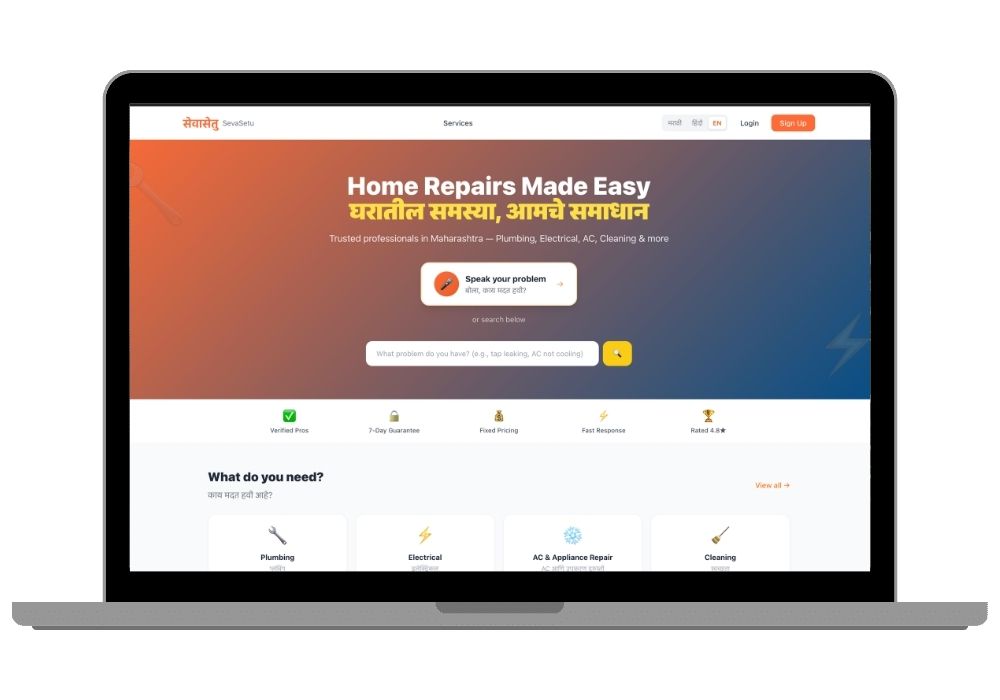
SevaSetu -- AI-Powered Home Services Platform with Voice Booking, Real-Time Chat and Razorpay Payments | Django Final Year Project
SevaSetu is a Django-based full-stack home services marketplace connecting users with verified professionals, featuring AI voice booking (Groq LLaMA), real-time chat, Razorpay payments, and PDF invoicing.
Technology Used
Django 5.x | Python 3.10+ | Django Channels 4.x | Redis | Celery | Tailwind CSS | JavaScript | Groq API | LLaMA 4 Scout | Razorpay API | WeasyPrint | WhiteNoise | SQLite | PostgreSQL | WebSocket | Gmail SMTP

Project Files
SevaSetu -- A Complete Home Services Platform Built with Django
SevaSetu is a production-grade home services web application developed using Python Django. It connects homeowners with verified local service professionals across multiple cities and districts. Unlike basic CRUD projects that most students submit, SevaSetu covers an entire business workflow from service request to payment collection and invoice generation. If you are a final year student looking for a project with real depth and practical value, this one checks every box your evaluators care about.
What Makes SevaSetu Different from Other Final Year Projects
Most home service projects out there are just a form and a database table. SevaSetu goes far beyond that. It handles 11 distinct booking stages, from the initial request all the way through vendor assignment, live tracking, work completion, customer confirmation, and invoice generation. There is a dispute resolution system, a vendor wallet that auto-credits 80 percent of earnings, subscription plans for recurring services, and a 7-day service guarantee with complaint tracking. This is the kind of project that shows evaluators you understand how real software works.
AI Voice Booking with Groq LLaMA (SevaSathi)
The standout feature is SevaSathi, an AI-powered voice assistant. Users speak their problem in Marathi, Hindi, or English, and the system uses Groq API with LLaMA 4 Scout to parse the intent, identify the right service category, and start the booking process without any typing. For students interested in AI and machine learning projects, this is a practical demonstration of natural language processing applied to a real use case.
Real-Time Chat Between Customers and Vendors
Once a vendor is assigned to a booking, a WebSocket-based chat channel opens automatically using Django Channels and Redis. Customers and vendors can communicate directly within the platform. This is not a basic polling system. It uses persistent WebSocket connections at ws/chat/<booking_id>/ for actual real-time messaging.
Razorpay Payment Integration
SevaSetu includes full Razorpay checkout integration with server-side HMAC signature verification. The booking is created first, then payment is collected through a modal. This is production-level payment handling that you can actually demonstrate during your project viva.
Trilingual Support -- Marathi, Hindi, English
Every page, every notification, and every service listing supports three languages. Users select their preferred language during registration. The project uses Django's built-in i18n framework with locale files for Marathi (mr), Hindi (hi), and English (en). For students working on projects that need to demonstrate localization and accessibility, this is ready out of the box.
Auto-Generated PDF Invoices
When a customer confirms that the work is done, the system generates a PDF invoice automatically using WeasyPrint. Invoices are stored in the media directory and can be downloaded from the dashboard. This feature alone adds a layer of professionalism that most student projects miss entirely.
Complete Service Catalogue
SevaSetu ships with 7 service categories and 29 specific service problems. Plumbing covers tap leaks, drain blockages, geyser issues, flush repairs, new tap installation, and pipe leaks. Electrical services handle fans, switches, short circuits, light fittings, and MCB tripping. AC and appliance services deal with cooling issues, water leaks, washing machines, fridges, and microwaves. The catalogue also includes cleaning, painting, carpentry, and pest control services. Each service has estimated pricing and spare part cost tracking.
Maharashtra Location Hierarchy
The project comes pre-seeded with real geographic data: 10 districts, 31 cities, and 98 areas across Maharashtra. The location system follows a District to City to Area hierarchy with cascading dropdown menus. Cities covered include Pune, Mumbai, Thane, Nashik, Nagpur, Aurangabad, Solapur, Kolhapur, Navi Mumbai, Pimpri-Chinchwad, and more.
Subscription Plans and Smart Reminders
Five subscription plans come pre-loaded: Monthly AC Maintenance, Weekly Home Cleaning, Monthly Pest Control, Quarterly Plumbing Check, and Annual Home Care. The system tracks visits per subscription. On top of that, Celery-powered async tasks send seasonal maintenance reminders. AC service reminders go out before summer, pest control reminders before monsoon season. This kind of contextual automation is exactly what makes a project stand out during evaluation.
Vendor Management and Wallet System
Vendors go through a verification process before they can accept bookings. Each vendor has a wallet, and 80 percent of every completed booking is automatically credited. The vendor dashboard shows earnings, booking history, and active assignments. Customers can also request the same vendor they had before for repeat service in the same category.
Booking Lifecycle with 11 Stages
The booking flows through these stages: Requested, Vendor Assigned, Vendor Accepted, Vendor En Route, In Progress, Work Completed, Customer Confirmed, Invoice Generated, and Closed. Bookings can also be Cancelled or Disputed at specific points. Each stage transition is tracked with timestamps and status updates visible on both customer and vendor dashboards.
Technology Stack
The backend runs on Django 5.x with Python 3.10 or higher. Real-time features use Django Channels 4.x with Redis. Background tasks run on Celery with Redis as the broker. The frontend uses Tailwind CSS via CDN with vanilla JavaScript. Payments go through Razorpay in test mode. PDF generation uses WeasyPrint. Email notifications use Gmail SMTP. Static files are served through WhiteNoise. The database is SQLite for development and PostgreSQL for production.
Who Should Use This Project
SevaSetu is built for final year students in BCA, MCA, BTech Computer Science, and BSc IT programs. It covers enough ground to work as a project for web development, artificial intelligence, full-stack development, or software engineering courses. The codebase is clean, well-structured, and follows Django best practices. It also works well as a portfolio project for job interviews.
What You Get
You receive the complete source code with 35+ HTML templates, all static assets, seed data commands, and an installation guide that walks you through every step. The project includes demo accounts for testing: 5 customer accounts, 10 vendor accounts, 20 sample bookings, and an admin panel. Need additional support? CodeAj offers project setup sessions, full mentorship until submission, custom report writing, research paper guidance, and presentation coaching.
Applications
Beyond academics, this codebase can be adapted for any on-demand service marketplace. Home maintenance platforms, urban service aggregators, freelance worker management systems, or hyperlocal service apps can all be built on this foundation. The modular structure with separate Django apps for accounts, bookings, chat, invoices, notifications, and subscriptions makes it straightforward to extend or modify for different use cases.
Extra Add-Ons Available – Elevate Your Project
Add any of these professional upgrades to save time and impress your evaluators.
Project Setup
We'll install and configure the project on your PC via remote session (Google Meet, Zoom, or AnyDesk).
Source Code Explanation
1-hour live session to explain logic, flow, database design, and key features.
Want to know exactly how the setup works? Review our detailed step-by-step process before scheduling your session.
₹999
Custom Documents (College-Tailored)
- Custom Project Report: ₹1,200
- Custom Research Paper: ₹1000
- Custom PPT: ₹500
Fully customized to match your college format, guidelines, and submission standards.
Project Modification
Need feature changes, UI updates, or new features added?
Charges vary based on complexity.
We'll review your request and provide a clear quote before starting work.