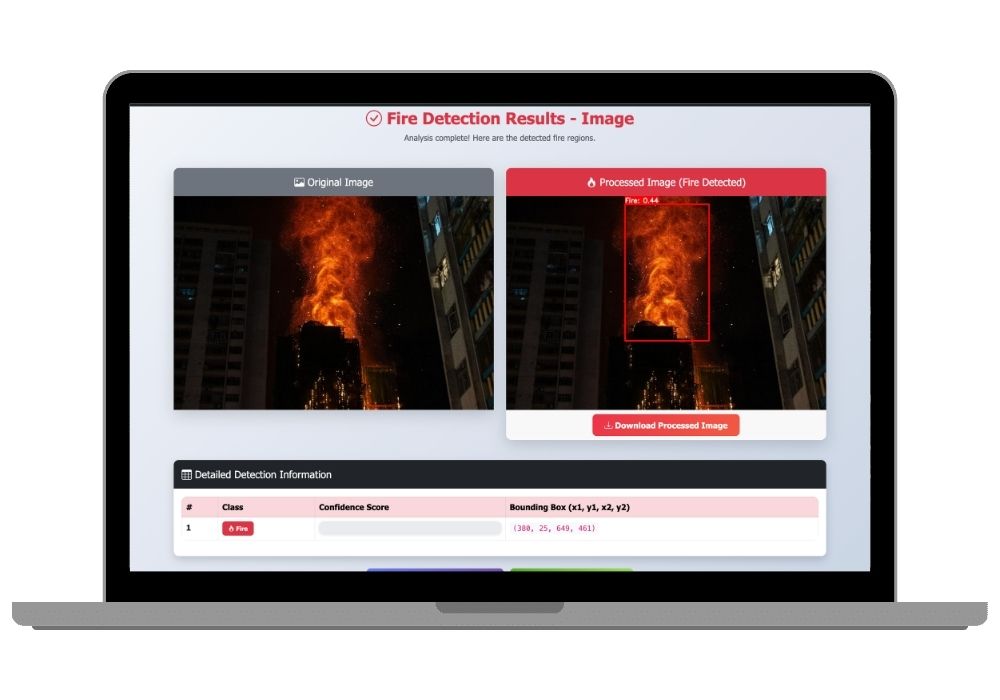
Real-Time Fire Detection System with YOLOv8 and Django Web Interface
Advanced AI-powered fire detection system using YOLOv8 deep learning for real-time fire identification in images and videos with Django web framework, perfect for smart safety applications and industrial monitoring systems.
Technology Used
Django | Python | YOLOv8 | Ultralytics | OpenCV | PyTorch | NumPy | Pillow | Bootstrap 5 | HTML5 | CSS3 | JavaScript | SQLite


Project Files
Project Overview
The Real-Time Fire Detection System represents a cutting-edge solution in the domain of computer vision and artificial intelligence, specifically designed to address critical fire safety challenges. Built on the powerful YOLOv8 architecture, this comprehensive web application provides instant fire detection capabilities across both static images and dynamic video content. The system combines state-of-the-art deep learning models with an intuitive Django-powered web interface, making advanced fire detection technology accessible to users without requiring technical expertise.
This project stands out as an ideal final year engineering solution, demonstrating practical implementation of multiple advanced technologies including object detection, web development, computer vision processing, and real-time inference systems. The application processes uploaded media files through a trained neural network that has learned to identify fire patterns with high accuracy, drawing precise bounding boxes around detected fire regions while providing confidence scores for each detection.
Comprehensive Project Features
Core Detection Capabilities
Multi-Format Image Detection: The system accepts various image formats including JPG, JPEG, and PNG files, processing them through the YOLOv8 neural network to identify fire regions with precision. Each detection includes detailed metadata such as bounding box coordinates, confidence percentages, and classification labels, enabling users to understand exactly where and with what certainty fire has been detected.
Advanced Video Processing: Video fire detection capability sets this system apart from basic image classifiers. The application processes video files frame by frame, supporting popular formats like MP4, AVI, and MOV. The intelligent video processor analyzes each frame independently, tracks fire occurrences across the timeline, and generates comprehensive statistics including total frames analyzed, frames containing fire, average confidence scores, and maximum detection confidence throughout the video.
Real-Time Visualization Engine: Every detection result features professional-grade visualization with color-coded bounding boxes overlaid on the original media. The system draws precise rectangular annotations around detected fire regions, accompanied by confidence labels that help users quickly assess the reliability of each detection. The visual feedback is generated using OpenCV rendering techniques, ensuring smooth integration with the original media quality.
Technical Architecture Features
YOLOv8 Deep Learning Integration: At the heart of the system lies the YOLOv8 object detection model, specifically trained or fine-tuned for fire detection scenarios. YOLO architecture enables single-pass detection, meaning the entire image is processed in one forward pass through the neural network, resulting in significantly faster inference times compared to region-based detection methods. The model has been optimized to recognize fire characteristics including flame patterns, smoke, color signatures, and thermal properties.
Django Web Framework Backend: The application leverages Django's robust MVC architecture to handle HTTP requests, file uploads, user sessions, and response rendering. The backend implements secure file handling mechanisms, validates uploaded content, generates unique filenames to prevent collisions, manages media storage directories, and coordinates the detection pipeline from upload through processing to result delivery.
OpenCV Computer Vision Processing: OpenCV powers the image and video manipulation capabilities, including reading various media formats, extracting individual video frames, drawing annotation overlays, encoding processed videos with appropriate codecs, and managing color space conversions. The library ensures compatibility across different input formats while maintaining processing efficiency.
Responsive User Interface: Built with Bootstrap 5 framework, the interface provides a modern, clean, and fully responsive design that adapts seamlessly across desktop, tablet, and mobile devices. The UI includes intuitive upload forms, real-time preview capabilities, progress indicators during processing, comprehensive result display panels, and download options for processed media.
Intelligent Processing Features
Confidence Threshold Filtering: The system implements configurable confidence thresholds to filter out false positives and uncertain detections. Only detections exceeding the confidence threshold are displayed, ensuring that users receive high-quality, reliable fire alerts rather than being overwhelmed with questionable detections.
Statistical Analysis Dashboard: For video processing results, the system generates detailed statistical summaries including total frame count, number of frames containing fire detections, detection density percentages, average confidence scores across all detections, maximum confidence encountered, and temporal distribution of fire occurrences throughout the video timeline.
Batch Frame Processing: The video detection pipeline efficiently processes large video files by implementing optimized frame extraction and inference batching. This approach balances processing speed with system resource utilization, allowing for practical processing of lengthy surveillance footage or monitoring recordings.
File Management System: Automated file handling includes secure upload validation checking file types and sizes, unique filename generation using UUID or timestamp mechanisms, organized storage in separate directories for uploads and processed outputs, and automatic cleanup options to manage storage space efficiently.
Real-World Applications
Smart Building Safety Systems: Integration into building management systems enables continuous monitoring of commercial spaces, residential complexes, industrial facilities, and public venues. The system can process feeds from existing CCTV infrastructure to provide early fire warnings, potentially saving lives and property by detecting fires in their initial stages before smoke detectors activate.
Forest Fire Monitoring Networks: Environmental agencies and forestry departments can deploy this technology for analyzing satellite imagery, drone surveillance footage, or fixed camera installations positioned across forest areas. Early detection of forest fires enables rapid response deployment, helping prevent the devastating spread of wildfires that threaten ecosystems and communities.
Industrial Facility Protection: Manufacturing plants, chemical facilities, oil refineries, and warehouses storing flammable materials face constant fire risks. This system provides continuous automated monitoring, supplementing human oversight with tireless AI surveillance that never misses a shift, gets distracted, or suffers from fatigue-related oversights.
Transportation Infrastructure Safety: Tunnels, bridges, parking structures, and transportation hubs can utilize this technology for enhanced safety monitoring. The system can analyze footage from existing security cameras, providing an additional layer of fire detection that complements traditional sensor-based systems.
Agricultural and Rural Monitoring: Farm buildings, grain storage facilities, and rural properties often lack sophisticated fire detection infrastructure. This affordable, software-based solution can be deployed with basic camera equipment to provide advanced fire detection capabilities in underserved areas.
Event and Crowd Management: Large gatherings, concerts, festivals, and sporting events can benefit from real-time fire detection across venues. The system processes video feeds to identify fire hazards quickly, enabling security teams to respond before incidents escalate in crowded environments where panic can be as dangerous as fire itself.
Technical Advantages
Single-Stage Detection Architecture: Unlike two-stage detectors that first propose regions and then classify them, YOLO processes the entire image in one pass, dramatically reducing inference time while maintaining high accuracy. This efficiency makes real-time or near-real-time processing feasible even on modest hardware.
Transfer Learning Capability: The YOLOv8 model can be fine-tuned on custom fire datasets, allowing adaptation to specific environmental conditions, camera angles, or fire types. This flexibility ensures the system can be optimized for particular deployment scenarios, whether detecting industrial fires, forest fires, or residential fires.
Scalable Web Architecture: The Django framework provides a solid foundation for scaling the application. The modular architecture allows easy addition of features like user authentication, detection history databases, API endpoints for mobile applications, webhook notifications for alert systems, and integration with third-party services.
Cross-Platform Compatibility: As a web-based solution, the system runs in any modern browser across Windows, macOS, Linux, and mobile operating systems. No specialized client software installation is required, making deployment and adoption straightforward for organizations of any size.
Project Architecture and Components
The system follows a clean three-tier architecture separating presentation, business logic, and data layers. The presentation layer consists of Bootstrap-powered HTML templates with custom CSS styling and JavaScript interactivity. The business logic layer implements Django views handling request routing, form validation, and response generation, along with custom utility modules managing YOLO model loading, inference execution, and result processing. The data layer manages file storage, media handling, and future database integration for detection history.
The detection pipeline follows a clear workflow: file upload reception, validation and secure storage, model inference invocation, result processing and annotation, statistical analysis, and finally result rendering with download capabilities. This modular approach ensures maintainability, testability, and extensibility for future enhancements.
Educational Value for Final Year Projects
This project provides comprehensive learning across multiple domains crucial for modern software engineering. Students gain hands-on experience with deep learning model deployment, understanding not just theory but practical implementation challenges. Web development skills are honed through full-stack development, from frontend design to backend API creation. Computer vision expertise develops through working with OpenCV, understanding image processing pipelines, and video handling techniques.
The project demonstrates integration of multiple complex technologies, teaching system design, API interaction, error handling, and performance optimization. Documentation skills improve through creating comprehensive README files, code comments, and user guides. Presentation abilities are enhanced when explaining the technical architecture, model selection rationale, and real-world applications during project demonstrations and viva examinations.
Deployment and Customization
The system can be deployed on various platforms including local development servers for testing and demonstration, cloud platforms like AWS, Google Cloud, or Azure for production use, containerized environments using Docker for consistent deployments, and platform-as-a-service solutions like Heroku or PythonAnywhere for simplified hosting. Each deployment option offers different tradeoffs between ease of setup, scalability, and cost.
Customization possibilities include adjusting confidence thresholds for different sensitivity requirements, training custom models on specialized fire datasets, adding new detection classes beyond fire, integrating alert notification systems, implementing user authentication and history tracking, creating REST APIs for programmatic access, and developing mobile applications for remote monitoring.
Performance Characteristics
Detection accuracy depends on model training quality and typically ranges from 85% to 95% for well-trained models on appropriate datasets. Inference speed varies with hardware, averaging 30-50ms per image on modern CPUs and 10-20ms on CUDA-enabled GPUs. Video processing time is proportional to video length and frame rate, with a 1-minute video at 30fps taking approximately 2-5 minutes to process on standard hardware. Memory requirements are modest, with the base system using 500MB-1GB RAM, plus additional memory scaling with input file sizes.
Complete Project Package
When you purchase this project from CodeAj Marketplace, you receive a comprehensive package including complete source code with detailed comments, pre-trained fire detection model, installation and setup documentation, user guide and operation manual, architectural documentation explaining design decisions, video demonstration of the working system, and dedicated support for setup assistance. Optional add-on services include custom project reports tailored to your institution requirements, research paper drafts for publication or project documentation, PowerPoint presentations for project defense, custom feature implementation based on specific needs, and one-on-one source code explanation sessions ensuring complete understanding of the implementation.
Why Choose This Project
This fire detection system represents an excellent choice for final year engineering projects because it combines trending AI technologies with practical real-world applications, demonstrates mastery of multiple technical domains, offers clear social impact and safety benefits, provides extensive customization and extension possibilities, includes comprehensive documentation suitable for academic evaluation, and showcases both theoretical understanding and practical implementation skills. The project has been successfully deployed and tested, ensuring you receive a working, demonstrable system rather than theoretical concepts requiring completion.
Expansion Possibilities
The modular architecture supports numerous enhancements including real-time camera feed processing for live monitoring, integration with IoT devices for automated fire suppression system activation, mobile applications for remote alert reception, multi-model ensemble systems combining different detection approaches, cloud-based distributed processing for handling multiple camera feeds simultaneously, historical analysis and reporting dashboards, machine learning pipeline for continuous model improvement, and integration with existing building management or security systems.
Extra Add-Ons Available – Elevate Your Project
Add any of these professional upgrades to save time and impress your evaluators.
Project Setup
We'll install and configure the project on your PC via remote session (Google Meet, Zoom, or AnyDesk).
Source Code Explanation
1-hour live session to explain logic, flow, database design, and key features.
Want to know exactly how the setup works? Review our detailed step-by-step process before scheduling your session.
₹999
Custom Documents (College-Tailored)
- Custom Project Report: ₹1,200
- Custom Research Paper: ₹1000
- Custom PPT: ₹500
Fully customized to match your college format, guidelines, and submission standards.
Project Modification
Need feature changes, UI updates, or new features added?
Charges vary based on complexity.
We'll review your request and provide a clear quote before starting work.