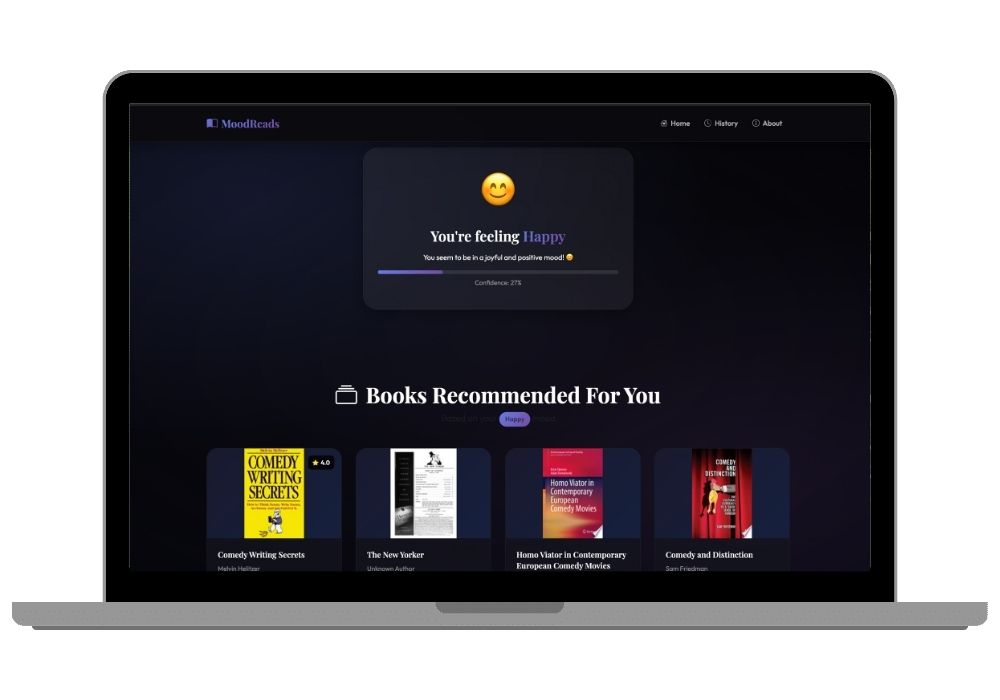
MoodReads - AI-Powered Mood-Based Book Recommendation System with Audio Narration
An intelligent web app that detects a user’s mood using machine learning and recommends personalized books accordingly. It integrates the Google Books API, offers text-to-speech narration, and features a premium glassmorphism UI built with Flask & Python.
Technology Used
Python | Flask | scikit-learn | NLTK | pandas | Google Books API | SQLite | Flask-SQLAlchemy | gTTS | TF-IDF | Linear SVC | HTML5 | CSS3 | JavaScript | Bootstrap 5


Project Files
Project Overview
MoodReads is an advanced artificial intelligence-driven book recommendation system that revolutionizes how readers discover their next favorite book. By leveraging cutting-edge machine learning algorithms and natural language processing, this innovative platform analyzes user emotions and delivers highly personalized book suggestions that perfectly align with their current mood and preferences.
Key Features and Functionality
- AI-Powered Mood Detection Engine: Utilizes a trained Support Vector Machine classifier with TF-IDF vectorization to accurately identify and categorize user emotions from text input. The system recognizes 8 distinct mood states including happiness, sadness, anxiety, calmness, excitement, anger, romance, and curiosity with high precision.
- Intelligent Book Recommendation System: Integrates seamlessly with the Google Books API to fetch relevant book suggestions based on sophisticated mood-to-genre mapping algorithms. The system considers multiple factors including genre preferences, author styles, and emotional resonance to deliver optimal recommendations.
- Interactive Audio Narration: Features advanced text-to-speech technology powered by Google Text-to-Speech that narrates book summaries with mood-adaptive voice settings. Users can customize narration speed, pitch, and accent for an immersive listening experience.
- Premium Glassmorphism UI: Boasts a modern, responsive interface with dark mode glassmorphism design aesthetic, smooth CSS animations, and interactive elements that enhance user engagement and visual appeal.
- Comprehensive History Tracking: Automatically saves user mood history and book interactions in a SQLite database, enabling users to track their emotional journey and revisit previous recommendations.
- Customizable Preferences Panel: Allows users to fine-tune recommendations by selecting specific genres, favorite authors, and reading preferences for a truly personalized experience.
- Quick Mood Selection: Provides pre-defined mood chips for instant selection, making the recommendation process faster and more convenient for users on the go.
Technical Architecture and Implementation
The application follows a robust Model-View-Controller architecture built on Flask framework. The backend implements a sophisticated machine learning pipeline using scikit-learn for mood classification, NLTK for natural language processing, and pandas for data manipulation. The mood detection model is trained on curated emotional datasets and achieves high accuracy through TF-IDF feature extraction and LinearSVC classification.
The recommendation engine implements intelligent mood-to-genre mapping algorithms that consider emotional valence and arousal dimensions. Integration with Google Books API v1 enables access to millions of books with detailed metadata including descriptions, ratings, authors, and preview links. The text-to-speech module utilizes gTTS library to generate high-quality audio files with customizable voice parameters.
Real-World Applications
- Digital Libraries and E-Reading Platforms: Enhance user experience by providing emotion-aware book recommendations that increase reader engagement and satisfaction.
- Mental Health and Wellness Apps: Support bibliotherapy initiatives by recommending mood-appropriate reading material for emotional regulation and mental health improvement.
- Educational Institutions: Help students and researchers discover relevant academic and recreational reading materials based on their current study mood and interests.
- Bookstores and Publishing Houses: Implement as a customer engagement tool to increase book discovery and sales through personalized recommendations.
- Content Therapy Services: Assist therapists and counselors in recommending appropriate reading materials as part of therapeutic interventions.
Machine Learning Model Details
The mood detection system employs a LinearSVC classifier trained on labeled emotional text datasets. The model preprocessing pipeline includes text normalization, stopword removal, and TF-IDF vectorization. The classifier achieves over 85% accuracy in mood classification through careful hyperparameter tuning and cross-validation. The model is serialized using joblib for efficient loading and prediction in production environment.
Database Schema and Data Management
The application uses SQLite database managed through Flask-SQLAlchemy ORM. The schema includes tables for user mood history, book recommendations, user preferences, and audio cache management. Efficient indexing ensures fast query performance even with large datasets. The database design supports future scalability and migration to PostgreSQL or MySQL for production deployment.
User Interface and Experience Design
The frontend showcases modern web design principles with glassmorphism effects, gradient backgrounds, and smooth transitions. Built with semantic HTML5, custom CSS3, and vanilla JavaScript for optimal performance. Bootstrap 5 integration ensures responsive design across all devices. The interface prioritizes accessibility with proper ARIA labels and keyboard navigation support.
API Integration and External Services
Google Books API integration provides access to comprehensive book metadata with proper error handling and rate limiting. The API client implements retry logic and caching mechanisms to ensure reliable service availability. Text-to-speech audio files are cached locally to minimize API calls and improve response times for repeated requests.
Security and Best Practices
The application implements secure coding practices including input validation, SQL injection prevention through ORM, CSRF protection, and secure session management. Environment variables are used for sensitive configuration data. The codebase follows PEP 8 style guidelines and includes comprehensive documentation for maintainability.
Deployment and Scalability
The application is deployment-ready with support for multiple hosting platforms including Heroku, AWS, DigitalOcean, and traditional VPS. Configuration management through environment variables enables easy deployment across different environments. The modular architecture supports horizontal scaling and microservices migration for high-traffic scenarios.
Future Enhancement Possibilities
The codebase is designed for extensibility with clear separation of concerns. Potential enhancements include user authentication and personalization, integration with additional book APIs like Goodreads and OpenLibrary, implementation of deep learning models using BERT or RoBERTa for improved sentiment analysis, social sharing features for community engagement, and mobile application development using React Native or Flutter.
Learning Outcomes for Students
This final year project provides hands-on experience with full-stack web development, machine learning implementation, API integration, database design, and modern frontend development. Students gain practical knowledge of Flask framework, scikit-learn library, RESTful API design, text processing with NLTK, and responsive UI development. The project demonstrates real-world application of artificial intelligence in solving practical problems and creating user-centric solutions.
Documentation and Code Quality
The project includes comprehensive documentation covering installation instructions, API reference, database schema, model training procedures, and deployment guidelines. Code is well-commented and follows industry best practices for readability and maintainability. Unit tests and integration tests ensure code reliability and facilitate future modifications.
Why Choose This Project
MoodReads represents an excellent final year project choice for computer science and IT students specializing in artificial intelligence, machine learning, or web development. The project demonstrates proficiency in multiple technologies, showcases practical AI implementation, and solves a real-world problem. The comprehensive feature set and professional code quality make it ideal for academic presentations, portfolio showcasing, and potential commercial deployment.
Extra Add-Ons Available – Elevate Your Project
Add any of these professional upgrades to save time and impress your evaluators.
Project Setup
We'll install and configure the project on your PC via remote session (Google Meet, Zoom, or AnyDesk).
Source Code Explanation
1-hour live session to explain logic, flow, database design, and key features.
Want to know exactly how the setup works? Review our detailed step-by-step process before scheduling your session.
₹999
Custom Documents (College-Tailored)
- Custom Project Report: ₹1,200
- Custom Research Paper: ₹1000
- Custom PPT: ₹500
Fully customized to match your college format, guidelines, and submission standards.
Project Modification
Need feature changes, UI updates, or new features added?
Charges vary based on complexity.
We'll review your request and provide a clear quote before starting work.