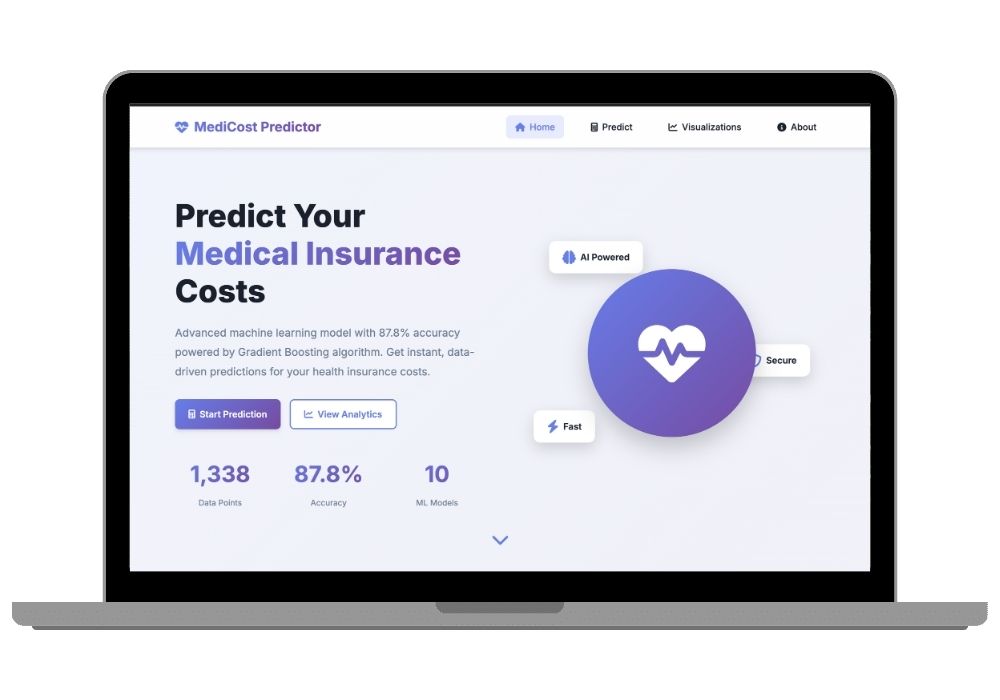
Medicost Predictor - AI-Powered Medical Insurance Cost Estimation System Using Machine Learning
Advanced machine learning web application that predicts medical insurance costs based on personal health factors using ensemble algorithms. Built with Flask and Scikit-learn, featuring real-time predictions, interactive data visualizations, and comprehens
Technology Used
Flask | Python | Scikit-Learn | XGBoost | Pandas | NumPy | Plotly.js | HTML5 | CSS3 | JavaScript | Gunicorn | Machine Learning


Project Files
Project Overview
Medicost Predictor is a sophisticated machine learning web application designed to estimate medical insurance costs with remarkable accuracy. This intelligent system analyzes individual health parameters including age, BMI, smoking status, number of children, gender, and region to provide instant cost predictions. Built on Flask framework and powered by ensemble machine learning algorithms, this project demonstrates the practical application of data science in healthcare financial planning.
Key Features and Functionality
- Multi-Model Ensemble Prediction: Implements Gradient Boosting, Random Forest, and XGBoost algorithms to achieve 87.80% prediction accuracy through intelligent model combination
- Real-Time Cost Analysis: Provides instant medical insurance cost estimates with comprehensive risk categorization into Low, Moderate, and High risk levels
- Interactive Data Visualization: Features dynamic charts and graphs using Plotly.js to display age vs charges correlation, BMI distribution patterns, regional cost variations, and smoking impact analysis
- Model Performance Dashboard: Includes comparison metrics for 10+ machine learning algorithms with R-squared scores, enabling transparent model evaluation
- Responsive Web Interface: Modern, mobile-friendly design ensuring seamless user experience across all devices with intuitive navigation and clean aesthetics
- Risk Assessment Engine: Intelligent categorization system that evaluates predicted costs against statistical thresholds to determine insurance risk levels
- Data-Driven Insights: Comprehensive analysis tools that help users understand the primary factors influencing their healthcare costs
- Scalable Architecture: Built with production-ready technologies including Gunicorn deployment support for enterprise-level applications
Technical Implementation
The system leverages advanced regression techniques trained on comprehensive medical insurance datasets containing demographic and health information. The backend utilizes Flask for routing and API management, while Scikit-learn and XGBoost handle the machine learning operations. Trained models are serialized using pickle for efficient loading and prediction. The frontend combines HTML5, CSS3, and JavaScript with Plotly.js for creating engaging, interactive visualizations that make complex data accessible to non-technical users.
Real-World Applications
- Insurance Premium Planning: Helps individuals estimate potential insurance costs before purchasing policies, enabling informed financial decisions
- Healthcare Budgeting: Assists families and individuals in planning annual healthcare expenses based on their health profiles
- Insurance Company Tools: Can be adapted by insurance providers for quick premium estimation and risk assessment during customer consultations
- Health Risk Awareness: Educates users about how lifestyle factors like smoking and BMI directly impact insurance costs, promoting healthier choices
- Financial Advisory Services: Useful for financial advisors helping clients plan comprehensive financial strategies including healthcare expenses
- Academic Research: Serves as a practical demonstration of machine learning applications in healthcare economics and predictive analytics
- Policy Comparison Platform: Can be integrated into larger platforms that compare insurance policies based on predicted personalized costs
Machine Learning Models Performance
The project implements and compares multiple regression algorithms to ensure optimal prediction accuracy. Gradient Boosting emerged as the top performer with an R-squared score of 0.8780, followed closely by Random Forest at 0.8643 and XGBoost at 0.8502. Additional models including K-Nearest Neighbors, AdaBoost, Decision Trees, Support Vector Regression, and Linear Regression provide comparative baselines. This multi-model approach ensures robust predictions across diverse health profiles.
Learning Outcomes for Students
- Master end-to-end machine learning project development from data preprocessing to model deployment
- Gain practical experience with ensemble learning techniques and model optimization strategies
- Understand web application development using Flask framework and RESTful API design principles
- Learn data visualization best practices using Plotly.js for creating interactive, user-friendly charts
- Develop skills in model evaluation, comparison, and selection based on performance metrics
- Experience real-world application of regression algorithms in healthcare and insurance domains
- Build expertise in handling CSV datasets, feature engineering, and data transformation techniques
- Understand deployment workflows including virtual environments, dependency management, and production server configuration
Project Modules and Components
- Data Processing Module: Handles dataset loading, preprocessing, feature encoding, and train-test splitting operations
- Model Training Module: Implements multiple regression algorithms, hyperparameter tuning, and model serialization functionality
- Prediction Engine: Core module that loads trained models and generates cost predictions with risk categorization
- Visualization Module: Creates interactive charts showing data distributions, correlations, and prediction insights
- Web Interface Module: Flask routes, form handling, template rendering, and user interaction management
- Configuration Module: Centralized settings management for model paths, application parameters, and deployment configurations
Dataset Information
The project utilizes a comprehensive medical insurance dataset containing over 1,300 records with features including age, sex, BMI, number of children, smoking status, region, and actual insurance charges. This real-world dataset provides diverse examples spanning multiple demographics and health profiles, ensuring the trained models can generalize well to new predictions. The dataset includes both categorical and numerical features, requiring appropriate encoding and scaling techniques.
Technologies and Libraries
Backend technologies include Python 3.8+ as the core programming language, Flask 3.0.0 for web framework, Scikit-learn 1.3.0 for machine learning algorithms, XGBoost for gradient boosting implementation, Pandas for data manipulation, NumPy for numerical operations, and Gunicorn for production deployment. Frontend technologies encompass HTML5 for structure, CSS3 for styling, JavaScript for interactivity, and Plotly.js for advanced data visualizations. The project follows modern software engineering practices with virtual environment isolation and requirements.txt dependency management.
Installation and Deployment
The project includes comprehensive setup instructions covering repository cloning, virtual environment creation, dependency installation, model training, and application launching. The modular architecture allows easy customization and extension. Detailed documentation guides users through each step, from initial setup to accessing the application on localhost. The included generate_models.py script automates the entire model training pipeline, making it simple for students to reproduce results and experiment with different algorithms or datasets.
Why Choose This Project
- Demonstrates complete machine learning workflow from data to deployment
- Addresses real-world healthcare and insurance industry challenges
- Combines multiple cutting-edge technologies in a cohesive application
- Includes professional-grade code with proper structure and documentation
- Features impressive visualizations that showcase technical and presentation skills
- Provides excellent foundation for project presentations, viva, and reports
- Can be easily extended with additional features like user authentication, database storage, or mobile app integration
- Highly relevant for computer science, data science, and information technology final year projects
Project Deliverables
Complete source code with all modules and dependencies, trained machine learning models in pickle format, comprehensive dataset for training and testing, detailed project report covering methodology and results, presentation slides for project demonstration, installation and setup guide, API documentation for prediction endpoints, and video tutorial explaining code structure and functionality.
Extra Add-Ons Available – Elevate Your Project
Add any of these professional upgrades to save time and impress your evaluators.
Project Setup
We'll install and configure the project on your PC via remote session (Google Meet, Zoom, or AnyDesk).
Source Code Explanation
1-hour live session to explain logic, flow, database design, and key features.
Want to know exactly how the setup works? Review our detailed step-by-step process before scheduling your session.
₹999
Custom Documents (College-Tailored)
- Custom Project Report: ₹1,200
- Custom Research Paper: ₹1000
- Custom PPT: ₹500
Fully customized to match your college format, guidelines, and submission standards.
Project Modification
Need feature changes, UI updates, or new features added?
Charges vary based on complexity.
We'll review your request and provide a clear quote before starting work.