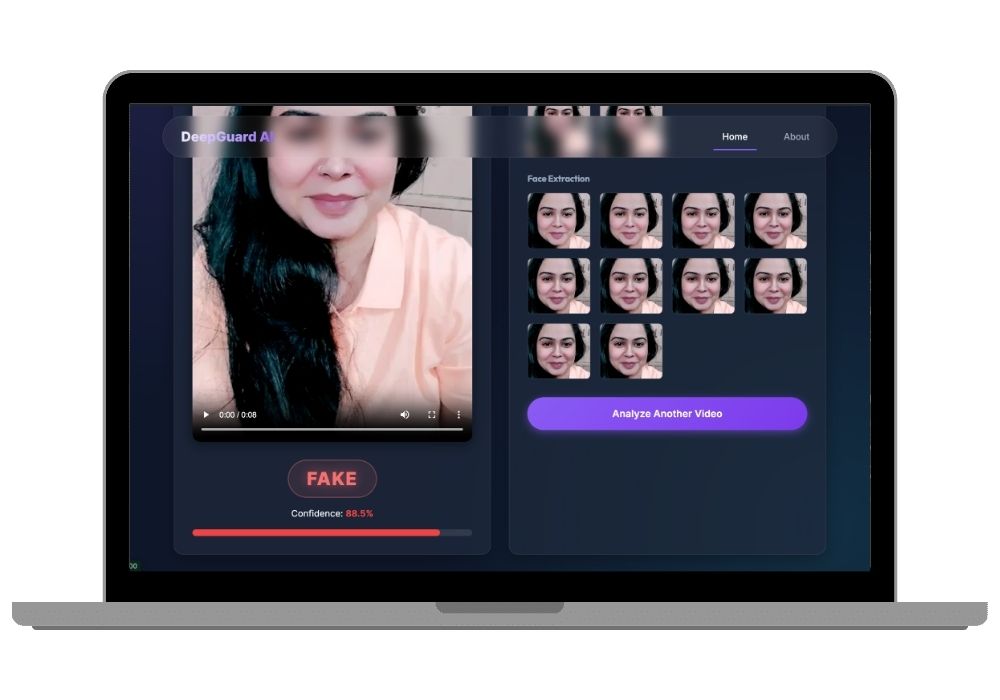
Advanced Deepfake Detection System Using ResNeXt and LSTM - AI Final Year Project with Source Code
A cutting-edge deepfake detection system combining ResNeXt CNN and LSTM networks to identify manipulated videos with 93.58% accuracy. Complete Django web application with pre-trained models, source code, documentation, and project report included.
Technology Used
Django | Python | PyTorch | ResNeXt-50 | LSTM | OpenCV | NumPy | Bootstrap | HTML5 | CSS3 | JavaScript | Deep Learning | Computer Vision | Video Processing


Project Files
Revolutionary Deepfake Detection Solution for Your Final Year Project
Discover the most advanced deepfake detection system designed specifically for computer science and AI students seeking an impactful final year project. This comprehensive solution leverages state-of-the-art deep learning architectures to combat the growing threat of synthetic media manipulation.
What Makes This Project Stand Out
This deepfake detection system represents the perfect blend of cutting-edge artificial intelligence, practical web development, and real-world cybersecurity applications. Built on a hybrid architecture combining ResNeXt-50 convolutional neural networks and Long Short-Term Memory networks, the system achieves remarkable accuracy in identifying video manipulations that fool the human eye.
Core Project Features
- Hybrid Deep Learning Architecture: Utilizes ResNeXt-50 for spatial feature extraction and LSTM for temporal sequence analysis, achieving up to 93.58% detection accuracy
- Complete Web Application: Fully functional Django-based web interface with modern glassmorphism UI design, allowing users to upload videos and receive instant deepfake analysis
- Multiple Pre-trained Models: Six different model variants trained on sequences ranging from 10 to 100 frames, providing flexibility in accuracy-speed trade-offs
- Real-time Video Processing: Advanced video frame extraction and processing pipeline using OpenCV for handling various video formats
- Professional UI/UX: Cyberpunk-themed interface with glassmorphism effects, responsive design, and intuitive user experience
- Comprehensive Documentation: Detailed installation guides, model architecture explanations, and API documentation
- Research-backed Implementation: Based on latest research in deepfake detection with proper citations and methodology
- Scalable Architecture: Designed to handle multiple concurrent users with efficient model loading and prediction pipelines
Technical Implementation Details
The system employs a sophisticated two-stage detection pipeline. In the first stage, ResNeXt-50, a powerful convolutional neural network variant, processes individual video frames to extract 2048-dimensional feature vectors. These vectors capture spatial anomalies such as inconsistent lighting, unnatural facial textures, and blending artifacts commonly found in deepfakes.
The second stage feeds these feature sequences into an LSTM network, which excels at identifying temporal inconsistencies. Deepfakes often exhibit subtle timing irregularities in facial movements, unnatural blinking patterns, and frame-to-frame jittering that become apparent when analyzed sequentially. The LSTM learns these temporal signatures during training and uses them for accurate classification.
Real-World Applications
- Social Media Platforms: Automated detection of manipulated content to prevent misinformation spread
- News Verification: Tools for journalists and fact-checkers to verify video authenticity
- Legal Evidence Validation: Forensic analysis of video evidence in legal proceedings
- Corporate Security: Protection against executive impersonation and fraud attempts, similar to our phishing detection systems
- Educational Awareness: Teaching tool to demonstrate AI capabilities and digital literacy
- Content Moderation: Automated screening systems for video-sharing platforms
- Cybersecurity Solutions: Integration into comprehensive security frameworks alongside projects like malware detection
Model Performance and Benchmarks
The project includes six pre-trained models with varying complexity levels, allowing you to choose based on your computational resources and accuracy requirements. The models are trained on diverse datasets containing both real and synthetic videos, ensuring robust generalization across different deepfake generation techniques.
| Sequence Length | Accuracy | Use Case |
|---|---|---|
| 10 frames | 84.21% | Quick screening, real-time applications |
| 20 frames | 87.79% | Balanced performance for moderate resources |
| 40 frames | 89.34% | Standard detection with good accuracy |
| 60 frames | 90.59% | Enhanced accuracy for critical applications |
| 80 frames | 91.49% | High-precision detection |
| 100 frames | 93.58% | Maximum accuracy for forensic analysis |
Why Choose This Final Year Project
High Impact Domain: Deepfake detection addresses one of the most pressing challenges in the age of AI-generated content, making it highly relevant for academic evaluation and future career opportunities. This computer vision project stands alongside other cutting-edge solutions in our portfolio.
Industry-Ready Skills: You will gain hands-on experience with PyTorch, computer vision, sequence modeling, web development, and deployment practices that are directly applicable to industry positions in AI and machine learning. Similar to our face recognition projects, this system demonstrates practical AI implementation.
Research Potential: The project provides an excellent foundation for research papers, with opportunities to explore novel architectures, dataset improvements, or domain-specific optimizations. Check our research paper publishing services to learn more.
Demonstration Value: The web interface allows you to create impressive demonstrations for project presentations, interviews, and portfolio showcases.
What You Receive
- Complete source code with detailed comments and documentation
- Six pre-trained model files with different accuracy-performance profiles
- Comprehensive project report formatted for academic submission
- Technical documentation covering architecture, methodology, and results
- Installation guide with step-by-step setup instructions
- PowerPoint presentation template for project defense
- Dataset preparation scripts and guidelines
- Testing framework and evaluation metrics
Technology Stack Overview
This project leverages industry-standard technologies and frameworks, ensuring you work with tools that are widely used in professional AI development. The Django backend provides a robust foundation for web services, while PyTorch enables efficient deep learning model development and deployment. OpenCV handles all video processing requirements, and the modern frontend stack ensures a professional user experience.
Perfect for Computer Science Students
Whether you are pursuing a degree in Computer Science, Artificial Intelligence, Data Science, or Information Technology, this project meets the complexity requirements of final year academic programs. It demonstrates proficiency in machine learning, web development, software engineering principles, and practical problem-solving skills that academic evaluators seek. Explore more final year projects in various domains.
Additional Support and Services
CodeAj provides comprehensive support to ensure your success with this project. Our team offers project setup assistance, source code explanations, customization guidance, and help with academic documentation. We also offer mentorship programs and collaboration opportunities. We understand the unique requirements of final year projects and are committed to helping you achieve excellent results.
Getting Started Is Easy
The project is designed for straightforward setup, even if you are new to deep learning frameworks. With Python 3.8 or higher and basic command-line knowledge, you can have the system running within 30 minutes. Detailed installation documentation guides you through every step, from environment setup to launching your first predictions.
Future Enhancement Opportunities
The modular architecture allows for numerous extensions that can enhance your academic submission. Consider implementing real-time video stream analysis, mobile application integration using Flutter or React Native, explainable AI visualizations, multi-model ensemble approaches, or specialized detection for specific deepfake generation methods. You could also integrate emotion detection or combine it with other AI/ML projects for enhanced capabilities. These enhancements can elevate your project and demonstrate advanced understanding.
Related Projects You Might Like
If you're interested in deepfake detection, you might also want to explore these related projects:
- AI Image Forgery Detection System - Detect manipulated images using deep learning
- Signature Verification System - Authenticate signatures using neural networks
- Instagram Fake Account Detector - Identify fake social media profiles
- Fake News Detection System - Combat misinformation with ML
- AI Fake Review Detection - Identify fraudulent product reviews
Explore More Categories
Browse our extensive collection of projects across different domains:
- AI & Machine Learning Projects
- Computer Vision Projects
- Cybersecurity Projects
- Web Development Projects
- Blockchain Projects
Ready to start your deepfake detection project? Contact us today or explore our services to learn how we can help you succeed. Check out our success stories to see how other students have benefited from our projects.
Extra Add-Ons Available – Elevate Your Project
Add any of these professional upgrades to save time and impress your evaluators.
Project Setup
We'll install and configure the project on your PC via remote session (Google Meet, Zoom, or AnyDesk).
Source Code Explanation
1-hour live session to explain logic, flow, database design, and key features.
Want to know exactly how the setup works? Review our detailed step-by-step process before scheduling your session.
₹1499
Custom Documents (College-Tailored)
- Custom Project Report: ₹1,200
- Custom Research Paper: ₹1000
- Custom PPT: ₹500
Fully customized to match your college format, guidelines, and submission standards.
Project Modification
Need feature changes, UI updates, or new features added?
Charges vary based on complexity.
We'll review your request and provide a clear quote before starting work.