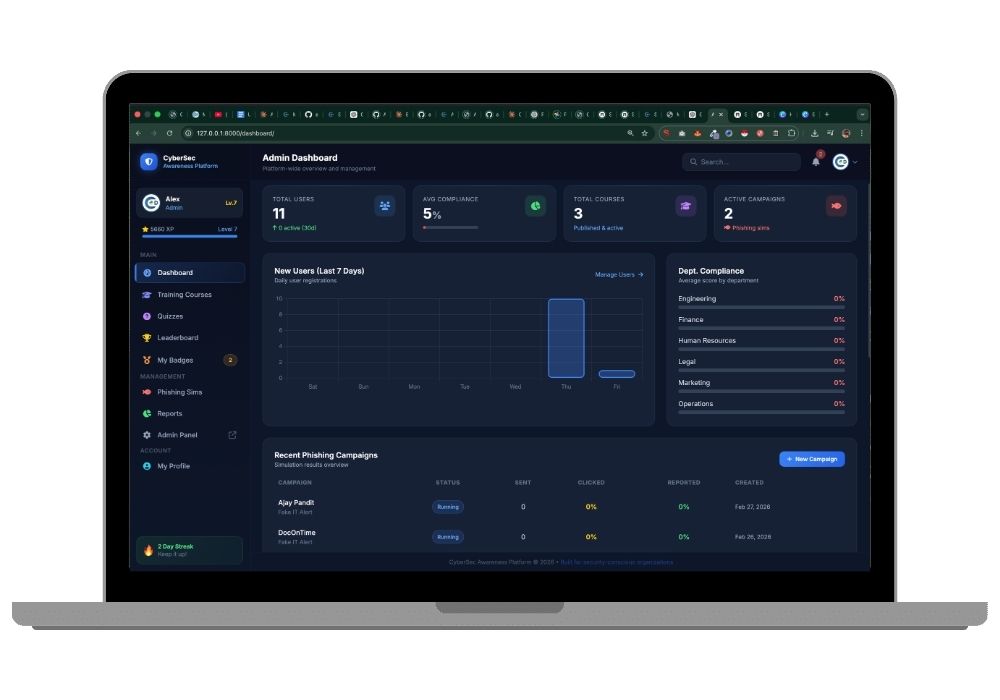


CyberSec Guard: Enterprise-Grade Cybersecurity Awareness Training Platform
CyberSec Guard is a full-stack, production-ready cybersecurity awareness training platform developed using Django, Celery, Alpine.js, and Chart.js. It is one of the most comprehensive Python final year projects with source code available in the cybersecurity domain, offering a complete end-to-end system that organizations and academic teams can deploy, study, and extend.
Human error remains the single largest cause of data breaches worldwide. Phishing attacks, weak password practices, and lack of security awareness cost organizations billions every year. CyberSec Guard directly addresses this challenge by simulating real-world threats in a controlled environment, educating employees through gamified courses and quizzes, and giving management clear compliance visibility — all within a single, beautifully designed platform.
Whether you are a final year student seeking a high-scoring, industry-relevant project, or a developer studying real-world Django architecture with Celery task queues and role-based access control, this project is built to impress. It is available exclusively on CodeAj Marketplace, where you will also find a curated library of final year projects with source code across multiple domains.
Core Modules and Features
CyberSec Guard is organized into eight distinct application modules, each with its own models, views, templates, and business logic. This modular architecture makes it an excellent study in scalable Django project design.
Role-Based Authentication System
Three-tier access control for Admin, Manager, and Employee roles. Includes email verification, Google OAuth login via Django Allauth, and full profile management. Every dashboard view is role-aware and displays only relevant data.
Phishing Simulation Engine
Create, schedule, and send phishing email campaigns to any group of users. Tracks individual click events using UUID-based anonymous tokens. Users who click a simulated phishing link land on an educational page that teaches them what they missed. Campaign stats are displayed in real time on the dashboard.
Interactive Quiz Engine
Timed, multiple-choice quizzes with instant feedback after each answer. Tracks attempt history, score progression, and displays a company-wide leaderboard. Admins can create and manage quiz banks with full CRUD support.
Structured Course System
Courses are divided into lessons with YouTube video embeds, text content, and optional downloadable materials. The system tracks per-lesson completion, overall course progress, and automatically generates PDF completion certificates when a course is finished.
Gamification Engine
Employees earn XP points for every learning action — logging in daily, completing lessons, passing quizzes, finishing courses, and correctly reporting phishing emails. XP accumulates toward seven levels from Beginner to Security Champion. Badges are auto-awarded via Django signals when milestone conditions are met.
Compliance Reporting Dashboard
Managers and Admins get a compliance overview showing training deadlines, completion rates per department, individual employee scores, and historical snapshots. Reports can be exported as CSV or PDF. Automated email reminders are dispatched via Celery Beat before training deadlines expire.
Notification System
An in-app bell notification system injects real-time alerts into every page via a Django context processor. Email notifications for upcoming deadlines, badge awards, and campaign results are sent asynchronously through the Celery worker queue so the web request is never blocked.
Role-Specific Dashboards
Three completely different dashboard views — one per role — each with animated statistics counters, Chart.js bar, line, and doughnut visualizations, and a live activity feed. Skeleton loaders replace spinners for a polished, professional feel.
Technical Architecture and Design Decisions
This project is as much a lesson in software architecture as it is a functional application. Every design decision was made with scalability, maintainability, and academic rigor in mind.
Django Application Structure
The project is organized under a config/ root for settings, URLs, and Celery configuration, and an apps/ directory containing eight independent Django applications: accounts, dashboard, phishing, quizzes, courses, gamification, and reports. This separation of concerns means each module can be tested, modified, or extended independently — a pattern that directly reflects real-world enterprise Django development.
Celery for Asynchronous Task Processing
All email operations — phishing campaign dispatch, compliance reminders, and badge notifications — are handled by Celery with Redis as the message broker. A dedicated Celery Beat scheduler handles recurring tasks. This architecture ensures that no user-facing HTTP request ever waits for an email to send, keeping the platform fast and responsive at any scale.
Django Signals for Decoupled Business Logic
XP award calculations and badge checks are handled entirely through Django signals. When a user completes a lesson, the completion view fires a signal. The signal handler in the gamification app calculates XP, checks badge eligibility, and awards accordingly — without the course view needing to know anything about gamification. This decoupling is a textbook example of clean architecture.
Token-Based Phishing Tracking
Each phishing email contains a uniquely generated UUID token embedded in a tracking URL. When a recipient clicks the link, the click is recorded against their user record without requiring them to be logged in. This mirrors the exact mechanism used by professional phishing simulation tools used in the industry.
Class-Based Views Throughout
Every view in the platform uses Django's Class-Based Views (CBVs). This means standard patterns like ListView, DetailView, CreateView, and UpdateView are used consistently, with custom mixins for role checking and permission enforcement. The result is DRY, readable, and highly consistent view code.
XP Reward Configuration (settings.py)
- XP_LESSON_COMPLETE = 10 points per lesson
- XP_QUIZ_PASS = 25 points for passing a quiz
- XP_QUIZ_PERFECT = 50 points for a perfect quiz score
- XP_PHISH_REPORT = 30 points for correctly reporting a phishing email
- XP_COURSE_COMPLETE = 100 points for finishing a full course
- XP_DAILY_LOGIN = 5 points per daily login streak
- Seven levels: Beginner (0) through Security Champion (5000 XP)
UI Design: Glassmorphism Dark Theme
The platform features a premium dark glassmorphism UI built on a deep navy (#0f172a) background. Cards use backdrop-filter blur effects, smooth fade-in and slide-in animations, and progress ring components. This is not a template — it is a custom-designed UI built with Tailwind CDN utility classes and hand-crafted CSS, making it a strong visual differentiator in any presentation or viva.
Alpine.js powers all reactive components including the quiz countdown timer, the notification dropdown, and the toast notification manager. Chart.js renders all data visualizations including bar charts for department performance, line charts for XP trends, and doughnut charts for compliance rates. On badge awards and quiz completion, a confetti animation fires automatically for a celebratory user experience.
Real-World Applications
CyberSec Guard is not a theoretical concept. It models a platform category that large enterprises actually purchase and deploy. Understanding it gives you insight into a real product domain.
Corporate Security Training
Organizations with compliance requirements (ISO 27001, SOC 2, GDPR) need documented proof of employee security training. This platform provides exactly that infrastructure.
Phishing Awareness Programs
IT and security teams run periodic phishing simulation campaigns to measure and improve employee vigilance against email-based attacks.
HR and Compliance Teams
Managers use the compliance dashboard to track which employees have completed mandatory training before regulatory deadlines.
Academic Research
Students and researchers studying gamification in security education, human factors in cybersecurity, or LMS architecture can use this as a reference implementation.
EdTech Startups
The course, quiz, and certificate module can be adapted for any domain-specific e-learning platform, making this codebase a strong starting point for a startup idea.
Final Year Project Presentation
The breadth of features, the quality of architecture, and the completeness of the UI make this an outstanding final year project in cybersecurity, information security, or computer science.
Technology Stack
Every technology in this project was chosen deliberately. Each one is industry-standard and widely covered in placement interviews for software development and cybersecurity roles.
What You Receive with This Project
When you purchase CyberSec Guard from CodeAj Marketplace, you receive the complete source code with all eight application modules, a seed data management command to populate demo accounts and sample content, environment configuration templates, and full deployment documentation for both development and production environments.
CodeAj also offers a pre-built final year project report for this project, covering problem statement, literature review, system design, module descriptions, database schema, testing, and conclusion — formatted to meet standard university submission requirements.
Why This Cybersecurity Final Year Project Stands Out
Most final year cybersecurity projects focus on a single concept — a password strength checker, a basic intrusion detection system, or a static vulnerability scanner. CyberSec Guard is different. It integrates eight modules into a cohesive, professional platform that demonstrates mastery of backend development, asynchronous processing, security architecture, database design, UI engineering, and compliance thinking — simultaneously.
Examiners and placement interviewers alike respond to projects that show real-world thinking. When you can explain phishing token tracking, Celery task queues, Django signal architecture, and glassmorphism UI design from a single project you built and deployed, you demonstrate a depth of knowledge that generic CRUD projects cannot match.
Browse other high-quality cybersecurity projects with source code on CodeAj, or explore the full final year projects collection across all domains including AI, machine learning, web development, and blockchain.