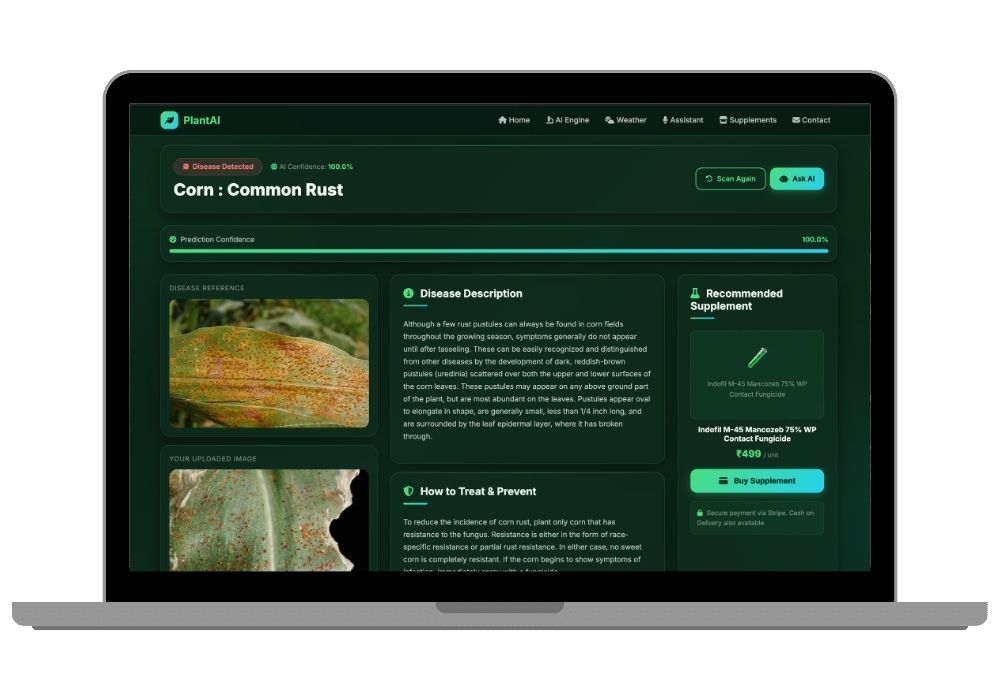
AI-Powered Plant Disease Detection System Using CNN and Flask — Final Year Project with Source Code
A deep learning web app that detects plant leaf diseases using a PyTorch CNN model, covering 39 classes across 13 crops, with real-time predictions, treatment suggestions, weather-based risk analysis, and an AI assistant.
Technology Used
Python | Flask | PyTorch | Torchvision | Pillow | NumPy | Pandas | Groq API | Stripe API | Open-Meteo API | Bootstrap 5 | Jinja2 | Gunicorn | Render


Project Files
AI-Powered Plant Disease Detection — A Complete Final Year Project
PlantAI is a production-ready web application that uses a Convolutional Neural Network (CNN) built with PyTorch to detect diseases from plant leaf images. Designed specifically as a comprehensive final year project, this system covers 39 disease classes across 13 major crop categories, giving students a deeply practical and technically rich submission that stands out in academic evaluations.
Whether you are a Computer Science, Information Technology, or Agriculture Engineering student looking for a meaningful AI final year project, PlantAI offers a complete, end-to-end solution with source code, documentation support, and professional add-on services to make your submission truly submission-ready.
This project is listed on CodeAj Marketplace, a platform trusted by thousands of students for ready-to-use final year projects with source code, setup assistance, and complete mentorship.
Core Features of the Plant Disease Detection System
Deep Learning Inference with PyTorch CNN
At the heart of PlantAI is a trained Convolutional Neural Network model built using PyTorch. The model classifies plant leaf images into one of 39 output classes with high accuracy. Each prediction comes with a confidence score, allowing the end-user to understand how certain the AI is about its diagnosis. This makes it an excellent demonstration of applied deep learning and computer vision concepts, which are central to most AI final year project evaluations.
39 Disease Classes Across 13 Crops
The classifier covers a wide and realistic range of crop diseases. Supported crops include Apple, Blueberry, Cherry, Corn, Grape, Orange, Peach, Pepper, Potato, Raspberry, Soybean, Squash, Strawberry, and Tomato. Disease conditions range from bacterial spot and powdery mildew to late blight, leaf scorch, and mosaic virus, along with a dedicated class for healthy leaves and background without plant material. This breadth makes the project suitable for agricultural technology demonstrations and research presentations.
Image Upload and Mobile Camera Capture
Users can diagnose plant diseases either by uploading a photograph from their device or by using the mobile camera directly within the browser. This dual input mode makes PlantAI practical in real field conditions, which is a compelling selling point for academic presentations and viva evaluations.
CSV-Backed Disease Information and Treatment Guidance
Once a prediction is made, the system fetches disease descriptions, prevention steps, and treatment guidance from a structured CSV file. This approach demonstrates clean data management and separation of concerns in software design, which evaluators appreciate in a well-architected final year project with source code.
Supplement and Fertilizer Marketplace Integration
PlantAI includes a built-in marketplace tab that recommends relevant fertilizers and agricultural supplements based on the detected disease. Product data is maintained in a separate CSV file, and the interface links out to purchase pages. This feature demonstrates practical integration of e-commerce logic within an AI application.
Weather-Based Disease Risk Analysis
The application connects to the Open-Meteo weather API to perform a rule-based disease risk analysis based on current and forecast weather conditions. This adds a real-world environmental dimension to the project and showcases students ability to integrate third-party APIs within a machine learning application.
Groq-Powered AI Plant Care Assistant
A built-in conversational assistant powered by the Groq API allows users to ask plant care questions using typed text or browser voice input. This generative AI integration elevates PlantAI well beyond a standard image classifier, making it one of the more feature-complete Python final year projects available for academic submission.
Stripe and COD Payment Integration
The supplement storefront supports Stripe Checkout for online payments and a COD order-capture path for offline transactions. Including real payment logic in a final year project demonstrates practical full-stack development skills that go beyond academic toy examples.
PWA Support and Responsive Design
PlantAI ships with a PWA manifest and service worker configuration, making it installable on mobile devices. The frontend is built with Bootstrap 5 and custom CSS, ensuring a clean, responsive experience across screen sizes.
Technology Stack
PlantAI is built entirely in Python, making it an ideal Python final year project with source code for students who want to showcase their backend and machine learning skills together. The core stack includes:
- Backend: Flask (Python web framework)
- Machine Learning: PyTorch, Torchvision, Pillow, NumPy
- Data Management: Pandas, CSV files
- AI Assistant: Groq API (large language model integration)
- Weather Data: Open-Meteo API
- Payments: Stripe API
- Frontend: Jinja2 Templates, Bootstrap 5, Custom CSS, Browser Speech API
- Deployment: Gunicorn, Render
Real-World Applications and Use Cases
Precision Agriculture and Smart Farming
The most direct application of PlantAI is in precision agriculture, where farmers can photograph leaves in the field and receive instant disease identification along with treatment recommendations. As mobile internet penetration grows in rural India and other developing markets, tools like this have genuine deployment potential.
Agricultural Advisory Services
Government extension officers, agronomists, and agricultural advisory platforms can embed or adapt this system to provide automated, consistent guidance to smallholder farmers at scale, reducing the lag between disease onset and treatment intervention.
Academic Research in Computer Vision
The CNN architecture and training setup in this project serve as a strong starting point for research into image classification for domain-specific tasks. The 39-class dataset scope and the model evaluation pipeline make it suitable for academic papers and conference presentations.
Agri-Tech Startup Prototyping
For entrepreneurs building in the agriculture technology space, PlantAI offers a validated prototype architecture combining computer vision, an AI chatbot, weather data integration, and an e-commerce layer — all in a single deployable codebase.
Educational Demonstrations
College lecturers and lab instructors can use PlantAI as a reference project to demonstrate real-world CNN deployment, REST API design, third-party service integration, and full-stack Python development in a single, coherent application.
Why This Is One of the Best AI Final Year Projects for CSE Students
Most final year projects stop at a model notebook or a basic interface. PlantAI is a fully integrated application with deployment-ready code, real API integrations, a functional marketplace, and a conversational AI layer. This depth of implementation ensures that students have genuine content to present, defend, and demonstrate during viva examinations.
The project also aligns naturally with multiple academic domains: Artificial Intelligence, Machine Learning, Computer Vision, Web Development, and Agricultural Technology. This cross-domain relevance makes it suitable for students from a variety of departments — Computer Science, Information Technology, Electronics, and Agricultural Engineering alike.
If you are looking for a final year project that is technically rigorous, visually polished, and easy to explain to a non-technical audience, PlantAI checks every box. You can explore more AI and machine learning final year projects on CodeAj Marketplace to find the right fit for your academic requirements.
Add-On Services Available with This Project
Idea Implementation — Custom Project Creation
If you want a version of this project tailored to your specific dataset, crop types, or department requirements, the CodeAj team builds fully customized implementations from scratch. Share your idea and receive a project designed to your exact specifications, complete with documentation and code explanation.
Project Setup and Source Code Explanation
Not comfortable setting up Python environments, configuring API keys, or running Flask applications? The expert setup service at CodeAj project setup walks you through the entire installation over a live Google Meet session, followed by a one-hour code walkthrough covering model architecture, routing logic, and database design. Over 500 students have used this service successfully.
Custom Project Report, Research Paper, and Presentation
Every academic submission requires documentation. CodeAj provides a fully customized project report formatted to your college guidelines, a research paper draft, and a professional PowerPoint presentation. The content is written to reflect your specific implementation, not a generic template. This service is included as part of the complete mentorship package available on the mentorship page.
Frequently Asked Questions
Is this project suitable as a final year project submission?
Yes. PlantAI is specifically designed for final year project submissions in Computer Science, IT, and related engineering disciplines. It includes a working model, a full-stack web application, real API integrations, and deployment configuration, giving you substantial material for your report and viva defense.
Do I need prior experience with PyTorch to use this project?
No prior experience with PyTorch is required to run and submit this project. The model is pre-trained and included in the repository. If you want to understand the architecture in depth, the source code explanation service covers exactly that in a live one-hour session.
Can I customize the project for a different set of crops or diseases?
Yes. The CSV data files and class mappings can be updated to reflect different crops or disease categories. For a fully retrained model on a new dataset, the custom project creation service handles the end-to-end implementation.
Is a project report included with the source code?
A pre-built report is not bundled with the source code download. However, a custom project report formatted to your institution's standards is available as an add-on service. This is the preferred approach because a report tailored to your college format performs significantly better during evaluation.
Extra Add-Ons Available – Elevate Your Project
Add any of these professional upgrades to save time and impress your evaluators.
Project Setup
We'll install and configure the project on your PC via remote session (Google Meet, Zoom, or AnyDesk).
Source Code Explanation
1-hour live session to explain logic, flow, database design, and key features.
Want to know exactly how the setup works? Review our detailed step-by-step process before scheduling your session.
₹999
Custom Documents (College-Tailored)
- Custom Project Report: ₹1,200
- Custom Research Paper: ₹1000
- Custom PPT: ₹500
Fully customized to match your college format, guidelines, and submission standards.
Project Modification
Need feature changes, UI updates, or new features added?
Charges vary based on complexity.
We'll review your request and provide a clear quote before starting work.