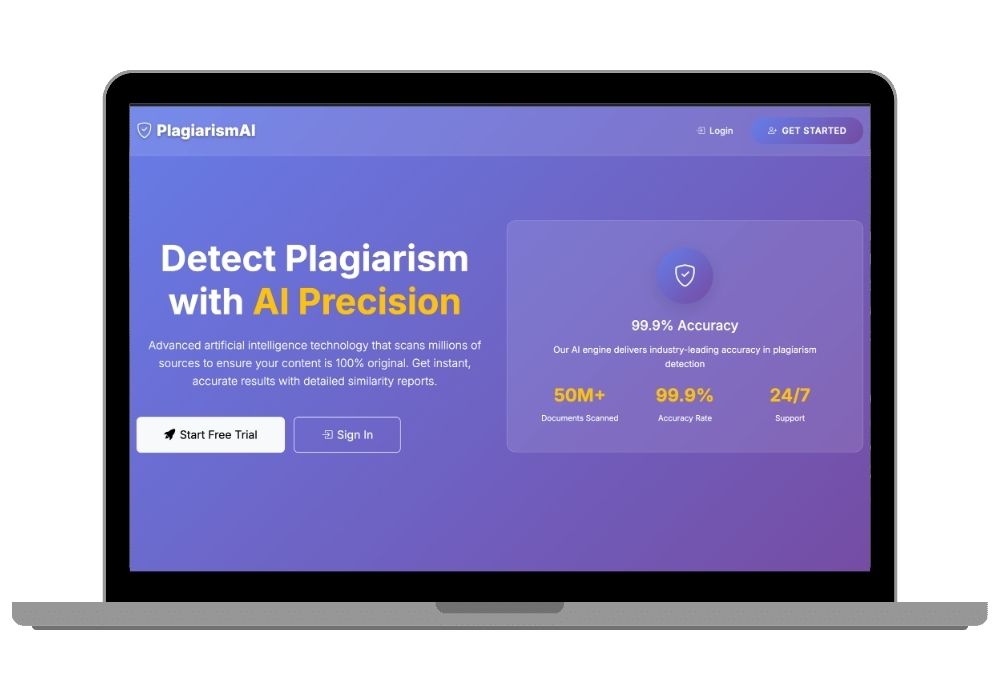
AI-Powered Plagiarism Detection System for Academic Papers | Smart Content Originality Checker
Advanced AI-based plagiarism analyzer using Django and NLTK to detect content similarity in academic papers, research documents, and student assignments with sentence-level detection and risk assessment reporting.
Technology Used
Django | Python | NLTK | Scikit-Learn | TF-IDF | Cosine Similarity | Bootstrap | SQLite | Python-Docx | HTML | CSS | JavaScript

Project Files
Overview
Our AI-Powered Plagiarism Detection System is a cutting-edge web application designed specifically for students, educators, researchers, and content creators who need reliable plagiarism checking capabilities. This intelligent system leverages advanced Natural Language Processing (NLP) and Machine Learning algorithms to detect content similarity with exceptional accuracy, making it one of the best Python projects for final year college students.
What Makes This Plagiarism Checker Unique?
Unlike traditional plagiarism detection tools, our AI-based analyzer uses sophisticated TF-IDF vectorization combined with cosine similarity algorithms to identify even subtle instances of copied content. The system performs deep sentence-level analysis, providing granular insights into potentially plagiarized sections with source attribution and confidence scores.
Key Features of the AI Plagiarism Detection System
- Advanced NLP Processing: Utilizes NLTK (Natural Language Toolkit) for tokenization, stemming, and semantic analysis to understand context beyond simple text matching
- TF-IDF Vectorization: Transforms textual content into numerical vectors using Term Frequency-Inverse Document Frequency for accurate similarity measurement
- Cosine Similarity Algorithm: Computes mathematical similarity scores between documents with precision up to decimal points
- Document Upload Support: Accept multiple file formats including DOCX, enabling seamless integration into academic workflows
- Sentence-Level Detection: Identifies specific sentences and paragraphs that exhibit high similarity with existing sources
- Risk Assessment Dashboard: Categorizes plagiarism into Low (0-30%), Medium (30-60%), and High (60-100%) risk levels with color-coded visualizations
- User Authentication System: Secure login and registration with session management and password encryption
- Report History & Analytics: Personal dashboard to track previous submissions, view historical reports, and monitor plagiarism trends
- Responsive Web Interface: Beautiful Bootstrap-powered UI that works seamlessly across desktop, tablet, and mobile devices
- Real-Time Analysis: Fast processing engine that analyzes documents in seconds, not minutes
- Source Attribution: Identifies potential sources for flagged content with similarity percentages
Real-World Applications of Plagiarism Detection System
This intelligent plagiarism checker serves multiple sectors and use cases:
- Academic Institutions: Universities and colleges can deploy this system to verify student assignments, research papers, dissertations, and thesis submissions, ensuring academic integrity across all departments
- Educational Assessment: Teachers and professors can quickly evaluate multiple student submissions during exams and assignment grading periods
- Research Organizations: Research institutes can validate the originality of scholarly articles, conference papers, and grant proposals before publication
- Content Creation Industry: Bloggers, journalists, copywriters, and digital marketers can verify content originality before publishing to avoid SEO penalties
- Publishing Houses: Book publishers and journal editors can screen manuscripts and articles for plagiarism before accepting for publication
- Legal Document Verification: Law firms can check contracts, patent applications, and legal briefs for content duplication
- Corporate Training: Organizations can validate employee certifications, training materials, and internal documentation
Technical Architecture & Machine Learning Implementation
The system is built on a robust Django framework with a sophisticated AI engine at its core. The plagiarism detection pipeline consists of multiple stages:
- Text Preprocessing: Input documents are cleaned, normalized, and tokenized using NLTK libraries. Stop words are removed, and stemming is applied to reduce words to their root forms.
- Feature Extraction: The preprocessed text is converted into TF-IDF vectors using scikit-learn's TfidfVectorizer, creating a numerical representation that captures semantic meaning.
- Similarity Computation: Cosine similarity is calculated between the submitted document and reference corpus, generating similarity scores ranging from 0 (completely different) to 1 (identical).
- Result Aggregation: Individual sentence scores are aggregated to produce an overall plagiarism percentage with detailed breakdowns.
- Report Generation: Visual reports are created with highlighted sections, similarity scores, and actionable recommendations.
Why Choose This Project for Your Final Year?
This AI-based plagiarism analyzer represents a perfect final year college project because it demonstrates mastery of multiple advanced concepts:
- Artificial Intelligence & Machine Learning: Implements real ML algorithms (TF-IDF, cosine similarity) for practical problem-solving
- Natural Language Processing: Showcases understanding of text processing, tokenization, and semantic analysis
- Full-Stack Web Development: Combines Django backend with responsive frontend using Bootstrap and JavaScript
- Database Management: Utilizes Django ORM for efficient data storage and retrieval of user reports
- User Experience Design: Features intuitive interface with modern UI/UX principles
- Security Implementation: Includes CSRF protection, secure authentication, and file validation
- Real-World Impact: Solves a genuine problem faced by educational institutions worldwide
Project Outcomes & Learning Benefits
By implementing this unique plagiarism detection project, students gain hands-on experience with:
- Building production-ready web applications using Django framework
- Implementing machine learning algorithms from scratch using Python
- Working with NLTK and scikit-learn libraries for NLP tasks
- Designing database schemas and managing relational data
- Creating RESTful APIs and handling file uploads securely
- Developing responsive user interfaces with modern web technologies
- Testing and debugging complex AI systems
- Understanding software architecture and design patterns
System Requirements & Technology Stack
This project is optimized for development on standard hardware and runs efficiently on most modern systems. The complete technology stack ensures scalability and maintainability for future enhancements.
Future Enhancement Possibilities
The plagiarism checker can be extended with additional features such as integration with Google Scholar and academic databases, API development for third-party applications, support for PDF and TXT file formats, multilingual plagiarism detection, batch processing for multiple documents, advanced visualization with charts and graphs, machine learning model fine-tuning, and cloud deployment options.
Perfect for Final Year Students
This best Python project for final year students combines theoretical knowledge with practical implementation. It's an ideal choice for computer science and IT students looking to showcase their skills in artificial intelligence, web development, and software engineering. The project demonstrates problem-solving abilities and technical competence required in modern software development roles.
Get Started Today
Whether you're a student searching for unique projects for final year submission, an educator looking for automated plagiarism checking tools, or a developer interested in AI-powered applications, this plagiarism analyzer provides a complete, production-ready solution. The comprehensive codebase, detailed documentation, and modular architecture make it easy to understand, customize, and deploy.
Extra Add-Ons Available – Elevate Your Project
Add any of these professional upgrades to save time and impress your evaluators.
Project Setup
We'll install and configure the project on your PC via remote session (Google Meet, Zoom, or AnyDesk).
Source Code Explanation
1-hour live session to explain logic, flow, database design, and key features.
Want to know exactly how the setup works? Review our detailed step-by-step process before scheduling your session.
₹999
Custom Documents (College-Tailored)
- Custom Project Report: ₹1,200
- Custom Research Paper: ₹1000
- Custom PPT: ₹500
Fully customized to match your college format, guidelines, and submission standards.
Project Modification
Need feature changes, UI updates, or new features added?
Charges vary based on complexity.
We'll review your request and provide a clear quote before starting work.