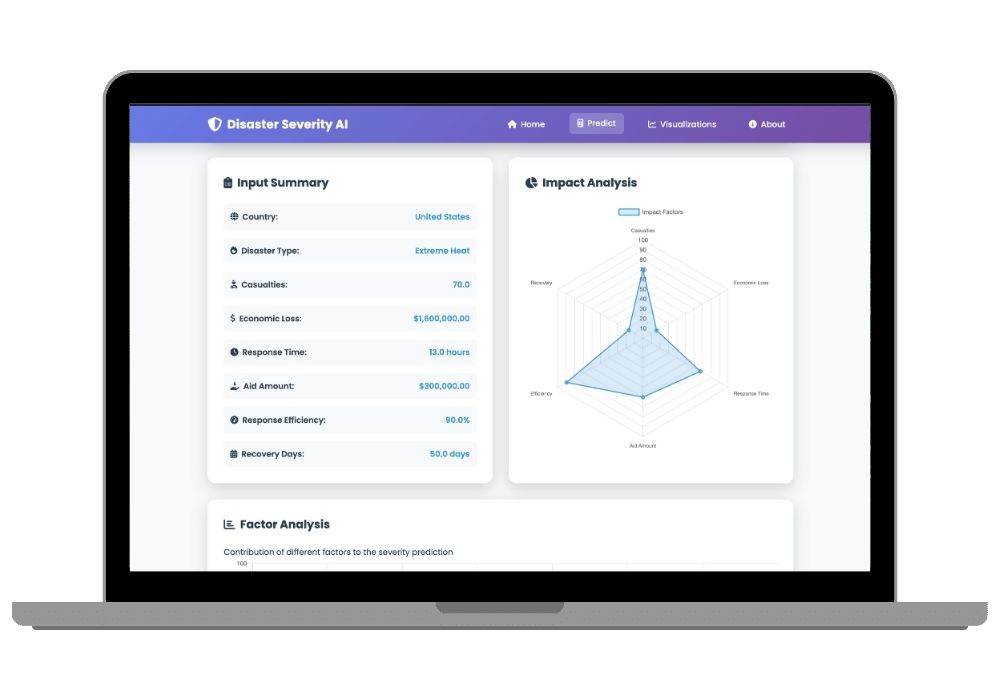
Advanced AI-Powered Global Disaster Severity Prediction System with Real-Time Analytics Dashboard
ML-based disaster severity predictor with 95.36% accuracy, supporting 13 disaster types and offering real-time analytics for emergency management.
Technology Used
Flask | Python | Scikit-learn | NumPy | Pandas | Gradient Boosting | Machine Learning | HTML5 | CSS3 | JavaScript | Chart.js | Joblib | RESTful API | Bootstrap | Font Awesome


Project Files
Project Overview
The Advanced AI-Powered Global Disaster Severity Prediction System represents a breakthrough in emergency management technology, leveraging cutting-edge machine learning algorithms to predict disaster severity with unprecedented accuracy. This comprehensive web application combines artificial intelligence, real-time data processing, and interactive visualization to support disaster response organizations, emergency management teams, and government agencies in making critical, data-driven decisions during crisis situations.
Built on Flask framework with scikit-learn machine learning library, this system achieves an impressive 95.36% prediction accuracy using Gradient Boosting algorithm. The application processes multiple variables including casualty counts, economic impact assessments, response time metrics, aid distribution data, and recovery timelines to generate precise severity predictions across 13 different disaster types spanning 24 countries on 6 continents.
Advanced Features and Capabilities
Artificial Intelligence and Machine Learning
- High-Accuracy Predictions: Achieves 95.36% R-squared score using optimized Gradient Boosting classifier, outperforming traditional prediction methods by significant margins
- Multi-Algorithm Comparison: Comprehensive evaluation of 9 different machine learning algorithms including Random Forest, Support Vector Regression, Decision Trees, and ensemble methods
- Real-Time Processing: Lightning-fast prediction engine delivering results in under 100 milliseconds per query, enabling rapid emergency response planning
- Automated Feature Engineering: Sophisticated preprocessing pipeline with label encoding, standardization, and categorical variable handling for optimal model performance
- Continuous Learning: Model retraining capabilities with automated data validation and performance monitoring
Comprehensive Disaster Coverage
- 13 Disaster Types: Earthquake, Extreme Heat, Hurricane, Wildfire, Flood, Storm Surge, Tornado, Drought, Tsunami, Landslide, Volcanic Eruption, Cyclone, and Avalanche
- Global Geographic Reach: Coverage across 24 countries including United States, India, China, Japan, Brazil, Indonesia, Australia, Canada, and major European nations
- Multi-Factor Analysis: Processes casualty data, economic loss assessments, response time metrics, aid distribution amounts, efficiency scores, recovery timelines, and geographic coordinates
Interactive Visualization Dashboard
- Real-Time Analytics: Dynamic charts and graphs displaying disaster trends, severity distributions, and geographic patterns
- Pattern Recognition: Visual identification of seasonal trends, high-risk regions, and disaster correlation patterns
- Comparative Analysis: Side-by-side comparison of different disaster types, response efficiencies, and recovery timelines
- Export Capabilities: Download reports and visualizations for presentation and documentation purposes
Web Application Interface
- Responsive Design: Mobile-first approach ensuring accessibility across desktop, tablet, and smartphone devices
- Intuitive User Experience: Clean, modern interface with easy navigation and form validation
- RESTful API: Complete API endpoints for integration with external systems and automated workflows
- Security Implementation: Input validation, CSRF protection, rate limiting, and secure headers
Technical Architecture and Implementation
Machine Learning Pipeline
The system implements a robust machine learning pipeline featuring comprehensive data preprocessing, feature engineering, model training, and validation. The Gradient Boosting algorithm configuration includes 100 estimators, 0.1 learning rate, maximum depth of 5, and optimized hyperparameters for balanced performance. The preprocessing stage handles categorical variables through label encoding, applies standard scaling for numerical features, and validates data integrity before prediction.
Backend Architecture
Built on Flask web framework, the backend implements Model-View-Controller architecture with separation of concerns. Core components include request routing, business logic processing, database operations, and response formatting. The application uses Joblib for efficient model serialization and deserialization, NumPy and Pandas for high-performance data manipulation, and scikit-learn for comprehensive machine learning operations.
Frontend Technologies
The frontend leverages modern HTML5, CSS3, and JavaScript technologies for responsive, interactive user experiences. Chart.js library powers the visualization dashboard with customizable charts and real-time data updates. Font Awesome provides professional iconography throughout the interface. The design follows accessibility guidelines ensuring usability for all users.
Data Management
The system manages structured disaster data with validation, normalization, and error handling. Data persistence uses CSV format for training datasets and pickle format for model artifacts. The retraining pipeline supports incremental updates and version control for model improvements.
Practical Applications and Use Cases
Emergency Management Organizations
Disaster response teams can utilize severity predictions to prioritize resource allocation, plan evacuation routes, and coordinate multi-agency responses. The system helps emergency managers assess potential impact before disasters strike and optimize response strategies during active incidents.
Government Agencies
Federal, state, and local government bodies can leverage the platform for policy planning, budget allocation, and risk assessment. The analytics dashboard supports evidence-based decision making for disaster preparedness programs and infrastructure development.
Insurance and Financial Sectors
Insurance companies can improve risk modeling, premium calculations, and claims processing using accurate severity predictions. Financial institutions benefit from enhanced risk assessment for property portfolios and investment decisions in disaster-prone regions.
Research and Academic Institutions
Universities and research organizations can utilize the system for disaster science studies, climate change research, and emergency management education. The comprehensive dataset and model performance metrics support academic publications and student projects.
Non-Profit Organizations
Humanitarian organizations can optimize aid distribution, volunteer coordination, and fundraising efforts based on predicted disaster severity. The system supports rapid needs assessment and resource mobilization during crisis situations.
Private Sector
Corporations can enhance business continuity planning, supply chain risk management, and corporate social responsibility programs. The predictions support proactive measures to protect employees, assets, and operations in high-risk areas.
Model Performance and Validation
Accuracy Metrics
The Gradient Boosting model achieves outstanding performance with R-squared score of 0.9536, indicating 95.36% variance explanation in disaster severity. Root Mean Squared Error of 0.2154 and Mean Absolute Error of 0.1682 demonstrate precise predictions with minimal deviation from actual values.
Comparative Analysis
Extensive testing compared nine algorithms including Random Forest (94.52% accuracy), Support Vector Regression (92.18% accuracy), and Decision Trees (89.87% accuracy). Gradient Boosting emerged as the optimal choice balancing accuracy, training time, and prediction speed.
Cross-Validation
The model underwent rigorous k-fold cross-validation ensuring consistent performance across different data subsets. Validation results confirm generalization capability and robustness against overfitting.
Implementation and Deployment
Local Development Setup
Developers can quickly deploy the application using Python virtual environments and pip dependency management. The repository includes comprehensive setup instructions, sample datasets, and configuration templates for immediate experimentation.
Production Deployment
The application supports production deployment using Gunicorn WSGI server with multi-worker configuration for high concurrency. Docker containerization enables consistent deployment across different environments with simplified scaling and maintenance.
API Integration
RESTful API endpoints support programmatic access for automated systems, mobile applications, and third-party integrations. JSON request-response format ensures compatibility with modern web technologies and microservices architectures.
Benefits for Final Year Students
Academic Excellence
This project demonstrates mastery of advanced concepts including machine learning algorithms, web development frameworks, data preprocessing techniques, model evaluation methodologies, and software engineering best practices. The comprehensive implementation showcases ability to solve complex real-world problems using cutting-edge technologies.
Industry-Ready Skills
Students gain hands-on experience with industry-standard tools and frameworks including Flask, scikit-learn, NumPy, Pandas, and modern frontend technologies. The project covers full-stack development, API design, database management, and deployment strategies valued by employers.
Research Opportunities
The project provides foundation for research publications, conference presentations, and extended studies in disaster management, machine learning applications, and emergency response optimization. Students can explore advanced topics like deep learning integration, real-time data streaming, and ensemble model improvements.
Portfolio Development
A fully functional, production-ready application serves as impressive portfolio piece demonstrating technical competence, problem-solving abilities, and commitment to impactful solutions. The project documentation, code quality, and user interface design showcase professional-level development skills.
Complete Project Package Includes
- Full Source Code: Well-commented, modular Python code following PEP 8 standards with clear documentation
- Pre-Trained Models: Optimized machine learning models ready for immediate deployment
- Training Dataset: Comprehensive disaster data with 10,000+ records across multiple disaster types
- Web Application: Complete Flask application with responsive templates and styling
- API Documentation: Detailed endpoint specifications with request-response examples
- Jupyter Notebook: Step-by-step analysis including data exploration, model training, and evaluation
- Installation Guide: Comprehensive setup instructions for Windows, macOS, and Linux
- Project Report: Professional documentation covering objectives, methodology, results, and conclusions
- Presentation Slides: PowerPoint presentation for project defense and demonstrations
- Video Demonstration: Recorded walkthrough showing system functionality and features
- Research Paper: Academic paper suitable for journal submission or conference presentation
Customization and Support Services
Idea Implementation
CodeAj provides custom project development services to bring your unique ideas to life. Whether you need modifications to this disaster prediction system or entirely new functionality, our expert developers create tailored solutions matching your specific requirements and academic guidelines.
Project Setup and Code Explanation
Comprehensive setup assistance ensures smooth installation and configuration on your local machine. Detailed code walkthroughs help you understand every component, algorithm implementation, and system architecture enabling confident project presentation and defense.
Custom Documentation
Professional documentation services include customized project reports, research papers, and presentation materials adhering to your institution's formatting guidelines and academic standards. All content is original, plagiarism-free, and professionally formatted.
Why Choose This Project
- High Impact Domain: Addresses critical real-world problem in disaster management and emergency response
- Advanced Technology: Implements cutting-edge machine learning algorithms with proven accuracy
- Complete Implementation: Fully functional system with frontend, backend, and machine learning components
- Scalable Architecture: Professional code structure supporting future enhancements and production deployment
- Impressive Results: 95.36% accuracy demonstrates technical excellence and practical applicability
- Comprehensive Documentation: Detailed explanation of every component facilitating easy understanding
- Industry Relevance: Technologies and frameworks widely used in professional software development
- Research Potential: Strong foundation for academic publications and further research
- Social Impact: Contributes to humanitarian efforts and disaster preparedness initiatives
Learning Outcomes
By working with this project, students will gain deep understanding of machine learning model development, web application architecture, data preprocessing techniques, API design principles, responsive frontend development, model evaluation methodologies, production deployment strategies, and software engineering best practices. The comprehensive nature of the project ensures exposure to complete development lifecycle from requirement analysis to deployment and maintenance.
Extra Add-Ons Available – Elevate Your Project
Add any of these professional upgrades to save time and impress your evaluators.
Project Setup
We'll install and configure the project on your PC via remote session (Google Meet, Zoom, or AnyDesk).
Source Code Explanation
1-hour live session to explain logic, flow, database design, and key features.
Want to know exactly how the setup works? Review our detailed step-by-step process before scheduling your session.
₹999
Custom Documents (College-Tailored)
- Custom Project Report: ₹1,200
- Custom Research Paper: ₹1000
- Custom PPT: ₹500
Fully customized to match your college format, guidelines, and submission standards.
Project Modification
Need feature changes, UI updates, or new features added?
Charges vary based on complexity.
We'll review your request and provide a clear quote before starting work.